Key Points
- Syrian Foreign Minister Asaad al-Shaibani met Mossad director Roman Gofman in Jordan on Sunday.
- The talks followed an Israeli strike on Abu al-Duhur airbase over a suspected Turkish military deployment.
- Damascus remains open to a new security agreement but says de-escalation requires reciprocal Israeli action.
The latest
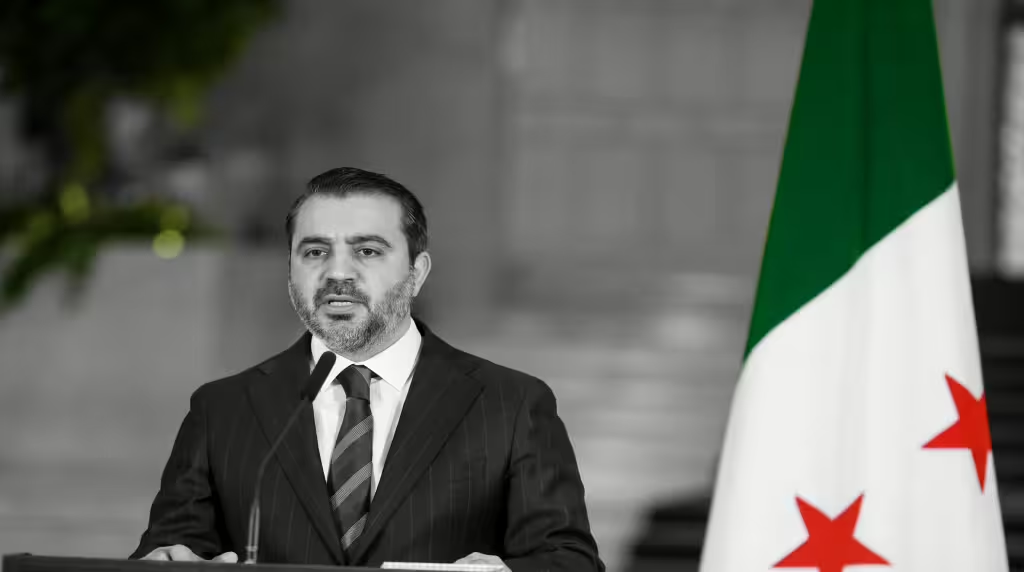
Syrian Foreign Minister Asaad al-Shaibani and Mossad director Roman Gofman met in Jordan on Sunday to ease tensions after Israel bombed a northern Syrian airbase, three people with knowledge of the matter said. The high-level contact came days after the attack sharply raised tensions between the countries and as senior US officials pressed Syria, Israel and Turkey to resume dialogue.
Details
- Strike scale: On Tuesday, the Israeli Air Force dropped at least eight bombs on runways and hangars at Abu al-Duhur, roughly 45 miles from the Turkish border. Israel described the attack as a “warning shot” after earlier contacts among Israel, Syria and the United States.
- Israeli case: Israel said intelligence indicated Turkey planned to deploy drones and a radar system at the base, creating a military buildup it sought to prevent. It warned that preparations had to stop or it would take military action, then proceeded with the strike.
- Damascus denial: During the private discussions, Syria denied intending to let Turkey establish a presence at Abu al-Duhur. Al-Shaibani later said there was no plan for a Turkish base, permanent military presence or deployment of Turkish forces at the site.
- Turkish visit: Al-Shaibani acknowledged that Turkish military officers had visited the base several days before the bombing. He characterized the visit as part of continuing military cooperation involving training and exchanges of expertise, and said he relayed that explanation to Israel before it attacked.
- US diplomacy: Trump administration envoy Tom Barrack and other senior US officials urged all three governments in recent days to restart dialogue. Their intervention followed the airbase attack and the breakdown of earlier behind-the-scenes exchanges over the site.
- Syria’s position: Al-Shaibani said Syria remained ready to negotiate with Israel on de-escalation and a new security agreement. He said one side could not carry the responsibility alone, and urged Israel to reassess a policy of continued military operations, which he said would increase instability rather than produce long-term security.
- No public comment: The Israeli prime minister’s office declined to comment. A spokesperson for al-Shaibani did not immediately respond to a request for comment on the Jordan meeting.
Background
The confrontation developed around competing accounts of Turkish activity at Abu al-Duhur. Damascus framed the visit by Turkish officers as limited cooperation on training and expertise, while Israel treated preparations at the base as a potential military deployment and acted after its warning failed to alter the activity it cited.
What’s next
The next indicator will be whether Syria, Israel and Turkey resume the US-urged dialogue, and whether Syrian-Israeli contacts move into negotiations over the new security agreement al-Shaibani said Damascus is prepared to pursue.