Key Points
- Powerus has started assembling $5,000 Guardian drone interceptors at a contract manufacturing facility in the United Arab Emirates.
- Its local-production model uses modular parts and existing factories to accelerate output near threatened markets.
- The expansion addresses rising Iranian drone attacks as costly American-made interceptor stockpiles dwindle.
The latest
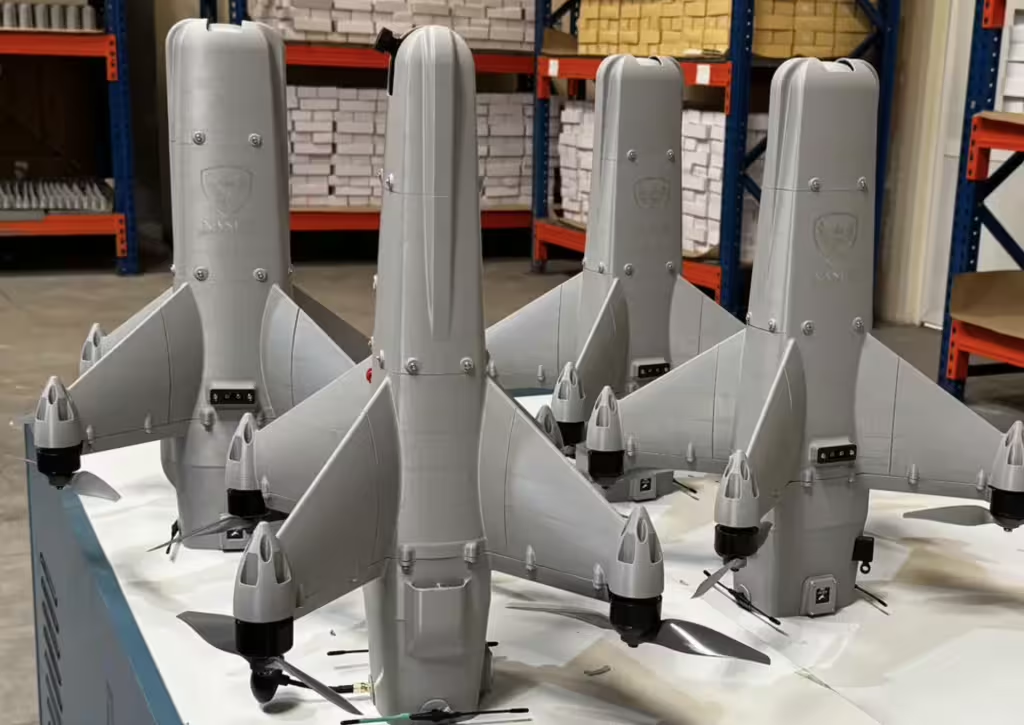
Powerus, a West Palm Beach-based start-up, has begun producing low-cost Guardian drone interceptors at a contract manufacturing facility in the United Arab Emirates, its first Middle East operation. Workers assemble 3-D-printed components during shifts lasting up to 12 hours, producing interceptors capable of striking drones at speeds of up to 200 miles per hour. The facility came online last month as Iran’s attacks rapidly intensified demand for defenses manufactured closer to threatened civilian infrastructure.
Details
- Production targets: Factories affiliated with Powerus currently make about 3,000 interceptors a month. The company aims to build a network producing 15,000 monthly worldwide by mid-2027. The UAE plant makes roughly 30 units daily and is targeting 100; Powerus supplied its contractor with training, components and software.
- Guardian economics: Guardian costs about $5,000 and draws on a Ukrainian design effective against Russian Shahed drones. Its modular pieces snap together, using commercially available microchips and GPS modules. It targets midsize drones but cannot intercept ballistic missiles like Lockheed Martin’s PAC-3 system, making it a complement rather than substitute.
- Attack toll: Since the war began in February, Iran has fired more than 500 ballistic missiles and 2,200 drones at UAE targets. The attacks killed at least 15 people, injured hundreds, halted an oil refinery and destroyed two Amazon data centers, while American-made interceptor stockpiles dwindled.
- Contracts and rivals: Powerus announced a $22 million commercial contract to protect Middle Eastern oil and gas infrastructure, plus an Air Force contract worth up to $90 million. It also partnered with a defense company near Mumbai to manufacture in India. Raytheon plans to make Coyote interceptors in the UAE, while California start-up Neros is developing a basic $5,000 Bandit model.
- Trump connections: Soon after the war started, Powerus announced a merger with listed golf-course operator Aureus Greenway Holdings, brokered by Dominari Securities. Dominari’s parent counts Donald Trump Jr. and Eric Trump as shareholders and advisory board members. Unusual Machines, whose advisory board includes Trump Jr., invested $30 million in June; former White House adviser Keith Kellogg joined Powerus’s advisory board.
Background
Powerus traces its origins to Russia’s 2022 invasion of Ukraine, where Michael Sinensky and Roman Vinfeld delivered medical kits and met Army Special Operations veteran Brett Velicovich. They later formed the company with Andrew Fox and Ziv Marom, licensed battle-tested Ukrainian technology and acquired drone businesses specializing in modular aircraft and autonomous heavy-lift systems.
What’s next
The next production markers are 100 interceptors a day at the UAE facility and 15,000 a month globally by mid-2027. Lockheed Martin’s competing lower-cost European interceptor is scheduled for testing in 2028.