Key Points
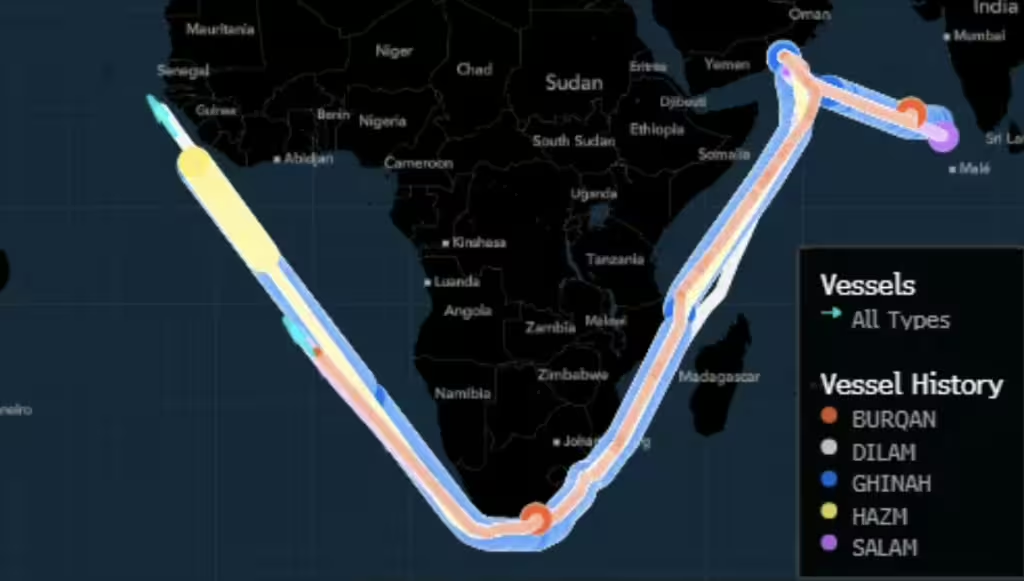
- Saudi Arabia has sent at least six empty supertankers around Africa to avoid the Bab el-Mandeb.
- Houthi threats are complicating Yanbu exports after Hormuz’s effective closure made the western route vital.
- Longer voyages are raising delivery costs while Saudi exports remain below pre-war levels.
The latest
Saudi Arabia is reshaping global oil deliveries as Houthi threats make the Bab el-Mandeb and Yanbu harder to use. The kingdom is moving millions of barrels north across the Red Sea, sending empty tankers around Africa and offering Chinese buyers cargoes for collection in the Gulf of Oman. The workarounds preserve routes to customers but add distance, shipping complexity and expense while supplies remain constrained by the Iran war across the Middle East and onward to major Asian markets.
Details
- Double distance: Following the Houthis’ July announcement of a blockade on Saudi ports, tankers loading at Yanbu increasingly avoided Bab el-Mandeb. Many now sail north through Suez to Egypt’s Sidi Kerir, then head for Asia around Africa. That journey reaches roughly 17,000 miles, more than double the normal distance. The six diverted Saudi supertankers are now moving along Africa’s western coast toward the Mediterranean.
- Egypt bottlenecks: Several Asian refiners rejected Saudi Aramco’s request to collect cargoes at Yanbu, citing difficulty finding willing ships, and sought pickup at Sidi Kerir instead. Moving crude through Egypt creates bottlenecks: Suez is too shallow for fully laden supertankers, while the cross-country pipeline cannot handle all the Saudi crude normally purchased by Asia.
- Tanker movements: Over the past month, vessels controlled by South Korea’s Sinokor, Greece’s Dynacom and Norway’s DHT shuttled crude from Yanbu to Ain Sukhna at the pipeline’s southern end. Tracking data and satellite imagery also showed 20 supertankers gathered south of Hormuz as activity increased at Saudi Gulf ports.
- Oman workaround: Four supertankers carried about 8 million barrels from Saudi Gulf ports since Aug. 11; three were owned by Sinokor. The activity points to crude being shuttled through Hormuz near Oman or the United Arab Emirates, a method already used by Gulf producers. Saudi Arabia has begun offering Chinese customers cargoes from the Gulf of Oman.
- Buyer choices: At least one East Asian refiner is considering dropping a Saudi loading next month because of higher costs. Japanese and South Korean refiners are generally set to collect September cargoes from Sidi Kerir, prioritising energy security. Several European refiners received full September allocations after the nomination process was delayed by about a week.
Background
Saudi west-coast facilities became crucial to limiting the oil price surge after Iran effectively shut Hormuz. Threats to Yanbu have shifted pressure to the Red Sea exit. Overall Saudi exports and Asian term allocations remain below pre-war levels, while transport costs rise across the supply chain.
What’s next
September loadings will show whether Sidi Kerir and Gulf of Oman arrangements can sustain deliveries. Key indicators are completed Asian allocations, actual departures from Gulf and Red Sea ports, and the East Asian refiner’s decision on its planned Saudi cargo.