The latest:
Turkey’s Defense Ministry flatly rejected Israel’s justification for its strike on a Syrian military airport, saying no Turkish military delegation was present at the Syrian air force base before or during the raids. The denial followed Prime Minister Benjamin Netanyahu’s statement that Israel would not tolerate a Turkish military buildup moving south, and that a warning delivered to Ankara had gone unheeded.
Details:
- The Turkish denial: Rear Admiral Zeki Akturk, spokesman for the Turkish armed forces, said no Turkish military delegation was at the Syrian air force base before or during the Israeli raids, and pledged that efforts to protect Syria’s sovereignty and territorial integrity would continue with full resolve.
- Ankara’s demand: The Turkish statement urged the international community to take concrete and effective steps against Israeli actions it said threaten regional peace, warning that Israeli military intervention against neighboring states must never be normalized. Turkey said it would keep supporting Syria’s military capabilities and infrastructure.
- The presidency’s response: Fahrettin Altun, head of communications at the Turkish presidency, accused Netanyahu of threats and lies reflecting international isolation and political fear. Erdogan’s office said Ankara would not fall into Netanyahu’s trap and would fight what it called his destabilizing activity.
- Israel’s framing: The Prime Minister’s Office said Israel and Syria had agreed to preserve the security status quo, an understanding Damascus nearly violated by allowing Turkish soldiers to deploy at an air base near Aleppo. It said repeated warnings were ignored and Israel would welcome a return to the status quo.
- Netanyahu’s words: The prime minister said Israel had identified Turkish plans to position forces at an airport south of its line and had passed a clear message not to proceed. He said the message arrived but was not absorbed, so Israel made sure it would be understood.
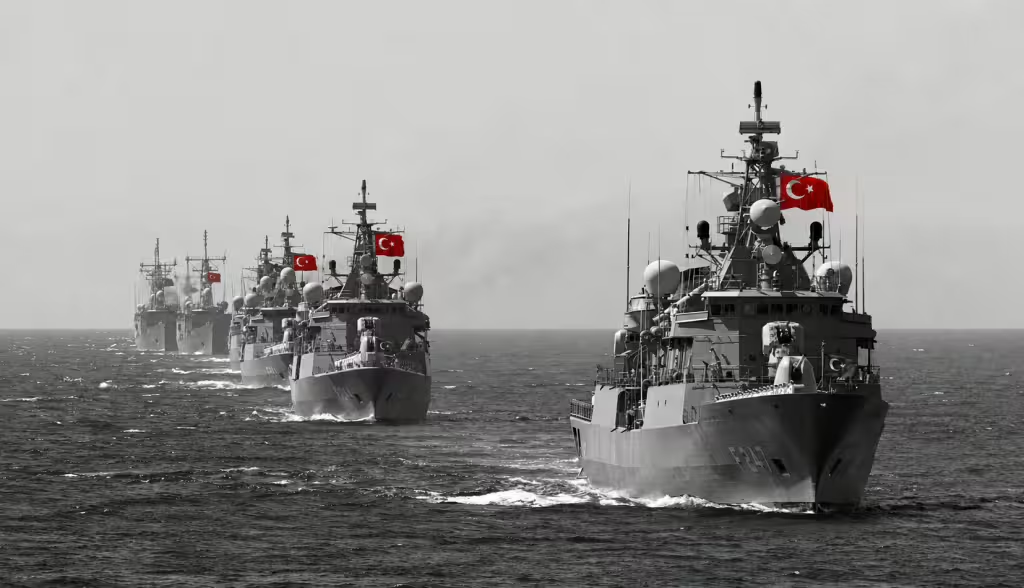
- At sea: According to sources, Turkey is sending warships into Middle Eastern areas where it has not previously operated, sometimes close to Israeli vessels. No unusual incidents or direct clashes have been recorded, but Israeli officials link the deployments to Turkish ambitions over natural resources and maritime control.
- The vigilance line: Israeli security officials said fighting Turkey is not currently among reference scenarios, and Ankara is treated as a hostile state rather than an enemy state. They described the situation as a narrow band that, as things stand, “can change in a moment.”
- Friction patterns: Officials described encounters in the eastern Mediterranean’s economic and international waters, including fast-boat displays near vessels and several warships briefly encircling a single ship. They said the pattern has not measurably changed in recent days compared with the past year.
- Analyst reading: Dr. Rami Daniel of the Institute for National Security Studies said the strike fell well north of an informal Israeli-Turkish division of Syria and abandoned Israel’s usual deniability, since the prime minister confirmed both the attack and its Turkish motive.
- Washington’s position: Tom Barrack, US ambassador to Turkey and special envoy to Syria, told the Washington Post the Israeli strike was dangerous and could have triggered military escalation. Reuters reported Mossad chief Roman Gofman spoke by phone last week with Syrian Foreign Minister Asaad al-Shaibani about Turkey’s military presence.
Background:
Israel struck the T4 air base runways in March 2025 after Turkey sought to convert it into a drone base following Assad’s fall, the Washington Post reported. Jonathan Hessen of the Jerusalem Institute for Strategy and Security said Turkish influence in Syria extends well beyond bases.
Between the lines:
Daniel assessed that Turkey’s condemnations, paired with accusations tied to Israeli elections, signal a practical wish to avoid escalation while enjoying American backing on Syria. He warned the strike’s political cost may exceed its military gain by turning Israel into a shared adversary that pushes Damascus closer to Erdogan, noting Sharaa still seeks distance from Ankara.
What’s next
Watch whether Turkish warships keep appearing in new Mediterranean zones near Israeli vessels, whether Damascus permits further Turkish deployments south of the informal line, and whether Barrack’s mediation produces a public US position on the strike.