The latest:
China’s Hengli Group, a conglomerate employing more than 300,000 people with annual revenue above $100 billion, is a leading importer of sanctioned Iranian crude, The Wall Street Journal reported, citing industry analysts, shipping brokers and the US Treasury. Treasury and shipping brokers say Hengli has received at least 5 million barrels of Iranian oil since 2023 from multiple US-sanctioned vessels.
Details:
- The network: Officials cited by the Journal describe Hengli as one of the largest firms in China’s teapot refinery network, the independent plants that buy sanctioned crude. Kpler data for 2025 indicate China absorbed more than 80% of shipped Iranian oil, with independent refiners taking a large share of that trade.
- The penalty: Treasury sanctioned Hengli’s oil refining operations earlier this year. China’s Commerce Ministry instructed companies not to comply, and the Chinese Foreign Ministry called the measures illegal, unreasonable unilateral sanctions.
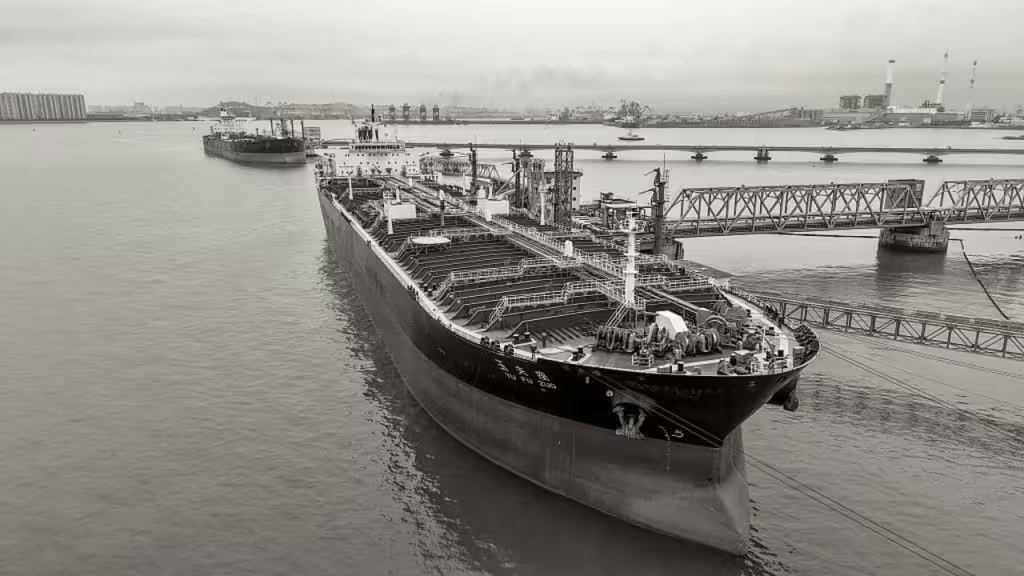
- The evasion: The Journal reported in May that Iran avoids US sanctions and the naval blockade through ship-to-ship transfers, with sanctioned tankers offloading Iranian crude at sea onto another vessel before it sails to China.
- The shadow fleet: Receiving vessels are often part of Iran’s shadow fleet of aging tankers that conceal their owners, reflag to states with weak maritime oversight, switch off tracking transponders and in some cases paint over identification numbers.
- The volumes: Homayoun Falakshahi, senior crude oil markets analyst at Kpler, told Asharq Bloomberg that Iranian crude refined in China averaged about 815,000 barrels per day in July, down from more than 1.36 million bpd in May. He said those volumes already sat outside the blockade zone.
- The assessment: Falakshahi argued Iran’s inability to export to China is a matter of time, saying the blockade restricts future exports and drains the crude already outside the Strait of Hormuz. He assessed that a sufficiently long blockade would leave Tehran with no oil available to sell.
- Trump’s leverage: President Donald Trump signaled Sunday he is ready to use economic pressure as the main tool to force Iran to reopen Hormuz to normal navigation. He told Axios his administration is tracking Iran’s inflation and its lack of funds, and that the naval blockade compounds Tehran’s financial problems.
- The economy: The IMF projects Iran’s economy will contract by more than 5% this year. Bloomberg said central bank data put annual inflation at 77%, while Johns Hopkins applied economics professor Steve Hanke wrote on X that the real rate is around 105%.
- Treasury’s read: Treasury Secretary Scott Bessent told Fox Business last week that sanctions on independent Chinese refineries produced a significant drop in Beijing’s purchases of Iranian oil, adding that Chinese crude buying overall fell about 40% in recent months on prices and large strategic reserves.
- The next lever: Washington views secondary sanctions on teapot refiners as a way to raise the cost of handling Iranian oil. Experts warn that extending them to larger Chinese banks accused of clearing billions in oil-linked transfers would bite harder but risk direct escalation with Beijing over critical minerals supply chains.
- Also: Independent Chinese refiners are Washington’s main pressure point on Tehran’s oil revenue.
Between the lines:
The July decline in refined Iranian crude does not yet prove the blockade works, since those barrels were already outside the blockade zone. The tighter constraint is future shipments, which is why Washington is weighing bank-level sanctions despite its dependence on Chinese critical minerals.
What’s next
Watch whether Treasury extends secondary sanctions beyond refiners to major Chinese banks, monthly Kpler volumes for Iranian crude processed in China, and any Iranian move on Hormuz navigation.