
Key Points
- Iranian state media said Mojtaba Khamenei appointed Hossein Taeb to command the Basij paramilitary force.
- Taeb led IRGC intelligence for 13 years until his removal in June 2022.
- Analysts told The Times the appointment signals preparation for confrontation abroad and unrest at home.
The latest:
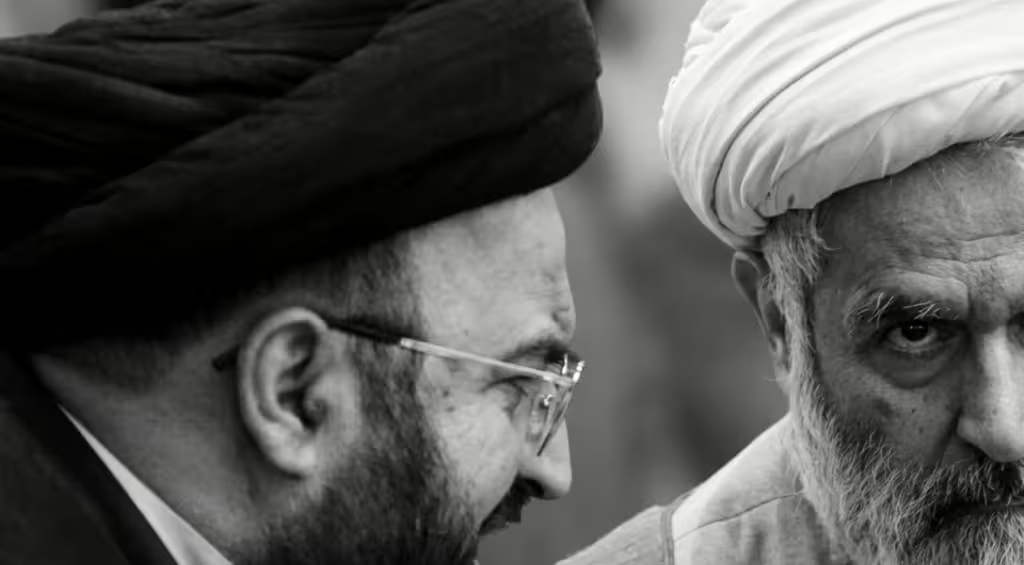
Hossein Taeb, the cleric who ran Revolutionary Guard intelligence for 13 years and was sanctioned by Washington in 2010 over the treatment of protesters, has been appointed to command the Basij paramilitary force, Iranian state media announced this week. The Times reported that the appointment came from Ayatollah Mojtaba Khamenei, who became leader in March. Taeb had spent four years out of public view.
Details:
- The force: The Basij is part of the Islamic Revolutionary Guard Corps and is embedded in neighbourhoods, universities, workplaces, factories, ministries and mosques, with members receiving benefits including preferential university places and public sector jobs, according to The Times. The report did not give a membership figure.
- The record: The Basij played a central role in suppressing successive uprisings, from the Green Movement of 2009 to nationwide protests this January, The Times reported. Taeb was deputy commander from 2007 and took command the following year. No casualty figures for those crackdowns were given.
- Sanctions: The United States sanctioned Taeb in 2010, citing the involvement of forces under his command in the beating, killing and arbitrary detention of peaceful protesters. The European Union followed a year later. The report did not say whether either designation has since been altered.
- Analyst reading: Omid Memarian of the Washington-based think tank Dawn said placing a veteran intelligence chief atop the regime’s most extensive grassroots security network brings surveillance and street mobilisation closer together, and called the appointment a sign of anxiety rather than confidence.
- Wartime constraint: Farzin Nadimi of the Washington Institute for Near East Policy said the reliance on veteran hardliners after significant leadership losses, alongside urgent structural reforms, pointed to a shortage of replacements. He did not name other appointments made in the same round.
- Street consequences: A Tehran political analyst, speaking anonymously for security reasons, said arrests across society were likely and could coincide with another war taking shape. He gave no timeframe, and the report cited no official Iranian statement on internal security plans.
- The removal: Taeb lost the intelligence post on June 23, 2022, after Israeli operations inside Iran including the removal of a nuclear archive and the assassination of nuclear scientist Mohsen Fakhrizadeh. The Tehran analyst tied the dismissal to the elder Khamenei curbing Mojtaba’s circle.
- Contested claim: The same analyst placed Taeb in a politicised Mahdist circle and claimed adherents would accept sacrificing 60 million Iranians. The Times said it could not substantiate that assertion or establish that Taeb personally holds it. Taeb has not responded publicly.
- Family link: Taeb’s brother Mehdi has publicly described the Islamic Republic as a precursor to the government of the Twelfth Imam and linked Iran’s regional interventions to preparing for his return, The Times reported. No date or venue for those remarks was given.
- Taeb’s own words: In a speech after the 12-day war in June last year, Taeb claimed the conflict had shifted the outlook of Iran’s Generation Z, saying young Iranians now wanted more missiles, stronger defences and even pre-emptive attacks. Where he delivered the speech was not specified.
- إضافة: Analysts read the move as anxiety over both external and domestic fronts.
Background:
Taeb met Mojtaba Khamenei more than four decades ago in the Habib Battalion of the Revolutionary Guards during the Iran-Iraq war, which Khamenei joined as a 17-year-old volunteer. Parliamentary speaker Mohammad Bagher Ghalibaf is another longstanding associate from that network, The Times reported.
Between the lines:
The Times frames the appointment as evidence against President Trump’s repeated claim that Iran’s new leaders are more reasonable than their predecessors. That reading rests on facts already stated: Taeb’s sanctions designation over protester deaths, his 13 years running an intelligence service that arrested journalists and dual nationals, and his own post-war call for more missiles and pre-emptive strikes.
What’s next
Watch whether arrests widen after the appointment, whether further IRGC command changes are announced, and whether Washington or Brussels adjusts Taeb’s existing sanctions designations.