Key Points
- Iran's Quds Force commander Esmail Qaani held unannounced closed-door meetings with Shiite blocs and armed factions in Baghdad.
- Sources said he urged no concessions to Washington on disarmament in exchange for government posts.
- The visit lands as PM-designate Ali Al Zaidi, backed publicly by Trump, assembles a cabinet.
The latest:
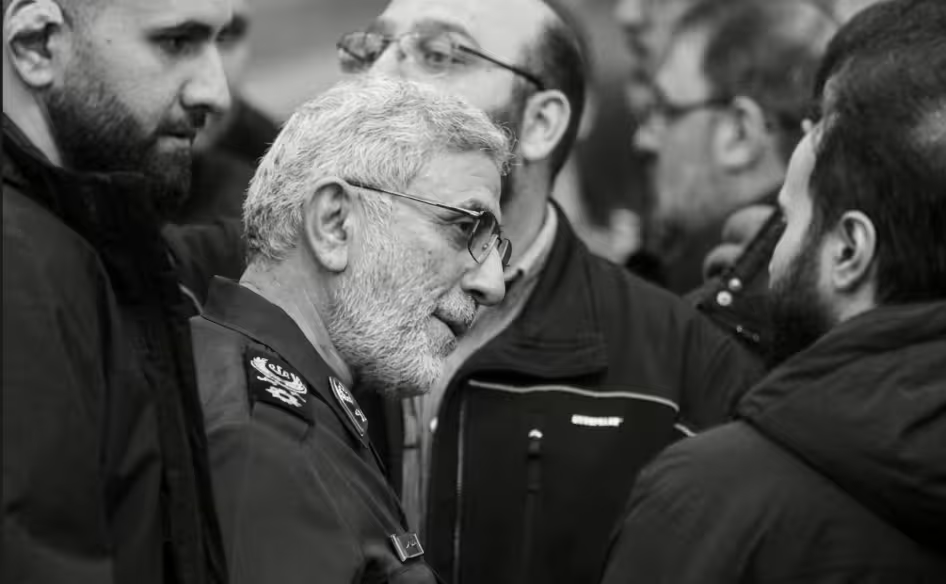
Iran’s Quds Force commander, Brig Gen Esmail Qaani, spent part of this week in Baghdad on an unannounced visit, meeting Shiite party leaders and commanders of Iran-backed armed groups, sources told ontime+. According to the sources, he set three red lines: no concessions to Washington on disarming the factions, no tilt towards the White House at Tehran’s expense, and no going too far in developing relations with the government of Syrian President Ahmed al-Sharaa. Iran has issued no public confirmation of the trip.
Details:
- The meetings: Sources said Qaani held closed-door sessions with leaders of Iraq’s main Shiite blocs and with commanders of Iran-backed factions, some of them operating inside the Popular Mobilisation Forces. The sources did not say how many meetings took place, how long the visit lasted, or when he arrived and left.
- The message: A source close to one of the armed groups said Qaani told the factions “not to make concessions to the US about disarming the militias in order to take government posts”, arguing that surrendering weapons under American pressure would weaken their leverage and erode their deterrent role.
- Washington’s demands: According to the sources, the talks covered three US demands: disarming the militias, barring politicians linked to them from senior posts, and folding the PMF into the regular Iraqi forces. No official Iraqi response to those demands was reported.
- Tehran’s position: An aide to a senior politician said Qaani sought to reassure allied leaders that Iran is not trying to block government formation outright, but wants guarantees the next cabinet will not lean towards Washington at the cost of ties with Tehran.
- The candidate: The Co-ordination Framework, parliament’s largest Shiite bloc, nominated businessman Ali Al Zaidi, 41, as a compromise candidate last month. The report described him as part of a new Iraqi elite that rose outside traditional party structures, with perceived openness to closer cooperation with the US and Gulf states.
- Iranian unease: A Co-ordination Framework member of parliament claimed Tehran has grown suspicious of the support the PM-designate receives from President Donald Trump and US-allied regional powers, and said there is a perception in Tehran that Washington is trying to install a government aligned with its regional agenda.
- Trump’s backing: After the nomination, Trump spoke to Al Zaidi by phone, voiced strong support and invited him to Washington once the government is formed, saying the US is with him all the way. On Truth Social he wished him success in forming a government free from terrorism.
- The US conditions: Washington has tied security assistance and economic support to progress on disarming armed groups and forming a government free of Iranian influence, following cross-border drone attacks and repeated strikes on US bases. The report did not specify the size of the assistance at stake.
- Al Zaidi’s silence: The PM-designate has not commented publicly on disarmament. Politicians said he is trying to present himself as a unifying figure balancing Iraq’s alliances without a rupture with either capital. He has taken no announced position on Qaani’s visit.
- Cabinet talks: An aide said negotiations over distributing ministries among the parties are still under way, and that Al Zaidi is expected to submit his cabinet, or half of it, later this week or next. The number of contested portfolios was not disclosed.
Background:
The endorsement marks a shift from January, when Trump threatened to withdraw US support if former prime minister Nouri Al Maliki were designated to form a cabinet. Tehran views Iraq as a corridor for its regional influence stretching from Lebanon to Yemen.
Between the lines:
Qaani’s stated red lines and Washington’s three demands are mutually exclusive on the same file: disarmament and PMF integration are precisely what he told the factions to refuse. That leaves Al Zaidi, publicly endorsed by Trump and privately distrusted in Tehran, forming a cabinet whose portfolios are still unallocated while both sponsors have attached conditions to their support. Neither side has published a deadline.
What’s next
Whether Al Zaidi submits a full or partial cabinet this week or next, how ministries are divided among the blocs, any Iranian confirmation of the visit, and whether the PM-designate states a position on disarmament.