Key Points
- Unitree priced its Shanghai IPO at 150.8 yuan per share, with subscriptions opening Monday.
- The offering seeks 6.1 billion yuan and would create mainland China’s first listed humanoid robot manufacturer.
- The deal tests funding appetite despite unresolved limits in reliability, dexterity and sustained autonomous work.
The latest
Chinese robotics company Unitree has priced its Shanghai initial public offering at 150.8 yuan a share, targeting proceeds of 6.1 billion yuan ($904 million). Subscriptions are due to begin Monday. Completion would make the Hangzhou-based company the first humanoid robot manufacturer listed on mainland Chinese markets, giving it public-market capital as domestic rivals also pursue listings to fund expensive development before broad factory or household demand is established.
Details
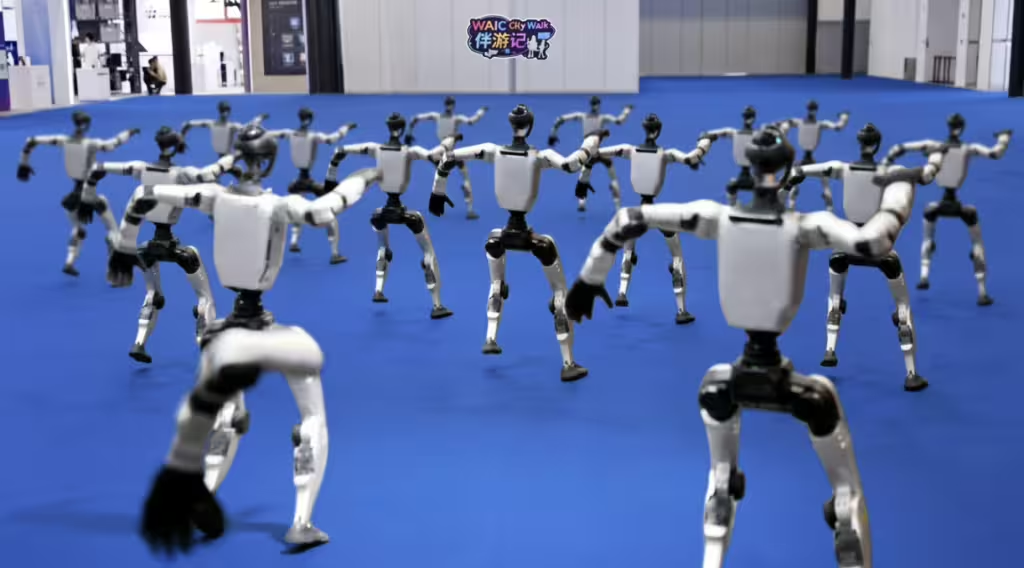
- Company origins: Founded in 2016 by engineer Wang Xingxing, Unitree first gained recognition for relatively inexpensive quadruped robots, often described as robot dogs. Its G1, H1 and R1 humanoids later drew global attention through widely shared demonstrations of running, dancing and martial arts. Visitors also watched its humanoids dance at the World Artificial Intelligence Conference in Shanghai on July 17, 2026.
- Growth and profit: Revenue rose more than fourfold to nearly 1.7 billion yuan in 2025, while adjusted net profit was about 600 million yuan. Reuters reported that Unitree is profitable, unlike many humanoid startups. Overseas revenue represented more than 40% of sales in every reporting period disclosed in its prospectus. Those disclosures show that Unitree enters the offering with rapid growth, positive adjusted earnings and a substantial overseas business.
- Manufacturing advantage: Unitree has demonstrated that China can produce sophisticated robots at prices well below many foreign competitors, drawing on extensive domestic supply chains for motors, sensors, batteries and other components. It competes with Tesla, Boston Dynamics and an expanding group of Chinese startups aiming eventually to deploy such machines in factories and homes.
- Commercial limits: Current commercial success does not establish that humanoids can replace workers. Most demand comes from universities and government-backed projects using robots for education, research and demonstrations. The machines still struggle with reliability, dexterity and varied tasks over long periods without human intervention, leaving mass-market demand unproven.
- Listing race: Building humanoids requires heavy spending on engineers, robot-training data, artificial-intelligence models and manufacturing capacity, years before demand is certain. Leju Robotics, maker of the Kuavo humanoid, applied in May to list on Shenzhen’s ChiNext market. Shanghai-based AgiBot began preparations in July for a Hong Kong IPO.
Background
Unitree has become a symbol of Beijing’s push into “embodied” intelligence, which combines AI models with machines able to navigate and interact with the physical world. Public markets can finance continued development while government support and investor interest remain strong, but they do not resolve the technology’s commercial limitations.
What’s next
Subscriptions open Monday. The immediate indicators will be investor demand, final proceeds and completion of the Shanghai listing. Only completion would confer Unitree’s claimed status as the first mainland-listed humanoid robot manufacturer; rival listing applications will remain the next sector milestones.