The latest
The UAE has assembled an African investment network spanning ports, free zones, farmland, mines and power projects, seeking post-oil growth and stronger control over supply chains. Announced investment since 2017 exceeds $168bn, according to Financial Times-owned fDi Markets, although some commitments remain statements of intent rather than completed projects. The expansion meets demand from governments facing an annual infrastructure financing gap estimated by the African Development Bank at $130bn-$170bn, while exposing investors to execution and geopolitical risks.
Details
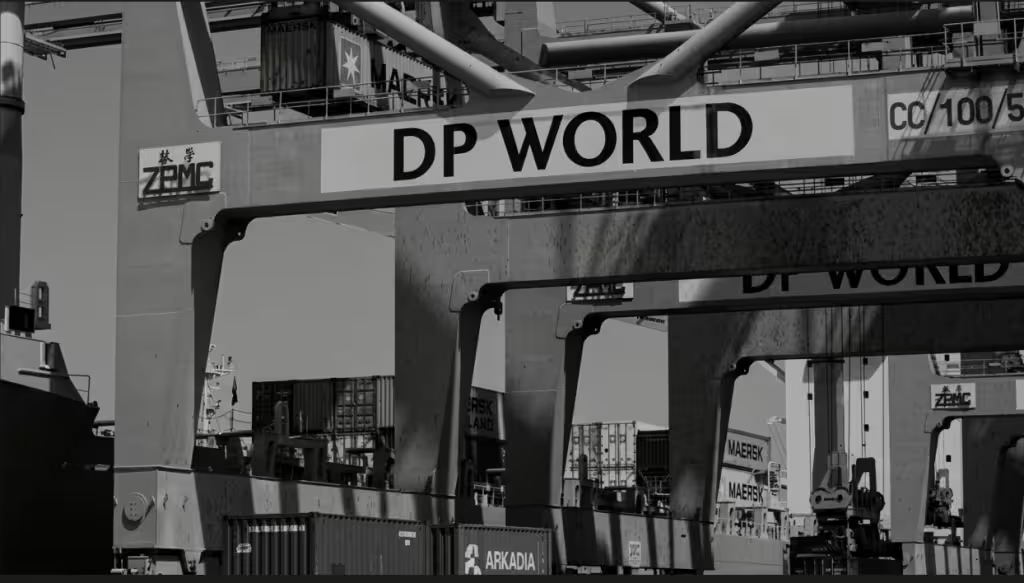
- Logistics network: DP World and Abu Dhabi Ports operate or are developing ports, inland terminals and free zones in 13 African countries. DP World’s acquisitions of established distributors extend its role in goods flows across more than 25 states. The IMF says non-oil trade between Africa and Gulf countries now exceeds $100bn, mostly involving the UAE and Saudi Arabia.
- Investment pipeline: International Holding Company, valued at $240bn and chaired by Sheikh Tahnoon bin Zayed, is a principal investment vehicle. Announcements include a $10bn Egyptian wind farm, a $4bn Ugandan refinery and a $1.2bn Senegalese port. Delivery is uneven: a $34bn green hydrogen venture in Mauritania was delayed by difficult demand, and the German partner said the UAE-backed investor withdrew.
- Berbera economics: DP World’s $450mn investment in Somaliland’s Berbera port sits under a 30-year lease and includes upgraded storage and a 250km road towards landlocked Ethiopia, a market of 120mn people. The World Bank and S&P Global ranked Berbera sub-Saharan Africa’s most efficient port in 2023. DP World has tied a capacity doubling to overcoming geopolitical constraints on shifting Ethiopian trade from Djibouti.
- Food and mining: In Sudan, an IHC food unit launched a $225mn venture in 2020 to cultivate 170,000 acres. Abu Dhabi Ports later announced $6bn for a Red Sea port and 450km road, but Sudan’s military government cancelled agreements in 2024 over alleged UAE support for the RSF, which Abu Dhabi denies. IHC says it has exited Sudan; its holdings meanwhile control 7 per cent of global tin supply through eastern DRC assets.
- Dubai finance: Dubai hosted 30,409 active African companies in 2025, according to its Chamber of Commerce. A confidential estimate by an African development institution put Africans’ cumulative Dubai property investment at $30.6bn during 2019-2025, one-third from Nigeria. Separately, Swissaid estimates nearly $30bn of African artisanal gold reaches Dubai undeclared annually. The UAE says it enforces anti-money-laundering controls and responsible sourcing standards.
What’s next
Execution will be tested by progress on the announced Egyptian wind farm, Ugandan refinery and Senegalese port, and by DP World’s decision on doubling Berbera’s capacity if Ethiopian trade can be redirected.