
The latest
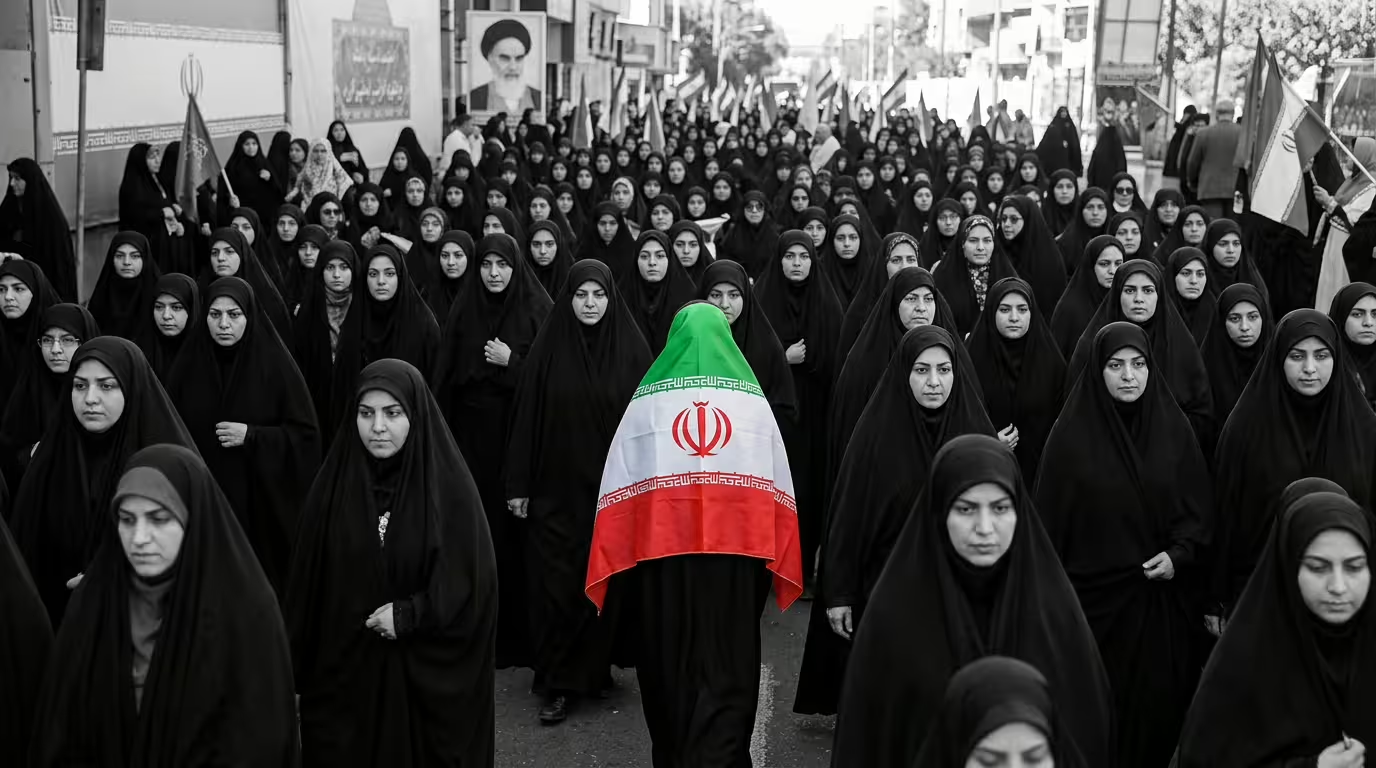
Saudi fighter jets joined US aircraft over Iraq on Wednesday in a joint operation against Iranian-backed militias, the report said, after more than 30 drone attacks targeted Saudi oil infrastructure over 72 hours. Crown Prince Mohammed bin Salman ordered the action and publicly described it as self-defence permitted under international law. The operation marked Riyadh’s first explicit shift from defence to offence, while Gulf Cooperation Council members pursued separate responses despite attacks attributed to Iran and its proxies.
Details
Saudi shift: Riyadh had generally avoided escalation, even floating a Gulf-Iran non-aggression pact in May. The report said missiles and drones struck Ras Tanura refinery, Shaybah oilfield and Prince Sultan airbase. On Thursday, Saudi Arabia announced a Red Sea maritime coalition after hosting representatives from 43 countries and the European Union.
UAE dialogue: The report said the UAE faced almost 3,000 Iranian drones and missiles in the first two months and initially retaliated while aligned with Washington and Israel. Abu Dhabi later opened direct contacts with Tehran. The government denied reports that billions in Iranian oil revenue were unfrozen, while flights and dhow trade resumed.
Mediator roles: Oman skipped the Saudi maritime meeting to protect its mediator role between Iran and the United States. Oman and Qatar have hosted ceasefire channels while accommodating US military assets. Qatar also shares the South Pars gasfield with Iran, requiring workable relations to safeguard its main income source.
Contested retaliation: The Wall Street Journal reported that Kuwait and Bahrain secretly sent jets to strike Iranian sites, with UAE intelligence and defensive air cover. Kuwait’s ambassador in Washington denied his country attacked Iran. Bahrain hosts the US Fifth Fleet; Kuwait balances a US defence alliance with a large Shia minority.
Competing strategies: A senior European diplomat called the conflict a test exposing deep Gulf divisions. Andreas Krieg of King’s College London said UAE policy reflected competing preferences: President Mohamed bin Zayed favoured coercion and deterrence, while his brother Sheikh Tahnoon bin Zayed promoted engagement and financial ties with Iran.
Background
Saudi-Iranian rivalry deepened after Iran’s 1979 revolution, ending their earlier role as US-aligned “twin pillars” of Gulf security. Competition later ran through the Iran-Iraq War and Yemen, where Riyadh backed the government against Iran-supported Houthis. The UAE combines opposition to Iranian proxies and close US-Israeli ties with substantial commerce and a dispute over three Gulf islands occupied by Iran since 1971.
What’s next
The first measurable test will be which governments formally join or operationally support the Saudi maritime coalition announced Thursday. Participation by the UAE or Oman, alongside whether attacks on the UAE remain paused while other Gulf states are targeted, will indicate the durability of military coordination and Abu Dhabi’s de-escalation with Tehran.