The latest
The fire has been extinguished, but one question still hangs over Damietta’s waters: where did the drone begin its journey? Egypt’s statement established that a drone attack took place. It did not name a group, identify a launch site or describe the aircraft’s route. That distinction matters. The point of departure could define the entire operation: Was this a long-range regional strike, or an attack launched from much closer to Egypt’s coast?
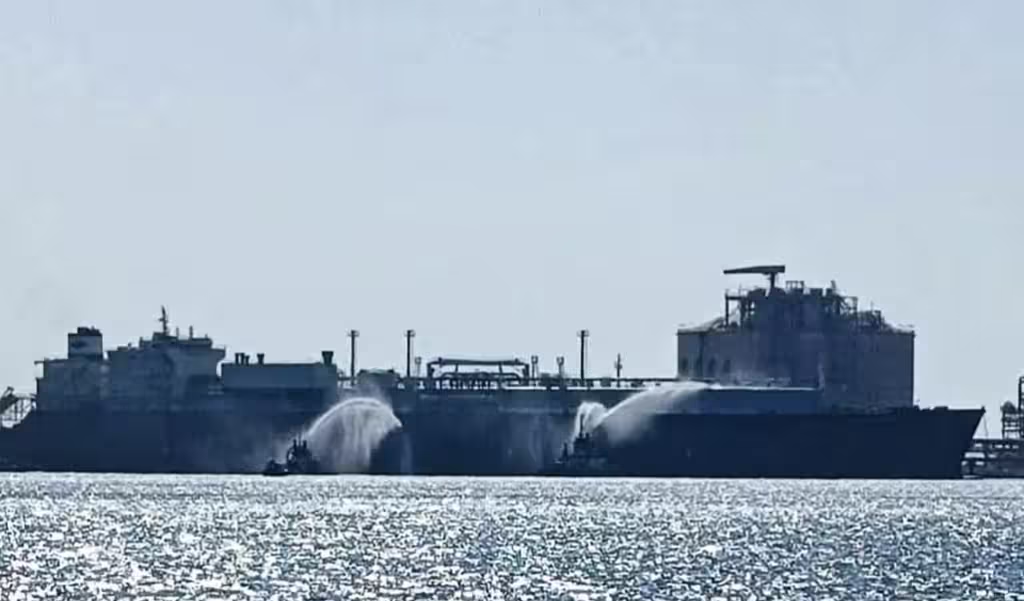
Reports said the drone struck the US-linked Energos Winter before the fire spread to the GasLog Salem. No injuries were reported, and no group has claimed responsibility. Ambrey and security sources had pointed to a drone attack from the outset. Iranian sources cited in other reports suggested the incident was meant to demonstrate an ability to threaten energy and shipping, but there has been no official claim or public evidence establishing a launch point.
That means the four scenarios do not carry equal weight. A launch from a ship or small boat in the eastern Mediterranean would shorten the flight and keep it over water. A nearby coastal launch would achieve much the same result but would require people and equipment to enter the area unnoticed. A direct flight from Iran is possible for long-range drones, though it would involve a longer and more exposed route. A launch from inside Egypt remains possible in theory, but no public evidence currently supports it.
Details
- What is established: Egypt’s preliminary investigation concluded that a drone caused the fires aboard the two vessels at Damietta port.
- What remains unknown: Cairo has not identified the perpetrator, the drone type or the place from which it was launched.
- Scenario one: A short- or medium-range drone could have been launched from a commercial vessel or small boat in the eastern Mediterranean.
- Scenario two: The aircraft may have taken off from a nearby eastern Mediterranean coastline and flown west over water toward Damietta.
- Scenario three: A direct launch from Iran is technically possible for some Shahed-136 variants, but the longer route would be more exposed to surveillance and interception.
- Scenario four: No public evidence supports an Egyptian launch site, though investigators cannot rule it out before examining components and communications records.
- The maritime setting: Damietta lies on the Mediterranean coast between Port Said and Alexandria, making nearby shipping movements central to the investigation.
- The physical evidence: The engine, guidance electronics and explosive residue may reveal the drone’s type and supply chain, but not necessarily who pressed the launch button.
Between the lines
In attacks of this kind, a drone’s country of manufacture is not the same as its launch point, and a launch point is not necessarily proof of who ordered the operation. Wreckage may identify where components were made. Radar, communications and vessel data are more likely to show how the drone reached the port. Treating those questions as one is the quickest route to an accusation that outruns the evidence.
What to watch
Investigators are waiting for answers from four places: the wreckage, radar networks, communications logs and records of vessels operating in the eastern Mediterranean before the strike. A long radar track would change the incident’s regional significance. If no such route emerges and suspicious maritime activity does, the focus will shift to the launch platform and the network that brought it close to Damietta.