The latest
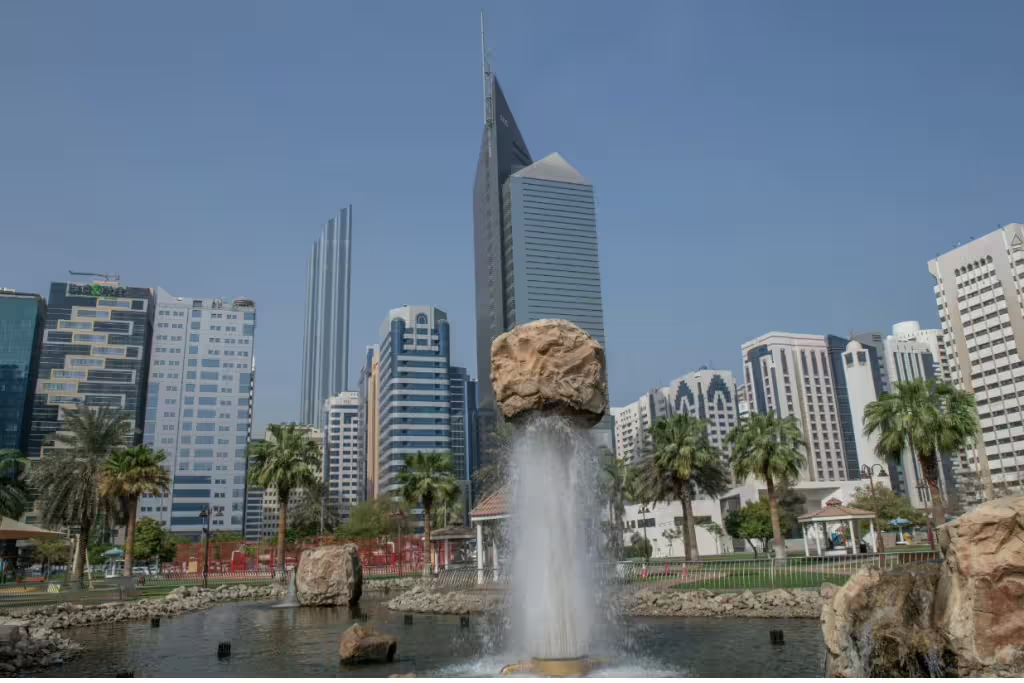
The war did not stop companies from entering the Dubai International Financial Centre. A total of 775 firms registered during the first quarter, with about one-third establishing a regional presence in March, when the conflict was at its peak and the UAE was facing intense Iranian attacks.
The center benefited from Dubai’s emergence as a leading destination for global wealth, its low-tax regime and the relative ease of establishing businesses. It has also reviewed regulations to attract more asset managers and hedge funds as Dubai competes with Abu Dhabi for major global investment firms.
DIFC is expanding its physical footprint to accommodate the influx. It began opening DIFC Square in March, a cluster of towers providing 600,000 square feet of commercial space, allowing prospective tenants including Deutsche Bank and Moody’s to begin fitting out offices.
Details
- Record milestone: DIFC now hosts 10,018 active companies, crossing the 10,000 mark for the first time after reporting 8,844 firms in February.
- New registrations: The hub added 2,318 companies over the latest 12-month period, producing a 30% increase in registrations.
- Workforce: DIFC has previously said that more than 50,000 people work for companies and institutions based in the financial hub.
- Growth sectors: Expansion was led by artificial intelligence, fintech and innovation companies, along with family-business entities and foundations.
- Hedge funds: Symmetry Investments, a firm spun out of Millennium Management, secured a license to operate in DIFC earlier this year.
- Global firms: Ken Griffin’s Citadel received approval to begin operating in the emirate, joining a broader movement of investment firms into Dubai.
- Regulatory support: Authorities offered flexibility to help the financial industry navigate wartime disruptions, while several companies publicly maintained confidence in the UAE.
- War damage: The UAE faced more Iranian attacks than any other country after the war began. Most missiles and drones were intercepted, but around a dozen people were killed and ports, oil sites and hotels sustained billions of dollars in damage.
- Uneven calm: Strikes on the UAE largely stopped after the ceasefire, although neighboring Kuwait and Bahrain reported attacks as recently as last week.
- Renewed risk: President Donald Trump said the US and Iran were discussing an end to the war but warned that fighting would resume if negotiations failed.
Between the lines
Crossing 10,000 companies does not mean the war left Dubai untouched. It shows that sectors absorb shocks at different speeds. Tourism, aviation and hospitality suffered quickly, while financial firms continued executing longer-term expansion plans supported by regulatory and tax advantages that are difficult to replace immediately.
What to watch
The real test is whether DIFC converts new registrations into jobs, assets under management and durable investment. The coming months will show whether sustained calm restores full momentum or renewed conflict causes companies to delay expansion while retaining their Dubai licenses.