The latest
Hamas has elected Khalil al-Hayya as chairman of its Political Bureau, replacing Yahya Sinwar after defeating veteran leader Khaled Mashaal in the movement’s internal elections, according to Hamas and senior officials quoted by Agence France-Presse. His appointment comes as Hamas faces mounting pressure over Gaza’s postwar governance, the restructuring of its leadership, and the future of its military wing.
Details:
- The vote: Hamas announced al-Hayya’s election, while a senior Hamas official told AFP he secured a majority of votes. Israeli media described the race against Khaled Mashaal as highly competitive.
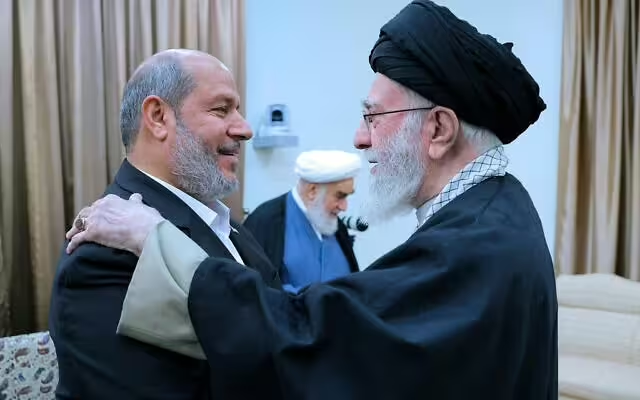
- Iran ties: Al-Hayya is considered one of Hamas’ closest figures to Tehran. He accompanied Ismail Haniyeh on multiple visits to Iran and helped restore Hamas’ relationship with Syria in 2022 as part of the movement’s return to Iran’s regional alliance, according to Reuters and regional policy institutes.
- Chief negotiator: Al-Hayya headed Hamas’ negotiating team during ceasefire and hostage-release talks and emerged as the movement’s most prominent political figure after the deaths of Ismail Haniyeh and Yahya Sinwar, with much of Hamas’ decision-making shifting to its external leadership in Doha.
- Disarmament stance: Throughout the war, al-Hayya repeatedly rejected proposals calling for Hamas to disarm, arguing that the group’s weapons are a Palestinian decision. Israel and the United States, meanwhile, continue to insist that any lasting postwar arrangement must include the dismantling of Hamas’ military capabilities.
- Leadership direction: Analysts view al-Hayya’s victory as a triumph for the faction most closely aligned with Iran over the camp represented by Mashaal, who had pursued relatively broader engagement with Qatar, Turkey, and several Arab governments.
Background
Relations between Hamas and Iran deteriorated after the outbreak of the Syrian civil war in 2011, when Hamas under Khaled Mashaal backed the Syrian opposition. However, ties gradually recovered from 2017 onward with the rise of Yahya Sinwar and Ismail Haniyeh, eventually evolving into renewed military, financial, and political cooperation that restored Tehran as Hamas’ principal external backer, according to Reuters and multiple research institutions.
Between the lines
Al-Hayya’s election suggests Hamas has chosen continuity rather than strategic moderation. He belongs to the camp that views retaining the movement’s weapons as essential to preserving its influence in Gaza, making international efforts to secure Hamas’ disarmament significantly more difficult. His close relationship with Tehran also indicates that Iranian influence is likely to remain central to Hamas’ strategic decision-making, even as the group continues relying on Qatar and Turkey for political and logistical support.
What to Watch:
Attention will now shift to the formation of Hamas’ new Political Bureau and the leadership’s approach to ongoing ceasefire negotiations. The movement’s position on postwar governance in Gaza and any future discussions over disarmament will likely determine the trajectory of talks with mediators, the United States, Israel, and regional stakeholders.