The Latest
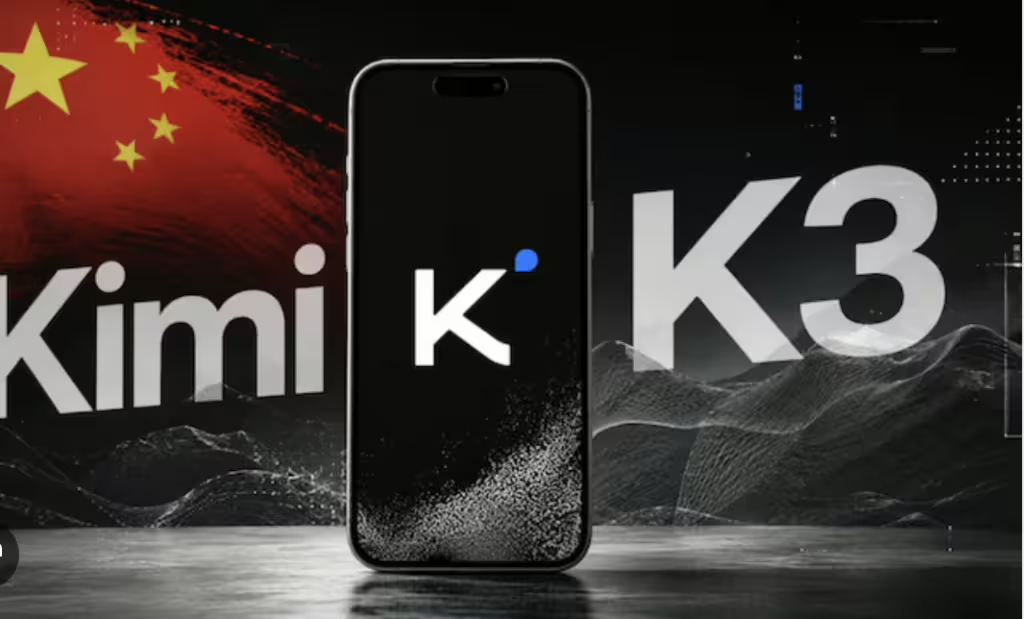
Moonshot AI’s Kimi K3 has entered the top tier of artificial intelligence models after scoring 57 on the Artificial Analysis Intelligence Index, compared with 60 for Anthropic’s Claude Fable 5 and 59 for OpenAI’s GPT‑5.6 Sol.
The result places K3 within a narrow distance of the two leading models and ahead of prominent systems including Claude Opus 4.8, but does not establish it as the world’s strongest general-purpose model.
K3’s clearest advantages appear in coding and agentic work, where models use tools and complete interconnected steps. Its cost, infrastructure requirements and performance consistency outside benchmark environments remain unresolved.
Details
- Scale and architecture:
Moonshot says K3 has 2.8 trillion parameters, native image understanding, tool-use capabilities and a context window of up to one million tokens. It uses a hybrid mechanism called Kimi Delta Attention, designed to reduce memory requirements when processing long contexts. - Overall ranking:
K3 scored 57 on Artificial Analysis’s composite index, which evaluates reasoning, knowledge, coding and agentic performance. Claude Fable 5 scored 60 and GPT‑5.6 Sol scored 59, leaving K3 narrowly behind both. - Coding performance:
The model performed strongly in Arena tests for building web interfaces and applications, where users compare model outputs directly. Leadership in front-end coding, however, does not demonstrate equivalent performance across analytical and knowledge-based tasks. - Long context:
The one-million-token context window allows users to submit large document collections or software repositories in a single session. Context capacity alone does not measure how reliably a model can retrieve and use the correct information within it. - Cost:
Moonshot prices K3 at $3 per million input tokens and $15 per million output tokens. Artificial Analysis estimated a weighted cost of about $0.95 per task, compared with $1.04 for GPT‑5.6 Sol and $2.75 for Claude Fable 5. K3 remains more expensive than several smaller models. - Speed:
K3 generated about 62 tokens per second, below the average among the models compared by Artificial Analysis. The large number of tokens produced by reasoning models could also reduce some of the savings suggested by headline API prices. - Openness:
Moonshot describes K3 as the first open-source model in the 2.8-trillion-parameter class. Its weights were not publicly available for inspection at the time of publication, preventing independent researchers from verifying its architecture or reproducing the company’s results.
Between the Lines
Kimi K3 matters less as proof that China has overtaken the US than as evidence that the gap between their leading AI laboratories is no longer wide or stable.
China is no longer competing only through lower-cost models. Its developers are producing systems that approach the frontier in coding, reasoning and tool use, increasing pressure on the business model of US companies that keep their most capable systems closed and relatively expensive.
K3’s scale may be both an advantage and a constraint. Releasing its weights would give companies greater control and customization, but the computing infrastructure required to run such a large system could place independent deployment beyond the reach of smaller organizations.
Launch benchmarks also require caution. Some comparisons test models inside different agents and coding environments, making it difficult to determine how much of the result comes from the model itself and how much comes from the surrounding system.
What’s Next?
- The release of K3’s weights and the terms of its license.
- Independent attempts to reproduce its benchmark results.
- Tests of its consistency in long, real-world assignments.
- Details of the hardware and actual cost required for private deployment.
- Possible pricing or access changes from OpenAI and Anthropic in response to stronger Chinese competition.