The latest
Axios reported that Senator Lindsey Graham, who died suddenly on Saturday, spent his final weeks laying the groundwork for a renewed push to normalize relations between Saudi Arabia and Israel. According to the report, Graham saw the effort as the central diplomatic prize in a broader postwar settlement with Iran, and as a rare opening that could hand Donald Trump a historic regional deal.
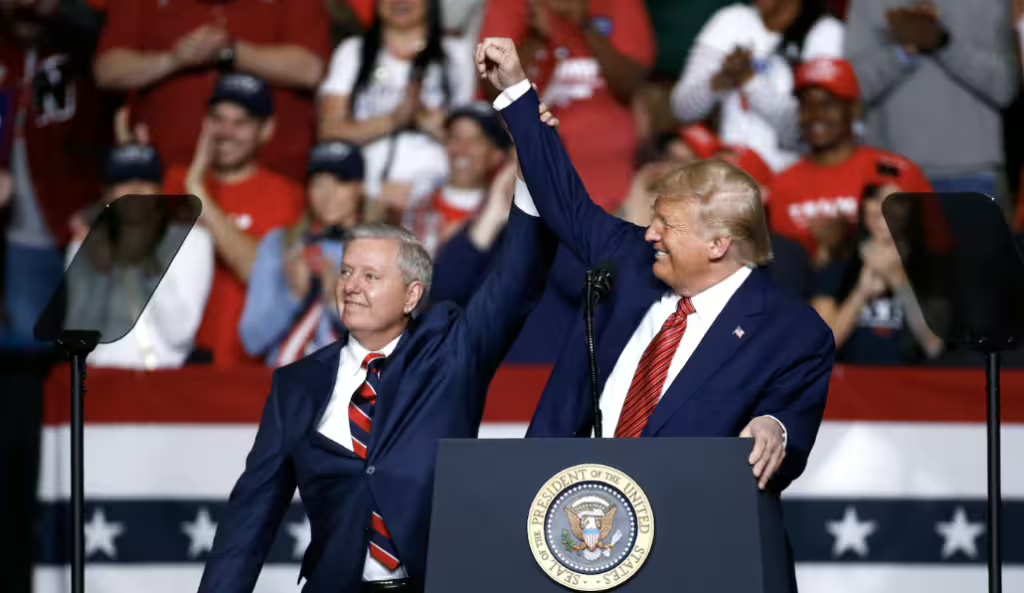
Trump underscored Graham’s political weight in a public tribute, calling him a dear friend and “a truly great man” who had done so much for the United States and for South Carolina. He ordered American flags across the country lowered to half-staff until Saturday evening at 6 p.m. The statement highlighted how closely Graham was tied to Trump’s foreign-policy orbit, and why his death is being viewed as a loss that reaches beyond the Senate into national security and regional diplomacy.
Graham’s plan was to launch an intensive diplomatic push after Israel’s October election and the U.S. midterms, with the aim of putting a deal together before the new Congress was sworn in in January. But he believed that first required bringing the Iran war under control, especially the crisis in the Strait of Hormuz. Even then, two political hurdles remained: securing Senate backing for a U.S.-Saudi defense treaty, and the emergence of an Israeli government prepared to meet Saudi conditions on a Palestinian state.
Details
- Strategic aim: Graham saw Saudi-Israel normalization as the top prize in a postwar regional settlement, not as a stand-alone bilateral file.
- Timing: He wanted intensive work to begin in September so that the main elements of a deal could be in place by November.
- Security condition: He believed that lowering tensions with Iran and stabilizing the Hormuz crisis had to come before any successful political push.
- Defense pact: A proposed U.S.-Saudi defense treaty was one of the core pillars of the package, with most of its text negotiated during the Biden administration.
- Senate math: Graham believed the post-election lame-duck session could be the only realistic window for ratifying such a treaty with a two-thirds majority.
- Saudi condition: Saudi officials maintained that any agreement had to include a clear, time-bound and irreversible path toward a Palestinian state.
- Israeli obstacle: Benjamin Netanyahu’s right-wing government rejected that condition, making the composition of the next Israeli government decisive.
- Trump tribute: Trump ordered U.S. flags lowered to half-staff and praised Graham’s record, underscoring his standing inside the president’s inner political circle.
Between the lines
Trump’s tribute gives the story a sharper American political dimension. Graham’s death does not only remove a hawkish Republican voice from Washington. It also removes an active channel of pressure and coordination between Trump and some of the region’s most sensitive files, from Iran to Saudi-Israel normalization. The absence may be felt in pace as much as in policy.
What to watch
The next test is whether the Trump camp keeps this track near the top of its regional agenda after Graham’s death, what kind of government emerges from Israel’s election, and whether Washington can reconcile a clear Saudi demand on Palestinian statehood with Israel’s desire for normalization without paying a comparable political price.