The latest
Lebanon is no longer a separate front in the region’s conflicts. According to The Washington Post, the ceasefire brokered by the Trump administration has become closely linked to Washington’s wider diplomacy with Iran, placing Lebanon at the center of a much larger regional bargain.
Under the U.S.-mediated framework, Israeli troops can remain in parts of southern Lebanon until the Lebanese state restores full security control and Hezbollah is disarmed. Hezbollah was not part of the negotiations and has rejected the agreement, warning that it could trigger internal unrest.
Israel, meanwhile, says it will not withdraw until Hezbollah no longer poses a military threat along its northern border. Iran has argued that a full Israeli withdrawal was part of the broader understandings tied to efforts to reduce regional tensions.
Why the deal is raising concerns
Analysts say the agreement places the Lebanese Armed Forces in an extremely difficult position. Any attempt to disarm Hezbollah by force could expose deep political and sectarian divisions and risk direct confrontation between the state and the Iran-backed group.
Speaking to The Washington Post, American University of Beirut political science professor Hilal Khashan said Lebanon has little leverage and described the agreement as a major test for the Lebanese army if it is expected to enforce Hezbollah’s disarmament.
Former Israeli intelligence official Dennis Citrinowicz argued that linking Israel’s withdrawal to an objective that is unlikely to be achieved in the near future effectively gives Israel an open-ended justification for maintaining its military presence in southern Lebanon.
Fighting has not stopped
Despite the ceasefire, Israel has continued carrying out airstrikes in southern Lebanon and the Bekaa Valley, saying it is targeting Hezbollah infrastructure and preventing the group from rebuilding its military positions near the border.
Lebanese officials accuse Israel of violating the ceasefire. President Joseph Aoun has called for national unity and warned against sectarian incitement, while Prime Minister Nawaf Salam says the agreement remains preliminary and that future negotiations will focus on setting a timetable for Israel’s withdrawal.
Background
Southern Lebanon has long been one of the most sensitive fronts in the confrontation between Israel and Iran. For decades, Hezbollah has relied on Iranian financial and military support, while Israel has viewed the group as its most significant security threat on the northern border.
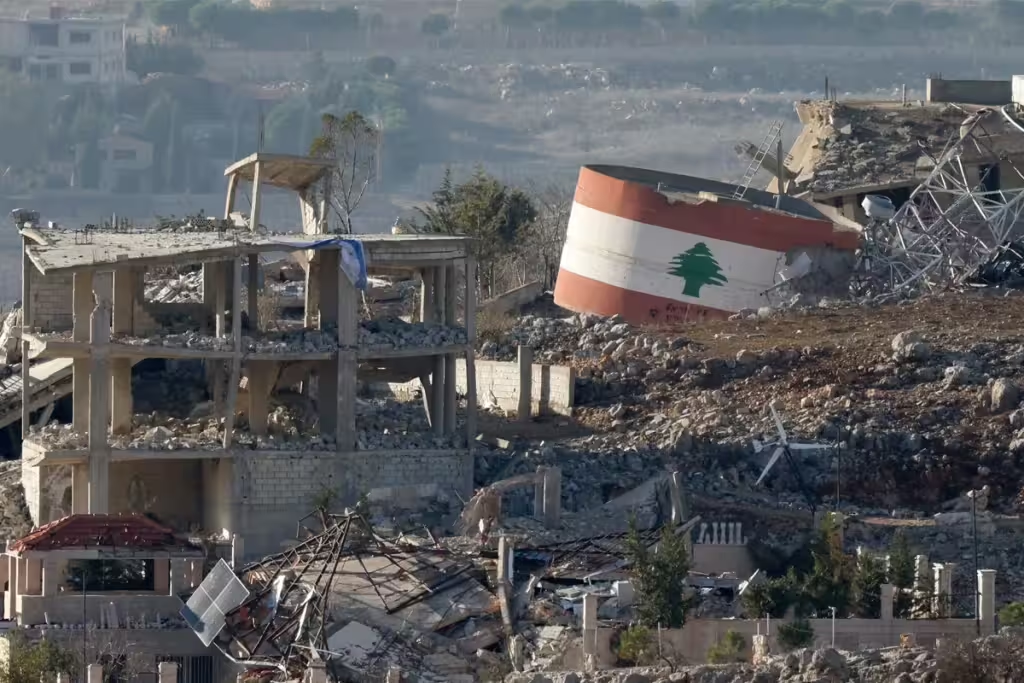
The conflict escalated sharply after the Gaza war erupted in October 2023, leading to expanded military operations inside Lebanon, widespread destruction in border communities, and the displacement of tens of thousands of civilians.
Analysts say the Trump administration is attempting to integrate stability along the Israel-Lebanon border into its broader negotiations with Iran. However, the unresolved question of Hezbollah’s future remains the biggest obstacle to a durable regional settlement.
What to watch
The agreement’s future depends on a question that neither side has answered: who will disarm Hezbollah, and how? If Israel continues to condition its withdrawal on Hezbollah’s disarmament while the group refuses to surrender its weapons, Lebanon could face several destabilizing scenarios, including a prolonged Israeli military presence, renewed fighting between Israel and Hezbollah, or growing friction between Hezbollah and the Lebanese state. Any of these outcomes could also complicate Washington’s broader diplomatic effort with Tehran.