
Details
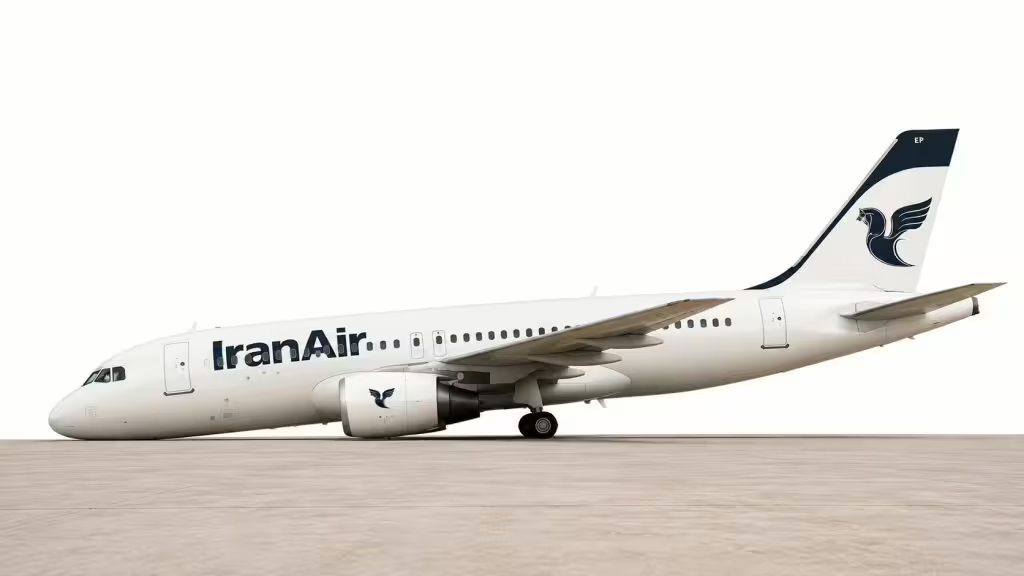
Bloomberg reported that air travel between the UAE and Iran resumed Monday after being suspended in the wake of the war that began on February 28.
According to Dubai Airports, which operates Dubai International Airport and Al Maktoum International Airport, Iranian carrier Flysepehran listed a scheduled Monday flight from Dubai to Tehran.
Iranian state media had said Saturday that flights between Dubai and Tehran would resume Monday. Dubai’s civil aviation authority had not issued an official confirmation.
Flysepehran’s website showed the next available Tehran–Dubai flight scheduled for Wednesday. After that, available flights were limited to Wednesday and Friday the following week.
The timing matters.
The resumption comes after weeks of unprecedented military escalation, during which the UAE was targeted as part of a wider confrontation across the Gulf. Abu Dhabi was not blindsided by the risk. A state of the UAE’s scale plans around strategic uncertainty and has long treated geopolitical volatility as part of its security environment.
What stood out was the scale of Iran’s focus on the UAE.
The IRGC appeared to test one of the most sensitive parts of the Emirati model: security, international confidence, capital flows and the continuity of economic life.
The outcome was not what Tehran wanted.
The UAE demonstrated advanced defensive capacity against missiles and drones, protecting cities, airports, ports and financial centers. More importantly, deterrence did not appear only as an air-defense function. It emerged as part of a broader architecture designed to protect the country’s development model.
That is the core shift.
The UAE did not build a defensive wall only to shield infrastructure. It built a deterrence posture that raises the cost of targeting it beyond the likely gains. Tehran understood that after weeks of war.
But the most important weapon was not military alone.
The UAE holds an economic and financial card Iran cannot easily replace. Dubai, in particular, has for decades been a vital outlet for Iranian trade and an important corridor for business, transfers and goods. Iranian media has itself acknowledged that replacing the UAE’s role would not be easy.
That makes the return of flights more than a technical aviation step.
It marks a shift from the language of drones to the language of necessity. Iran, after trying to pressure the UAE militarily, now finds itself needing to reopen a civilian and commercial channel with it. Geography is not enough. Economics eventually imposes its own logic.
The move also follows a phone call between UAE Foreign Minister Sheikh Abdullah bin Zayed Al Nahyan and his Iranian counterpart Abbas Araghchi, during which they discussed the latest regional developments. The call does not signal trust. It points instead to a reluctant phase of managed de-escalation.
For the UAE, the return of civilian flights does not mean the threat is over. For Iran, the resumption does not mean it has recovered its prewar position.
This is closer to a peace of necessity.
Iran needs the UAE economically and commercially. The UAE knows that containing tension is not only about intercepting missiles. It is also about managing the channels that make escalation less attractive to Tehran.
That is why Bloomberg’s report matters beyond a single Flysepehran flight.
After weeks of strikes and deterrence, Tehran is returning to Dubai through the gate of need.
What to watch
The key indicator now is not one resumed flight, but whether the flight schedule expands. If limited service becomes regular traffic, de-escalation will have started to move into the economic sphere. If flights remain sporadic, the return of aviation will stay an early test in a relationship still shaped by caution.