The latest
The Gulf may be facing a new American right that no longer sees Tehran only as an enemy to be defeated.
Instead, parts of Trump’s movement are beginning to treat Iran as a durable power that has to be managed.
That shift, if it holds, could reshape the region’s calculations: the Gulf, Israel, the Strait of Hormuz and the U.S.-Iran bargain.
For years, the Republican position was clear: Iran was an evil regime, Israel was an ally whose wars were rarely questioned, and the Gulf belonged inside the pressure camp against Tehran.
Now, according to The New York Times, a different language is emerging inside Trump’s right.
Iran is no longer only the center of an “axis of evil.”
It is becoming a hard, cohesive and resilient adversary.
And the question inside the right is no longer only how to defeat Iran.
It is whether Iran is worth another American war.
Details
• The New York Times reported that parts of the American right are beginning to frame Iran as a pragmatic country Washington may have to learn to live with.
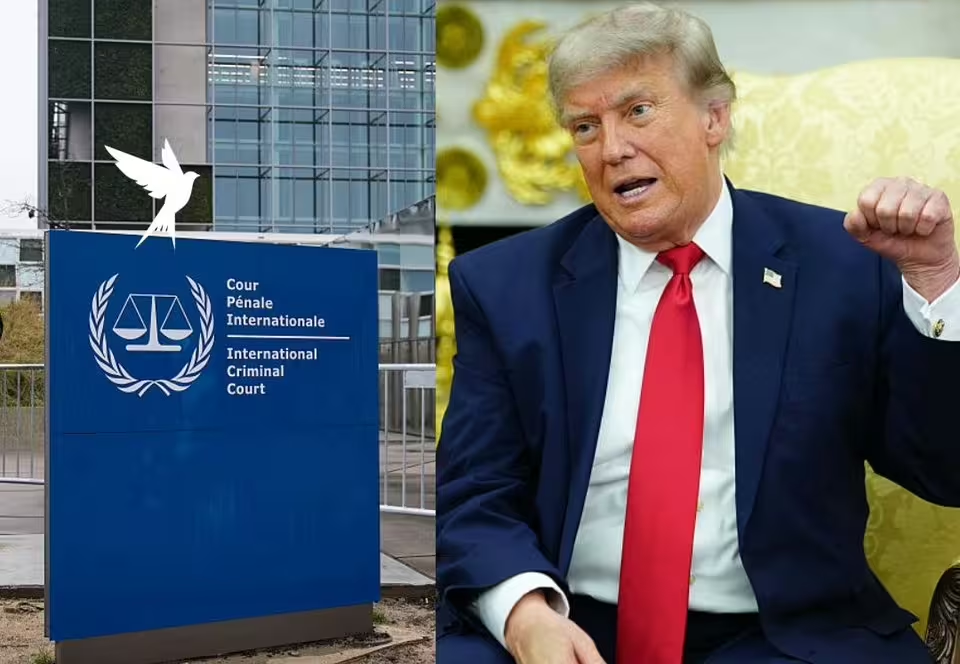
• Trump is leading the shift in public. He recently called Iran’s leaders “strong people, smart people,” after describing them at the start of the war as “very hard, terrible people” who wanted to “practice evil.”
• But this is not only about Trump. Vice President JD Vance is defending the preliminary deal, while voices such as Steve Bannon, Megyn Kelly and Tucker Carlson are pushing a less war-driven reading of Iran.
• For the Gulf, the implication is clear: a Republican Washington may no longer be willing to fight an open-ended war to defeat Iran or weaken it to the end.
• This does not mean the American right has become pro-Iran. It means it is more sensitive to the cost of war and more willing to accept Iran as an adversary to be contained.
• That makes the moves by Qatar, Oman and Saudi Arabia easier to understand. These states are not acting only because they avoided a direct military response to Iran. They are reading the changing mood in Washington.
• Qatar wants to be the negotiation channel and emergency line between Washington and Tehran, not just a state absorbing the consequences of the deal.
• Oman wants to lock in a rule for the Strait of Hormuz: no transit fees and coordination with the International Maritime Organization, so the waterway does not become an Iranian pricing card.
• Saudi Arabia wants to lead the reconciliation track, because any attempt to bring Iran back into the region without Riyadh would mean the U.S.-Iran deal is passing over the Gulf’s interests.
• This is why the Qatar-Oman-Saudi triangle looks less like routine diplomacy and more like a political answer to Washington’s turn.
• Gulf states can no longer assume the Republican Party will remain automatically committed to maximum confrontation with Iran.
• The New York Times cited a New York Times/Siena poll showing that 53% of potential Republican supporters under 45 opposed the Iran war, compared with 22% of those 45 and older.
• The more consequential number for Israel: 54% of younger Republican supporters said Trump was too supportive of Israel, compared with 16% among older Republicans.
• That is a heavy political signal. Republican support for Israel is not disappearing, but it is losing its automatic quality among younger voters.
• For the Gulf, this creates both space and risk. Space, because Washington may be less eager to push toward another war. Risk, because American deterrence may become less predictable.
• Israel may feel the cost first. If “no forever wars” becomes more powerful on the right, it will be harder to sell a long war against Iran as an American necessity.
• Some Republicans remain in the old camp. Ted Cruz warned against giving billions of dollars to “theocratic lunatics,” and Tim Sheehy said Iran’s leaders still want Americans dead.
• But even inside the Senate, the tone is shifting. Roger Marshall, who once said negotiating with Tehran was nearly impossible, later said Iran needs missiles to defend itself and repeated the “no forever wars” line.
• Steve Bannon captured the pragmatic wing’s reading when he said Trump knows he will not get an Iranian “surrender ceremony” in Bandar Abbas.
• That sentence matters for the region: Washington may have moved from dreaming of Iranian surrender to managing Iran as it is.
• Tucker Carlson went further, saying Iran could emerge from the war as a major power because of its ability to close the Strait of Hormuz.
• Whether that judgment is exaggerated or not, it reveals something deeper: part of the American right now sees Iran’s strength not only as a reason for war, but as a reason to negotiate.
What to watch
First, the Gulf.
If this shift hardens inside the American right, Gulf states will have to build their own arrangements with Iran rather than wait for another U.S. confrontation.
That is what Qatar, Oman and Saudi Arabia are already doing.
Second, Israel.
The question is now inside the younger Republican generation: does Israel remain a point of automatic right-wing consensus, or does it become part of a harder debate over America’s interest?
Third, Iran.
Tehran will read this shift carefully. If it concludes that the American right no longer wants an open war, it may harden its position on Hormuz, missiles and proxies. If it understands that coexistence is conditional, it may enter a more pragmatic negotiating track.