
The latest
President Donald Trump opened a new front in his dispute with Prime Minister Benjamin Netanyahu, not only by criticizing Israel’s operations in Lebanon but also by proposing that Syria take responsibility for dealing with Hezbollah.
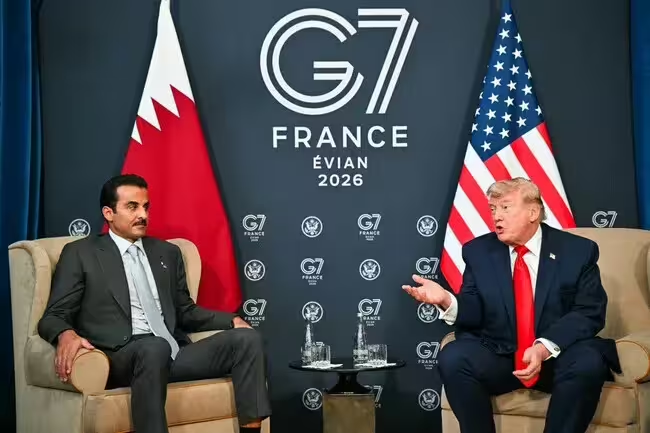
Speaking alongside Qatar’s Emir Sheikh Tamim bin Hamad Al Thani on the sidelines of the G7 summit in Évian, France, Trump said Israel’s campaign against Hezbollah had dragged on for too long without delivering a decisive outcome and had come at a high human cost. He added that he had advised Israel to leave the issue to Damascus.
Trump described Syrian President Ahmad al-Sharaa as “very tough on Hezbollah” and said the new Syrian leadership could be more effective in confronting the Lebanese group than Israel.
Details
• Trump called Israel’s strike on Beirut, carried out hours before the Iran agreement was finalized, “brutal” and “disproportionate,” saying he personally conveyed his dissatisfaction to Israeli officials.
• The U.S. president urged Netanyahu to show “greater responsibility” toward Lebanon, underscoring growing tensions between the two leaders over both Lebanon and Iran policy.
• Trump linked the durability of the Iran deal to avoiding escalation in Lebanon, arguing that Israeli military action nearly jeopardized months of diplomatic work.
• The proposal reflects Washington’s growing confidence in Syria’s new leadership following the fall of Bashar al-Assad. Trump has repeatedly praised al-Sharaa’s role in stabilizing and unifying the country.
• Damascus, however, has shown little appetite for such a role. Al-Sharaa recently denied any intention of military involvement in Lebanon, saying Syria’s priority is ending conflicts, not entering new ones.
What to watch
The key question is no longer just whether the U.S.-Iran agreement will hold. It is whether Washington is attempting to open a new track in Lebanon through Damascus. If Trump’s proposal evolves beyond rhetoric, Syria could find itself playing a direct role in the Hezbollah file for the first time in years—a scenario likely to unsettle Israel and reshape calculations along Lebanon’s southern border.