The latest
There is the World Cup. And then, in a way, there is Shakira’s World Cup.
Almost every time the tournament returns, so does she — as if the event needs not only football, but also her voice, her body language and the kind of energy that turns a song into another stadium.
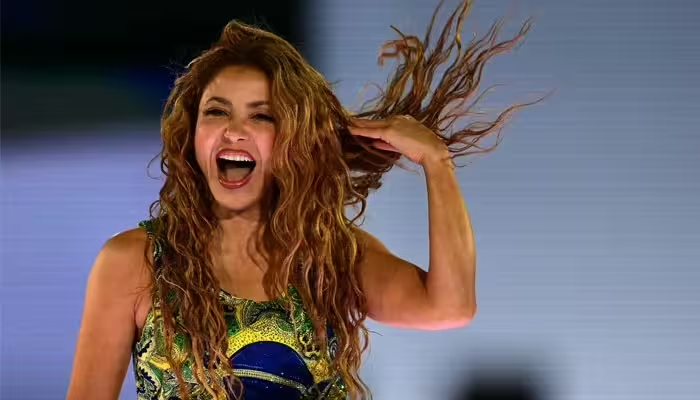
Tonight, Shakira returns to the opening of the 2026 World Cup not as a passing guest, but as one of the artists most woven into the tournament’s modern history.
From 2006 to 2010 and 2014, and now again in 2026, she has built a parallel soundtrack to the World Cup: celebration, dance, Latin rhythm, African pulse, mass audience and a global image that needs no translation.
But Shakira’s story is bigger than an opening song.
She is the daughter of Colombia who moved from local Latin pop to global superstardom without losing her own sound. She was never just a Latin version of the American pop machine. She was something else: Arab roots through her father, Colombian spirit, Latin rhythm and the intelligence to know that a body might open the door, but only an unforgettable song keeps it open.
That is why Gabriel García Márquez noticed her.
The great Colombian novelist wrote about her with unmistakable admiration. He saw music that did not sound like anyone else’s and an artist who had invented her own kind of innocent sensuality.
He was not simply writing about a young star. He was reading a Colombian force that had entered the world without apologizing for her accent, movement or difference.
A striking line is often attributed to Shakira about Márquez: “Gabo is the only one who doesn’t love me for my ass.”
Whether she said it exactly that way or it became part of the mythology around their bond, the line captures something central to her public image.
Shakira understood early that the world often saw her body before it heard her voice. She also had enough talent to make it do both.
Details
• Shakira was born in Barranquilla in 1977 and began her career early before breaking through globally with her first English-language album, “Laundry Service.”
• Her art was built on an unusual mix: Latin pop, rock, belly dance, Caribbean rhythms and a voice with a rough edge that never sounded like the fully polished pop standard.
• Her World Cup story took off in 2006 with “Hips Don’t Lie,” then became a global phenomenon in 2010 with “Waka Waka,” one of the tournament’s most remembered songs.
• In 2010, football also entered her personal life. During the “Waka Waka” era, her name became linked to Barcelona and Spain star Gerard Piqué.
• Shakira and Piqué became one of the most famous love stories between music and football. It ended in a public breakup in 2022, after more than a decade and two children.
• After the split, Shakira turned music into a personal weapon. She converted pain into art, scandal into a story of strength and divorce into a new chapter of stardom.
• Her return to the 2026 World Cup comes from that place. She is not only an opening-night performer, but a woman returning from one of the hardest personal chapters of her life to the largest global stage.
• Her new song, “Dai Dai,” with Burna Boy, brings her back to the space she knows best: a crowd song built to become a chant, not just a release.
• Shakira now stands on the stage not only as a Latin icon, but as a bridge between the global south, popular culture and football as the world’s most universal language.
What to watch
The 2026 World Cup opening is not just another musical slot in the tournament schedule.
For Shakira, it is a return to the place that helped build part of her myth. For the World Cup, it is the return of a collective memory that already knows her voice.
She sang for the tournament when the world was celebrating. She sang for it at the height of a football love story. Now she returns after divorce, maturity and a personal battle, as a star who knows that staying power is harder than arrival.
Márquez saw something in her that did not sound like anyone else.
For years, the World Cup has been proving he was right.