
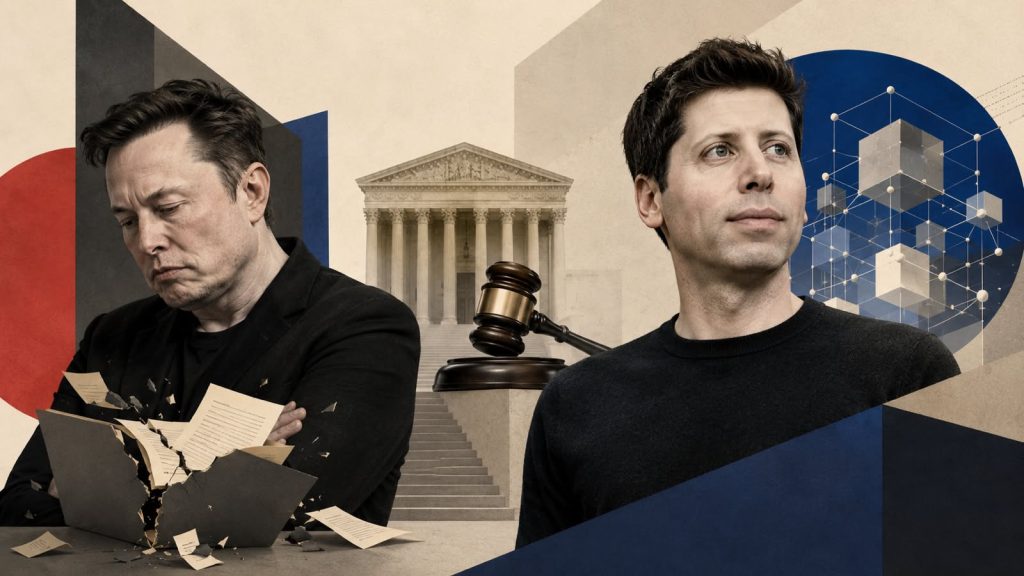
A U.S. federal court has dismissed Elon Musk’s claims against OpenAI, CEO Sam Altman and President Greg Brockman, after a legal battle that reopened one of Silicon Valley’s most sensitive questions: who controls the future of artificial intelligence, and who defines its original mission.
The decision came after a roughly three-week trial in Oakland, California. A jury found that Musk had missed the statute of limitations for filing the lawsuit. Although the jury’s verdict was advisory, Judge Yvonne Gonzalez Rogers adopted it and dismissed the core claims in the case.
Details
* The dispute dates back to OpenAI’s founding in 2015 as a nonprofit organization co-founded by Musk, Altman, Brockman and others, before Musk left the company in 2018 amid internal disagreements.
* Musk accused OpenAI’s leadership of abandoning the company’s stated original mission: developing artificial intelligence for the benefit of humanity, and shifting toward a for-profit model backed by major partnerships and investments, especially with Microsoft.
* Musk had asked the court to force Altman and Brockman to step down and return all equity in OpenAI’s for-profit entity to its nonprofit parent, a move that could have disrupted OpenAI’s current structure and funding plans.
* OpenAI argued that Musk had known about the move toward a capped-profit structure, and that his lawsuit was also tied to competition after he launched xAI, not only to protecting OpenAI’s original mission.
* The jury deliberated for about two hours before reaching its conclusion, making the ruling a swift legal setback for Musk in a case he had used to challenge OpenAI’s governance.
What’s Next?
The ruling does not end the broader debate over OpenAI’s structure, investor relationships and original mission. But it weakens Musk’s legal hand in this round. Musk may still seek an appeal, while OpenAI leaves the trial in a stronger position as it faces growing scrutiny over its commercial expansion and role in the AI race.