
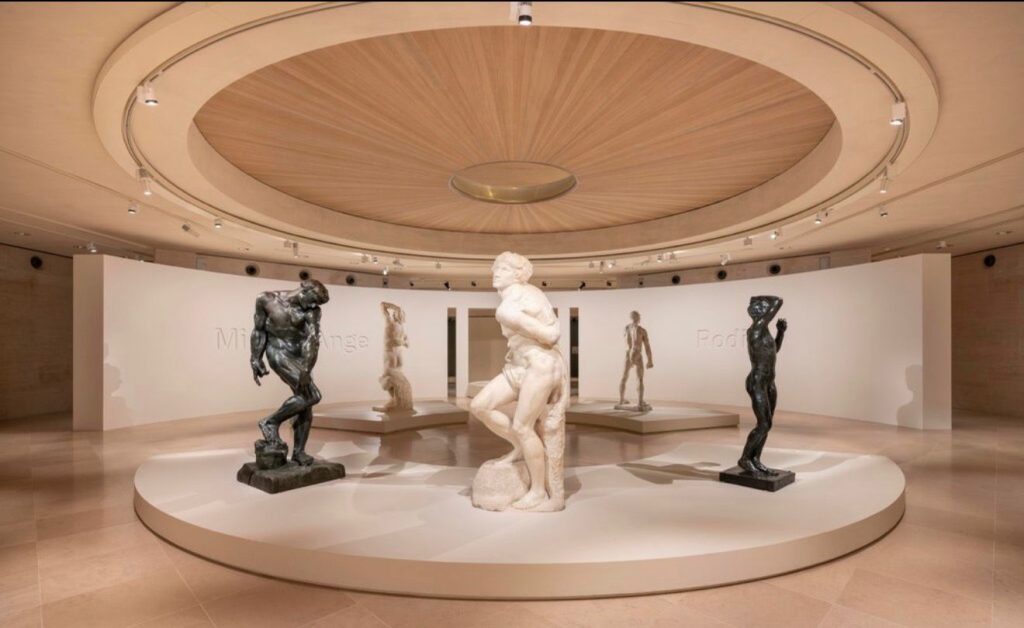
The Louvre Museum in Paris is opening a rare artistic confrontation between Michelangelo and Auguste Rodin in a new exhibition titled Michelangelo and Rodin: Living Bodies, featuring more than 200 works in collaboration with the Musée Rodin.
Running until July 20, the exhibition does not merely offer a traditional comparison between two great artists. It explores a deeper question: how can stone, bronze and plaster carry a body that thinks, suffers and breathes?
According to The New York Times, Rodin’s The Hand of God stands at the heart of the exhibition. In the work, a polished hand emerges from a rough marble block, holding two nude bodies in a moment of creation and love, in a direct reference to Adam and Eve and to Michelangelo, whom Rodin saw as an artistic god.
Details
- The exhibition is built around a confrontation between two of the West’s greatest sculptors, not only to prove similarity, but to understand how each treated the body as a space of thought and emotion, not merely muscular anatomy.
- Co-curator Marc Bormand explains that Michelangelo and Rodin were not simply aiming to display the anatomy of the body, but to reveal the thinking body, a body charged with feeling, tension and inner life.
- Michelangelo was famous for the idea of carving through removal: he saw the figure hidden inside the marble block, then removed the excess to liberate the body trapped within the stone.
- In works such as Rebellious Slave and Dying Slave, his unfinished style appears clearly: bodies twist as if trying to escape the prison of stone, not as if the sculptures were merely abandoned before completion.
- This unfinished style later became one of the secrets of Michelangelo’s appeal. Roughness and the marks of hammer and chisel were no longer defects, but evidence of the struggle between body and material.
- For Rodin, the encounter with Michelangelo was a turning point. After his trip to Italy in 1876, he studied the older master’s sculptures and drawings, later writing that his liberation from academicism came through Michelangelo.
- But Rodin did not imitate his distant master literally. Michelangelo carved from marble, while Rodin created a similar effect through clay and wax, then transformed the work into plaster or bronze.
- The essential difference is that incompletion in Michelangelo was often the result of changed projects or unfinished commissions, while Rodin made it a conscious aesthetic choice. He wanted the work to remain as though it were still coming into being.
- That is why Rodin’s sculptures, such as The Age of Bronze, Adam and the statue of Balzac, do not present a static body, but a living mass emerging from the pressure of material, light and shadow.
- The exhibition also includes around 30 Michelangelo drawings that reveal his obsession with anatomy, along with copies of major works that could not be transported from Italy, including replicas of Dawn and Dusk from Florence.
- What matters most in the exhibition is that it does not place roughness against beauty. Instead, it makes roughness itself a path toward beauty. Unpolished stone does not hide life; it leaves life visible as it struggles to appear.
What’s Next?
The exhibition invites a renewed reading of the relationship between perfection and incompletion in art. Works that appear unfinished may sometimes be more capable of conveying life than works polished to their final surface.
What unites Michelangelo and Rodin is not time or technique, but the belief that the sculpted body is not born only from a smooth surface. It is born from a violent struggle between hand and material, between form and stone, and between the artist and the spirit he is trying to set free.