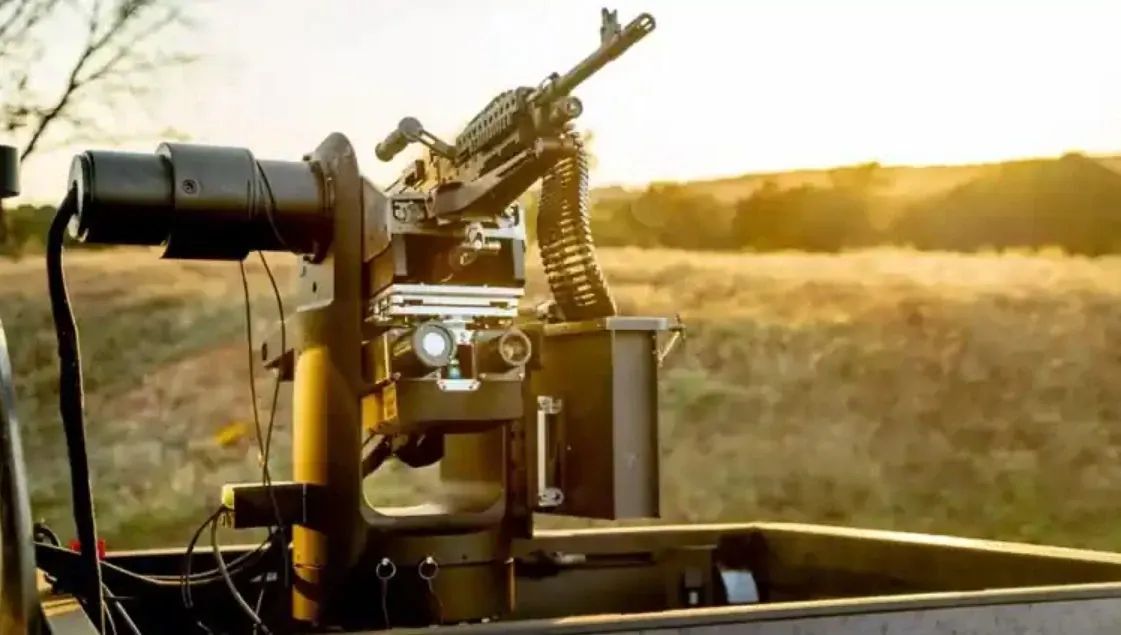
Drone warfare has entered a new phase after Ukraine announced the deployment of an AI-powered combat turret on the front lines to intercept Russian fiber-optic guided drones, a class of drones that is difficult to disable with traditional electronic warfare tools.
The new system detects the target, tracks it and calculates its trajectory autonomously, while the operator’s role is limited to confirming the strike, in an effort to close a growing gap in Ukraine’s defenses against drones that cannot be brought down by conventional jamming.
Details
* The system was developed by a team participating in Ukraine’s Brave1 defense innovation platform and has entered service with Ukrainian units across important sectors of the front.
* Ukrainian Digital Transformation Minister Mykhailo Fedorov said soldiers from the K-2 Brigade were the first to use the turret in combat, and that the system has now been deployed with more than 10 units.
* The turret uses artificial intelligence to detect incoming drones, track them, calculate their path, and then present the operator with a rapid interception decision.
* The system’s importance comes from the nature of the threat itself. Fiber-optic FPV drones connect to the operator through a thin cable, not radio waves, making them resistant to electronic jamming systems that have brought down large numbers of conventional drones.
* According to Ukrainian statements, Russia has begun using fiber-optic drones with ranges of up to around 50 kilometers, making them a more effective threat to Ukrainian supply lines and logistics.
* Kyiv sees the new turret as part of a small air-defense system being built to protect frontline forces from low-cost, high-impact drones.
* The problem is not limited to Ukraine. The same threat has appeared in southern Lebanon, where Hezbollah used fiber-optic guided drones against Israeli forces, pushing Israel to seek faster and more precise interception solutions.
* Israel is turning to AI-supported fire-control systems and computer vision, such as SMASH, which help soldiers lock onto and track fast-moving drones before carrying out interception.
* The experiences in Ukraine and Lebanon reflect a clear shift on the battlefield: jamming alone is no longer enough, because wired drones bypass electronic warfare and restore the need for direct kinetic interception.
* Ukraine is working on several defensive tracks at once, including interceptor drones, net-launching systems and autonomous turrets capable of shooting down small targets before they reach troops or supply lines.
* The danger of fiber-optic guided drones is that they combine low cost, high accuracy and resistance to jamming, making them well suited to long wars of attrition.
* If production of this drone type expands, frontline defenses will turn into a race between speed and algorithms: whoever detects first, tracks faster and fires more accurately wins.
What’s Next?
Ukraine is preparing to expand production and deployment of these turrets as part of a small air-defense system on the front line, in an effort to reduce the impact of Russian drones on supply routes and forward movements.
But the battle will not stop in Ukraine. The spread of fiber-optic guided drones across more than one battlefield means armies and armed groups have entered a new phase of the drone race: a phase in which jamming becomes less effective, while artificial intelligence, computer vision and close-range interception become more valuable.
The battlefield is changing fast. A drone that jamming systems cannot hear now needs a turret that can see it, track it and shoot it down before it arrives.