News
The Iran and Strait of Hormuz crisis is entering a more complicated phase, after Qatar moved onto the political mediation track, while Kuwait announced that it had dealt with drones inside its airspace, and Iran continued raising the ceiling of naval threats in the strait through messages from the IRGC and the navy.
These developments come as Washington awaits Tehran’s response to a proposal to stop the war and open a broader negotiation track, amid efforts by Qatar, Pakistan and other regional states to prevent the naval and aerial escalation from turning into a wider Gulf explosion.
Details
• U.S. Secretary of State Marco Rubio and White House envoy Steve Witkoff meet in Miami with Qatari Prime Minister Mohammed bin Abdulrahman Al Thani, as part of efforts to reach a memorandum of understanding that would end the war and open the door to detailed negotiations between Washington and Tehran.
• Doha is not moving alone. Pakistan remains the official mediator since the start of the war, while Qatar works behind the scenes as a channel capable of communicating with Iran and the United States at the same time. Follow-up reports on the track say Qatar and Pakistan are trying to build confidence measures, including allowing a Qatari gas tanker to pass toward Pakistan through a sensitive route near Hormuz.
• In contrast, Kuwait says it intercepted hostile drones in its airspace, coinciding with a maritime incident off Qatar, where a cargo ship was hit by an unknown projectile that caused a limited fire.
• The Kuwaiti army’s announcement that it detected and dealt with drones places Kuwait in a sensitive position. It is not a direct party to the war, but it sits inside the circle of aerial and naval pressure that Iran uses to send messages, especially with U.S. bases and interests in the region.
• In parallel, Iran’s IRGC continues raising the ceiling of threats in the Strait of Hormuz. Iranian and international reports speak of warnings to passing vessels that they must follow routes determined by Iran, in a clear attempt to impose a navigational fait accompli inside one of the world’s most important energy corridors.
• New Iranian statements add a more dangerous dimension, with a threat not to allow any oil shipments to pass through the Strait of Hormuz if Iran comes under attack.
• Iran’s navy says it has locally made stealth submarines operating in the Strait of Hormuz and on the seabed.
• Still, these Iranian claims require caution. So far, no independent verification has confirmed the scale of these capabilities or their actual effect on the naval balance of power inside the strait.
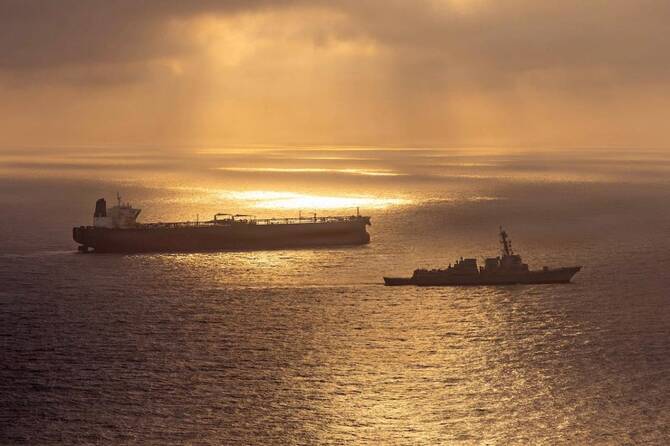
• Maritime reports indicate that traffic through the Strait of Hormuz has sharply declined since the start of the crisis, and that Iran is trying to turn practical control over the passage into a fait accompli by defining safe lanes, seizing or threatening ships, and using boats, drones and submarines as pressure cards.
• Washington, for its part, is trying to combine military pressure with negotiation. The naval blockade on Iran continues, while the Trump administration works through Qatar and Pakistan to extract an Iranian response that would allow for a broader ceasefire. But every new incident in Kuwait, off Qatar or in Hormuz weakens the chances of the diplomatic track.
• Qatar is becoming a dual player here: a political mediator on one hand, and a Gulf state directly inside the circle of maritime danger on the other.
• Kuwait, in turn, represents the clearest warning for smaller Gulf states. Drones entering airspace do not necessarily mean the start of a direct war, but they do mean that the Gulf’s safety margin is shrinking, and that the war around Iran is no longer confined to Iran, Israel and the United States.
What’s next?
The bottom line is that Qatar is trying to open the door to politics, Kuwait is testing the cost of security, and Iran is signaling that the battle in Hormuz is no longer only on the surface. Between these three lines, Washington faces a decisive question: is naval pressure enough to force Tehran into a deal, or is it pushing it to expand the war across the region?