News
This is the second day of Washington’s naval blockade on traffic linked to Iranian ports through a broad interception network outside the strait itself, after 6 merchant vessels leaving Iranian ports were forced to turn back in the opening hours of the operation.
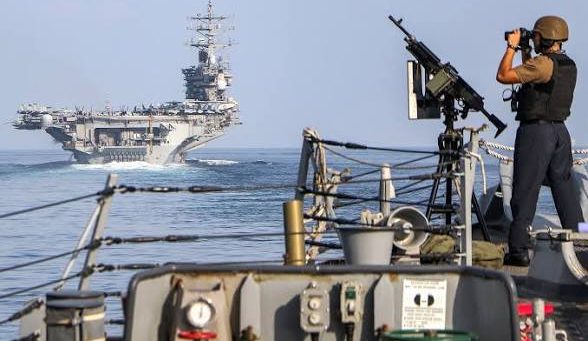
According to The Washington Post, more than 12 U.S. naval vessels are deployed across the Gulf of Oman and the Arabian Sea, backed by about 10,000 troops, as well as fighter jets and drones monitoring commercial shipping movements in the area.
The U.S. plan does not rely on stationing forces near Iranian ports or inside the Strait of Hormuz. Instead, it waits for ships to leave Iranian facilities, clear the strait, and then intercepts them at a suitable point and compels them to return.
Details
• The blockade applies only to ships that were inside an Iranian port, or entered one, after 10 a.m. U.S. Eastern Time on Monday.
• U.S. officials described the naval deployment as a lockdown net in the Gulf of Oman, rather than a direct presence inside the narrow waterway.
• None of the six interceptions required military escalation or the use of force to make the ships turn back.
• U.S. forces are not escorting the intercepted vessels back to Iranian ports, but they continue to support freedom of navigation for ships heading to or departing from non-Iranian ports.
• The report says Iran’s mining of the strait, combined with its narrowness and shallow depth, has made any military operation inside it more dangerous for naval forces.
• Before the war and the closure of Hormuz, about 20 million barrels of oil passed through the strait each day, roughly 20 percent of global supply, in addition to 20 percent of global liquefied natural gas trade.
What next?
The U.S. move increases pressure on Tehran, even if it does not resolve the core dispute. The talks held in Pakistan ended without an agreement, and energy prices are still pressuring Washington to find a way out. This means the blockade could shift from a temporary pressure tool into a prolonged test of the ceasefire itself if the fast political track now being discussed is not opened, with some sources expecting Islamabad to host a second round by the end of this week.