News
Washington: Trump has made Tuesday’s 8:00 p.m. Washington deadline the centrepiece of his latest message to Iran. He said the deadline would not be moved again, and warned that Iran could face a massive strike in a single night if it does not reopen the Strait of Hormuz and make broader concessions over the war. At the same time, he acknowledged that the latest ceasefire proposal on the table was an important step, but said clearly: it is not enough.
Against that backdrop, Trump presented the rescue of a crew member from a U.S. fighter jet shot down inside Iran as proof that the American military can operate deep inside Iranian territory. But the clearest political message was that the window for negotiation is narrowing fast and that the coming hours will be used to increase pressure.
Details
• Trump stressed that the potential strike could begin immediately after the deadline expires, and explicitly linked it to power stations, bridges and vital infrastructure if Tehran does not comply. He also said that this time the deadline will not move again.
• Defense Secretary Pete Hegseth said Monday would see the largest volume of strikes since operations began, and that Tuesday would be even bigger, signalling that the Pentagon views the hours before the deadline as a phase of escalation and pressure-building.
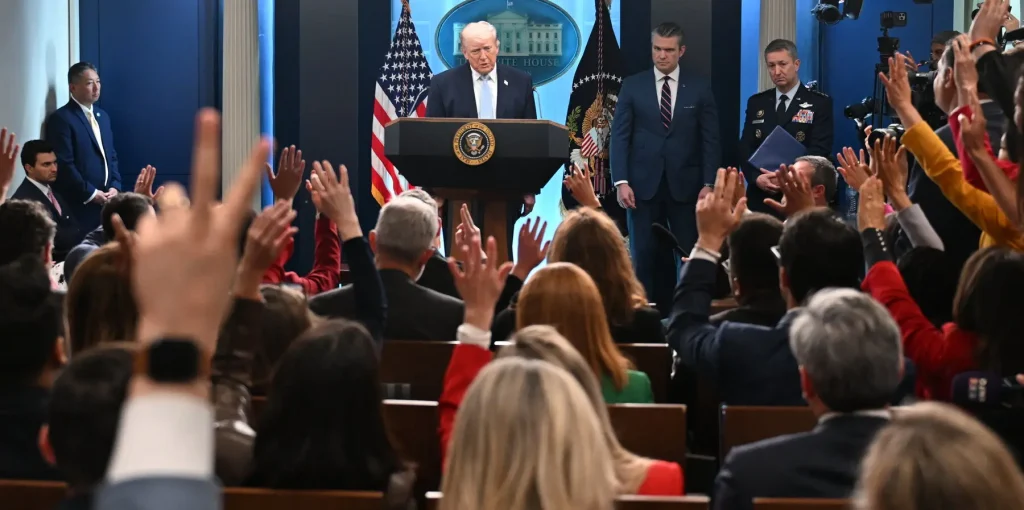
• Chairman of the Joint Chiefs of Staff Dan Caine appeared alongside Trump and Hegseth at the conference held to highlight the rescue mission, creating the impression that the White House wanted to merge the operational narrative with the political one at the same moment. He did not deliver a political statement on the scale of Trump or Hegseth, but his presence was part of an official display intended to show a unified military leadership behind the president.
• The limited new detail on the rescue operation is that it was larger and riskier than first appeared: transport aircraft and special helicopters entered hostile mountainous terrain, some helicopters came under ground fire, several U.S. personnel were injured, and American forces had to destroy equipment and aircraft after they became stuck on a makeshift airstrip so they would not fall into Iranian hands.
• Washington also used, according to U.S. reports, a deception campaign carried out by the CIA to make Iranians believe that the missing serviceman had already been found, in an effort to reduce the chances of his capture before the rescue force arrived.
• By contrast, Iran rejected the latest temporary ceasefire proposal. A Foreign Ministry spokesman said the U.S. offer was excessive in its demands and illogical, while Iranian officials said negotiations are incompatible with ultimatums and threats to strike civilian infrastructure.
What next?
The focus is now on the hours leading up to Tuesday at 8:00 p.m. Washington time, which is Wednesday at 4:00 a.m. Dubai time. If no diplomatic breakthrough emerges before then, the path outlined by Trump and Hegseth points to the war moving into a broader bombing phase targeting sensitive Iranian infrastructure.