Russian and Chinese experts do not view a Kharg occupation scenario as an easy operation or a quick solution. In both readings, the island appears to be an attractive target in terms of pressuring Iran’s oil exports, but also an extremely sensitive one in terms of cost and sustainability.
Russian experts tend to treat Kharg as the upper limit of a limited American operation, without moving into a broad ground war inside Iran.
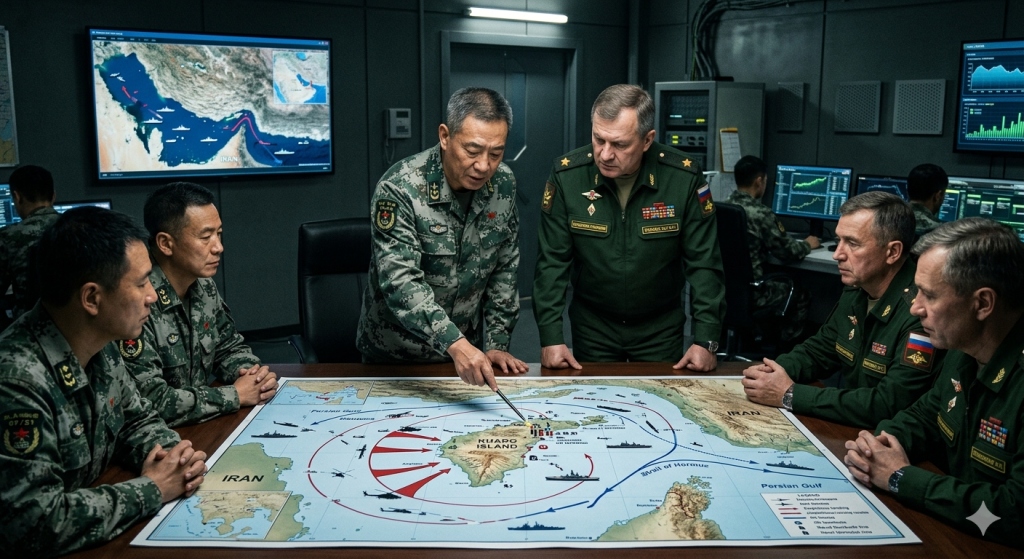
Chinese experts, by contrast, focus more on the next-day question: what if a landing is actually carried out? And how could the island be protected from an Iranian response?
Detail
In the Russian assessment closest to research centres, a broad ground operation does not appear likely. The more common idea is to seize Kharg, and perhaps part of the Hormuz coast, and use it as a bargaining lever!
Some Russian experts believe the likely American logic is clear: take control of Iran’s oil export hub and then use it to pressure Tehran over the Strait of Hormuz. In that sense, Kharg functions as both an economic and a military instrument at the same time.
But this does not mean a clean solution. In the same Russian reading, the likely Iranian response would not remain confined to the island, but could extend to Arab energy facilities and regional shipping.
Some Russians also point out that Kharg is hugely important, but not Iran’s only outlet in absolute terms. The existence of the Jask line partly reduces the impact of choking off the island, weakening the idea of a complete decision being achieved through it alone.
Another Russian reading suggests that the threat to occupy Kharg may be closer to strategic blackmail than to a fast-track victory plan. The island may theoretically be taken, but turning it into a lasting gain under Iranian fire is a very different matter.
The harsher Russian estimates hold that any American force landing on Kharg would quickly become a clear target for Iranian missiles, drones, and fast boats.
In the Chinese reading, the greater focus is on the moment after the landing. Kharg’s extreme proximity to Iran’s coastline means that any force stationed there would remain under constant threat, requiring continuous and costly air and naval protection.
Three paths
Some Chinese readings break down the seizure scenario into three routes:
• amphibious landing
• helicopter assault
• or airborne drop
Possibly a mixture of all three. But the common denominator is that none of them removes the problem of nearby Iranian fire.
Chinese experts also link Kharg to global energy security. An attack on the island would mean opening a new front against oil exports, markets, and maritime corridors.
Even with large American force concentrations in the region, the Chinese reading suggests that total numbers do not necessarily mean there is a sufficient force available to storm the island, hold it, and defend it over time.
What’s next?
The conclusion at which Russian and Chinese experts converge is clear:
• Kharg may be a target that can be attacked, but it is not a target that can be secured easily.
That is why it is viewed as a high-risk option that could give Washington a powerful pressure card, but could also tie it to a small, exposed island inside a wider war.