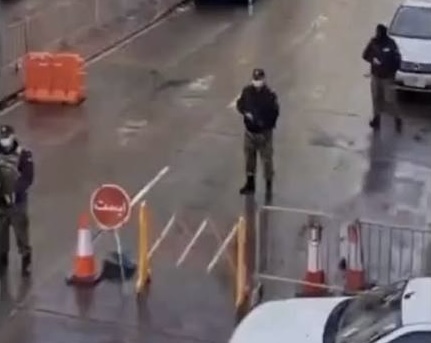
The scene inside Iran is now being described as a phase of open daily pursuit. Israeli strikes are moving beyond major sites and command centers, tracking regime figures wherever they go: in safe apartments, under bridges, inside sports complexes, and even at mobile checkpoints across Tehran and other cities.
The killing of Ali Larijani stands as the defining episode of this phase. He appeared publicly on Friday in the streets of Tehran, then was killed four days later after Israeli intelligence found him with other officials inside a hideout on the outskirts of the capital and carried out a direct missile strike. That same night, Gholamreza Soleimani, the Basij commander, was also killed after, according to the report, ordinary Iranians passed along information about his location with his aides inside a tent in a heavily wooded area of Tehran.
With those two strikes, Israel signaled that the campaign had entered a new phase: moving from destroying infrastructure to hunting down Basij figures themselves.
Detail
The operation began in the earliest days of the war on two parallel tracks:
• The United States focused on Iran’s military and industrial capabilities.
• Israel focused on the regime’s internal control apparatus: the Revolutionary Guard, the Basij, special police units, and the forces responsible for securing the capital.
As the strikes widened, Israel’s target map expanded in a striking sequence:
• First: command and control headquarters.
• Then: alternative gathering points after those headquarters were destroyed.
• Then: field deployment points and checkpoints.
• Finally: individual hideouts and the movements of commanders themselves.
Israel monitored sites that filled with security personnel after their facilities had been destroyed, then struck them. Among the deadliest attacks was the targeting of sports complexes used as alternative assembly points, most notably Azadi Stadium, where battle assessments reviewed by The Wall Street Journal said hundreds of security personnel and military members were killed.
The strikes did not stop there. Once Israel concluded that the security structure was beginning to fragment geographically, it moved to pursue smaller units. Loitering drones flying over Tehran and other areas were used to strike Basij barriers, checkpoints, and roadside deployments. In some cases, these attacks were based on tips from ordinary Iranian citizens.
That detail points to a growing human intelligence network inside Iranian society. Press reports go further, describing a deep penetration that led some security commanders to receive direct calls containing threats and warnings by name.
On the ground, the cumulative effects became visible through several signs:
• Security personnel sleeping in their cars or in mosques and public facilities.
• Units moving from headquarters into schools, hospitals, and civilian buildings.
• Neighbors evacuating buildings once they learn security personnel have taken shelter there.
• Routine police services stalling or freezing altogether.
• Shop owners being told to close early because police can no longer guarantee security.
In Tehran, witness accounts say some checkpoints were moved to more concealed positions, such as beneath bridges, to avoid detection and attack. In other neighborhoods, security forces resorted to setting up tents or sleeping inside buses and residential buildings. It is the picture of a coercive security apparatus being pushed steadily from the street into the shadows.
What Is Israel Trying to Achieve?
Israel appears to see this campaign as part of a broader effort to weaken the regime’s grip on the street. The central idea is to exhaust the instruments of repression, damage morale, and show that those enforcing control are no longer safe themselves.
That is why the chosen targets carry such weight. When Basij headquarters are struck, then fallback gathering points, then checkpoints spread across neighborhoods, the aim is to dismantle the chain of daily control through which the regime keeps society under pressure.
Information inside Iran remains under tight censorship, and anyone publishing images of the damage could face arrest. Military experience also suggests that bringing down governments from the air alone is an extremely difficult task.
There is another reality that has not yet changed: Iranian security forces still hold the streets and remain capable of deterring any broad uprising through direct threats. Many Iranians, according to The Wall Street Journal report, do not see this as a safe moment to rise up. They fear the regime may survive the war and emerge even angrier and more violent toward its opponents.
That is why the question remains open. Israel appears firmly convinced that a collapsing economy, popular anger, and sustained security pressure are pushing the regime onto a long path of decay. But there is still a wide distance between disorienting a security apparatus and bringing down an entrenched state, and that may require far more than airstrikes and assassinations.
The Deeper Conclusion
What The Wall Street Journal account reveals is a shift in the nature of the war itself. Israel is trying to break the tools through which the regime controls society and protects itself from within.
Yet this pursuit, however far it expands, has not resolved the central battle for survival. It has hit the regime in its nerves, rattled its men, and pushed them into hiding. But it has not yet stripped it of its final hold over a street still waiting for its moment.