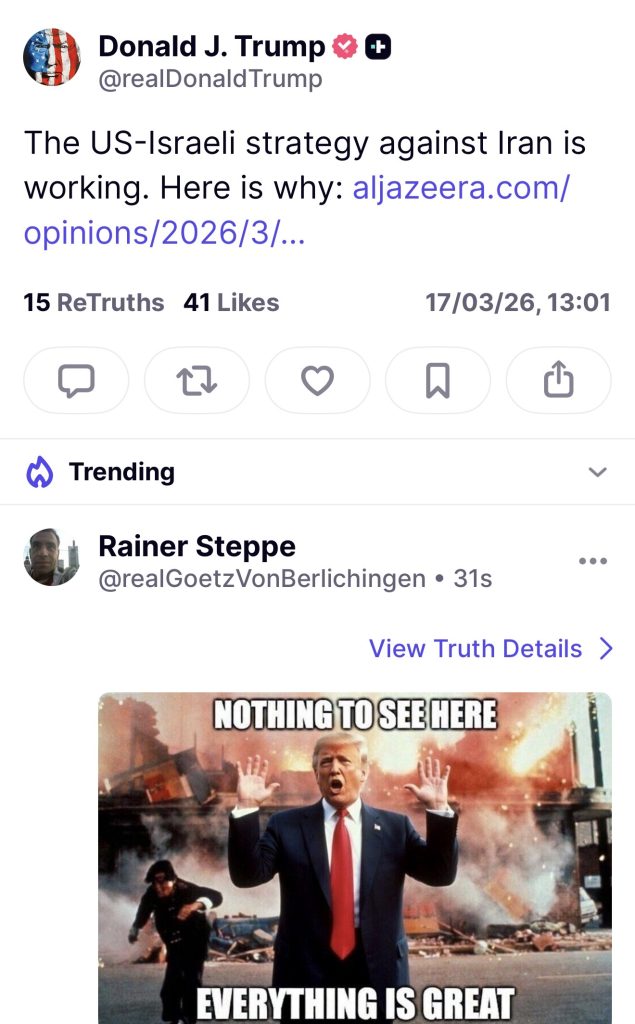
Trump publicly adopted the view of an Iraqi researcher on the course of the war after posting on his platform a link to an Al Jazeera English opinion piece whose title argues that the US-Israeli strategy against Iran is working.
The move carries both political and media significance. Trump did not merely defend the war in his own rhetoric; he relied on a published piece by an academic and analyst from the region to argue that what is unfolding is not chaos without a plan, but a campaign producing military and strategic results.
In that sense, Trump appeared to be giving his message outside validation that looks less partisan and closer to the language of experts.
Detail
The article’s central argument rests on five main points:
• The writer says the common reading of the war as a US-Israeli mistake without a plan is misleading because it counts the costs while ignoring what he calls the strategic balance sheet.
• He argues that Iran’s core instruments of power are being dismantled step by step, from ballistic missiles to drones, air defences, command structures and proxy networks.
• He stresses that the pace of Iranian launches has dropped sharply during the war, presenting that as evidence of declining offensive capacity rather than mere repositioning.
• He contends that the campaign has moved from paralysing air defences and command structures to targeting Iran’s defence industrial base, preventing what has been destroyed from being quickly rebuilt.
• He links the current war to the nuclear file, arguing that Iran entered 2026 at a dangerously short distance from a nuclear threshold, and that this reality makes the cost of inaction higher than the cost of war itself.
The article also seeks to strip the operation of any impression of improvisation. It presents the war as a campaign moving through clear phases: first, achieving air control and striking launch systems, then shifting to factories, research centres and fortified stockpiles.
In one of its most important passages, the writer says Iran now faces a strategic dilemma: if it fires what remains of its arsenal, its launch platforms are exposed; if it holds them back, its ability to impose a sustained cost on the war is reduced.
What next?
The focus now turns to two questions:
Will this narrative become the full official line of Trump and his administration?
And will battlefield developments in the coming days reinforce this claim or weaken it?
Trump’s reposting of the article also suggests that the battle over narrative has entered a new phase, centred on who gets to define the meaning of the war itself: is it a costly quagmire, or a successful dismantling of a regional adversary?
(Analysis)
Trump’s embrace of the article matters because it was published in the opinion section of a major media organisation, giving him the opportunity to lift out a central line and turn it into political support. In effect, he is telling both his supporters and his critics that even some voices from the region see the strikes as achieving their purpose.
But two things should be clearly separated.
First, Trump’s endorsement of the article is a news event in itself.
Second, the substance of the article remains an analytical argument and a political opinion, not a final judgement on the outcome of the war.