The war is moving into a more costly regional phase after a fresh Iranian wave of attacks struck several Gulf states on Sunday, while the United States and Israel continued targeting oil-related sites inside Iran. According to coverage by The Guardian and wire agencies, the Iranian attacks hit the United Arab Emirates, Saudi Arabia, Qatar, Bahrain and Kuwait. Two cases stood out in particular: damage to a desalination plant in Bahrain, and Kuwait’s announcement of a precautionary reduction in oil output.
In Bahrain, the interior ministry said a drone attack caused material damage to a water desalination plant, in addition to injuring 3 people and damaging a university building in Muharraq after missile fragments fell nearby. The strike is especially significant because it hit a vital civilian facility in a Gulf environment that depends heavily on desalination for water supply.
In Kuwait, the Kuwait Petroleum Corporation announced a precautionary cut in crude production and invoked force majeure amid disrupted shipments and continued difficulty moving through the Strait of Hormuz. Kuwait’s defence ministry also said fuel tanks at Kuwait International Airport were targeted in a drone attack, while reports said 2 firefighters were killed.
Detail
The significance of this story is not only the number of states hit, but the type of targets involved. The current picture can be reduced to 4 main points:
1.Water has entered the war
Damage to a desalination plant in Bahrain means the conflict has moved beyond military bases and security sites into highly sensitive civilian infrastructure. In the Gulf, targeting desalination is not a marginal development. It is direct pressure on water security.
2.Gulf energy has entered a phase of practical pressure
Kuwait’s precautionary oil cut shows that the attacks are no longer just a security threat. They are beginning to produce operational and economic consequences for production and exports. Continued disruption around Hormuz only raises the cost further for the entire region.
3.Iran’s oil heartland is under pressure too
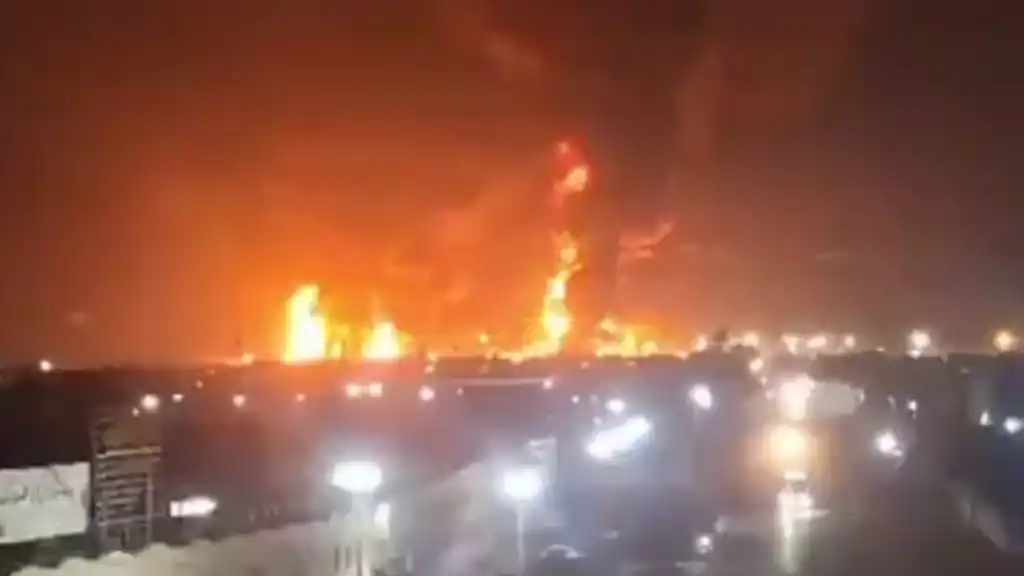
An Iranian official said 5 oil facilities in Tehran and Alborz were struck and that the fires were later contained. This means the equation is no longer simply Iran striking its neighbours. Iran’s own oil infrastructure is now firmly inside the target bank as well.
4.The war is shifting from a military confrontation to an infrastructure war
The clearest sign now is that the targeting is hitting 3 vital circles at once:
• water
• fuel
• oil
That raises the cost of the conflict for civilians and the economy, and that is precisely the kind of pressure Iran appears to want to create.
Why it matters
Because this shift changes the meaning of escalation itself. Earlier, the question was: who can strike harder? Now the question is: who can raise the cost of daily life, production and energy for the other side and for the wider region? Striking a desalination plant in Bahrain and fuel tanks in Kuwait, while oil sites around Tehran are also being hit, means the war is moving into a logic of pressure on critical arteries.
What next?
The main indicators to watch in the coming hours are:
1.Will attacks on water and electricity facilities be repeated?
If this pattern continues, it will mark a clearer shift towards targeting vital civilian infrastructure in the Gulf.
2.Will oil cuts widen or be repeated elsewhere?
If Kuwait’s model spreads, the fallout will no longer be only security-related. It will become an oil and pricing issue on a broader scale.
3.Will Washington and Tel Aviv keep striking Iran’s energy sector?
Continued attacks on oil sites around Tehran could signal a move towards direct economic pressure inside Iran, not merely attacks on military targets.
4.Will political threats evolve into wider military escalation?
Trump has said he is not interested in negotiating with Iran and left open the possibility of sending U.S. troops on the ground, suggesting the ceiling of the war may still rise further.
(Analysis)
The clearest angle in this development is that the war is no longer measured only by the number of missiles fired or the number of sites bombed, but by the type of infrastructure being drawn into the fight. When desalination is hit in Bahrain, oil output is cut in Kuwait, and oil sites near Tehran are struck, the conflict is moving towards a more dangerous equation: exhausting the capacity for life and production, not only the capacity for fighting. That stage is often more consequential for the region than conventional military strikes alone.