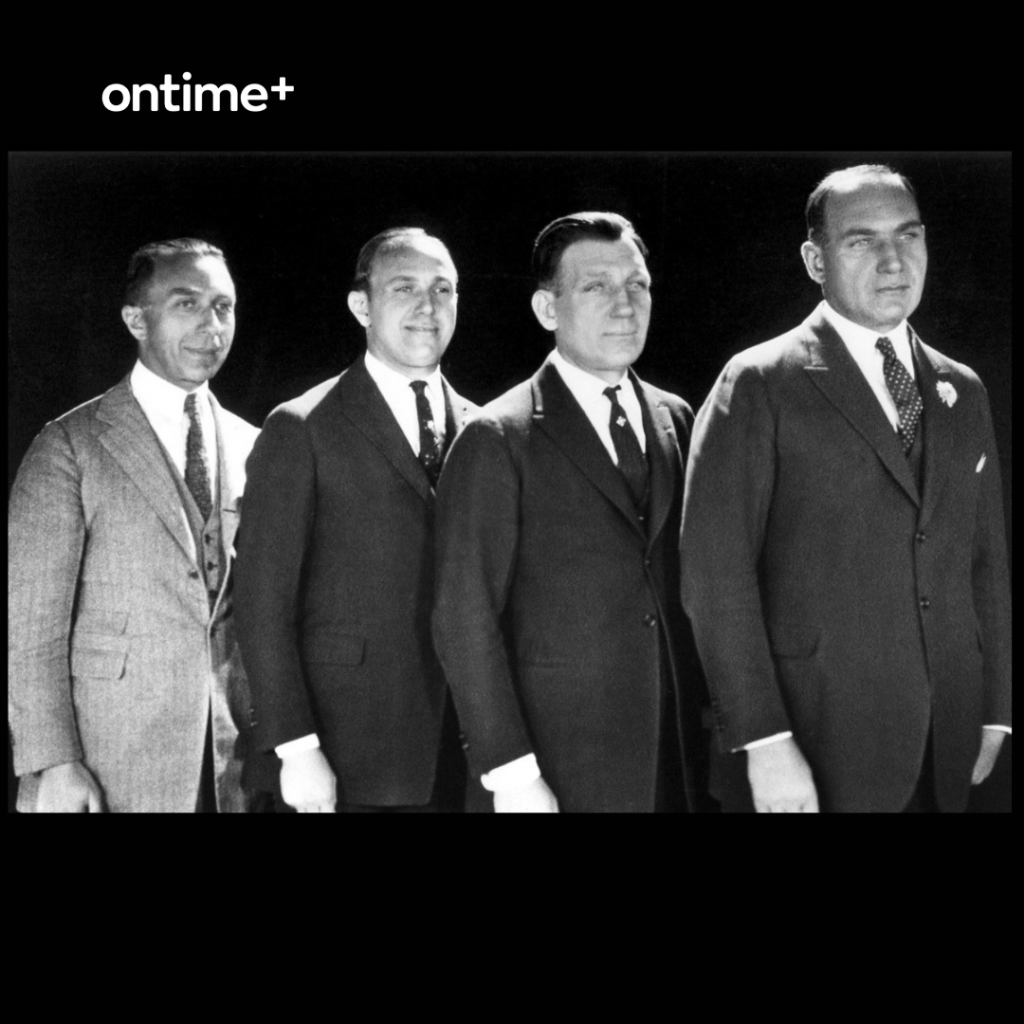
There are studio stories that begin with a red carpet. Warner Bros. begins with worn leather, an immigrant’s toolbox, and four brothers who rarely agreed on anything—except that the future belonged to whoever dared to change the rules first.
They were the sons of Benjamin Eichelbaum, a Polish immigrant cobbler and peddler—poor, Jewish, and perpetually on the edge of America’s promise. Harry, Albert, Sam, and Jack arrived with little more than survival instincts and a fierce suspicion of complacency. In time, they would drop the old name, become the Warners, and build a company whose logo would glow across the world. Encyclopaedia Britannica still frames the origin in those blunt terms: Polish roots, a cobbler father, and four brothers who turned hardship into industry.
Four brothers, four temperaments—and one engine
What made Warner Bros. feel different wasn’t only what they produced, but how the family machine worked.
- Harry, the eldest, was the moral centre and the cautious governor: a man of limits, discipline, and long-term survival.
- Albert was the commercial bloodstream—distribution, sales, the unglamorous art of getting films into theatres and money back to the company.
- Sam was the gambler of ideas and technology, obsessed with what cinema could become.
- Jack, the youngest, was the day-to-day power in Hollywood’s trenches: talent, production, ego-management, and the ruthless instincts of a studio boss.
Warner Bros. was formally founded on April 4, 1923 by the four brothers—an institutional “stamp” on a business they had already been building through exhibition and distribution.
The moment they changed cinema: sound
If Warner Bros. has a single mythic turning point, it is the bet on synchronized sound.
Sam pushed the company into Western Electric’s Vitaphone system—an expensive, unpopular wager at the time, taken while bigger studios hesitated. The risk nearly crushed them, then saved them. A year before The Jazz Singer, they tested the waters with Don Juan (1926) and Vitaphone shorts; the wider industry remained sceptical.
Then came The Jazz Singer (1927), which became a commercial shockwave and a cultural hinge: the “talkies” were no longer a novelty, and silence started to feel obsolete. The film’s New York premiere took place on October 6, 1927—and the tragedy is carved into studio history: Sam Warner died the day before, leaving the surviving brothers to return for his funeral instead of attending the night that proved he was right.
That is the Warner pattern in one scene: ambition, risk, family tension, and a transformation of the medium—paid for in full.
From studio to empire, from empire to bargaining chip
Over the decades, Warner Bros. became a pillar of the American studio system and later a multi-arm entertainment complex spanning film, television, and more.
But the modern era has been defined less by the romance of moviemaking and more by consolidation, debt, streaming wars, and corporate architecture.
That’s why today’s headline matters: it is not just a deal story—it is a story about who controls one of the world’s deepest libraries of stories.
What the Netflix withdrawal changed
In late February 2026, Warner Bros. Discovery’s board deemed Paramount Skydance’s offer “superior,” setting a short window for Netflix to counter. Netflix declined to raise its bid, effectively stepping away.
The key distinction is strategic:
- Netflix’s approach (as described in reporting) was a targeted purchase of Warner’s studio and streaming assets—a “parts” deal designed to strengthen content production and direct-to-consumer scale without necessarily inheriting everything else.
- Paramount Skydance’s approach is a bid for the entire company, which would place Warner assets (including major studio brands and news/TV holdings) under the same umbrella as Paramount’s broader portfolio—dramatically increasing regulatory scrutiny and the scale of post-merger restructuring.
So it’s not that Warner “follows Paramount” today—it’s that the deal momentum is shifting toward a full-company takeover if approvals hold.
How Hollywood read the news
Hollywood’s reaction—based on the immediate coverage—split into familiar camps:
- Investors applauded Netflix’s discipline. Netflix shares rose after the company walked away, signalling that markets preferred restraint over overpaying in a bidding war.
- Industry anxiety returned to two words: layoffs and leverage. Large media mergers almost always bring cost-cutting, consolidation of departments, and fewer greenlight centres. The Guardian’s coverage explicitly flags expectations of job cuts and consolidation fears around the combined power of mega-libraries.
- Regulators became part of the plot. A merger that concentrates major film/TV assets and prominent news brands invites antitrust questions in the U.S. and potentially beyond—especially in a political climate already sensitive to media power.
The deeper irony: Warner Bros. is back where it began—at a turning point
A century ago, the Warners were outsiders with a technology bet that the industry mocked until it couldn’t ignore it. Now, the company that once forced Hollywood to learn a new language (sound) is being negotiated as an asset in a new language—streaming scale, debt structure, termination fees, ticking fees, and regulatory risk.
The cobbler’s sons built an empire by taking the future personally. The question now is whether the next owner will treat Warner Bros. as a creative engine—or as a balance-sheet trophy.
Sources: Reuters. Associated Press. The Guardian. Encyclopaedia Britannica. Silent Film Society of Chicago (Vitaphone / Sam Warner).