In reality, Tehran runs two different naval arms with different doctrines and missions: the regular military navy, known as IRIN, and the Revolutionary Guard navy, known as IRGCN. This division is part of Iran’s way of manoeuvring: one navy for the conventional front and wider reach, and another for strait warfare, rapid close-in operations, and maritime denial.
The roots of the regular navy go back to before 1979. It operates the submarines and larger surface ships, and moves beyond the Gulf, especially into the Gulf of Oman and the Arabian Sea. The Revolutionary Guard, by contrast, was built as an ideological and fast combat force that effectively controls the Gulf and the Strait of Hormuz, relying on density, surprise, close approach, and strikes launched from the coast, islands, and small boats.
The result is a mix of submarines, surface ships, attack craft, mines, coastal missiles, and unmanned platforms. That combination is what has always made Hormuz a global choke point.
Detail
First: The Regular Military Navy
Its role is to protect Iran’s wider maritime security, operate the larger ships, and manage the undersea arm. According to NTI, all submarines still fall under this navy, and Iran’s undersea fleet is estimated at around 28 to 30 submarines, including 4 to 6 diesel attack submarines and 24 small submarines. The Russian-built Kilo submarines are based in Bandar Abbas at the entrance to Hormuz, but operate more effectively in the Gulf of Oman and the Arabian Sea because of the depth and salinity constraints inside the Gulf itself.
Second: The Revolutionary Guard Navy
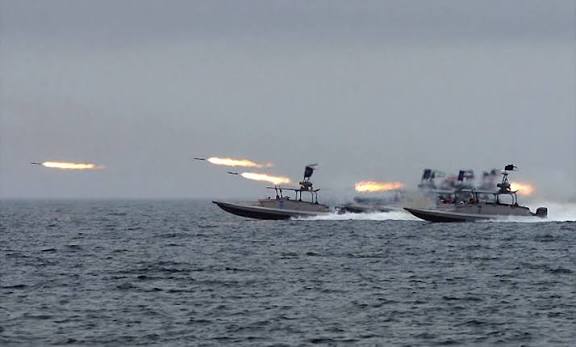
It functions as a maritime denial force. Its main area of responsibility is the Gulf and the Strait of Hormuz, and it is the force associated with fast boats, dangerous close encounters, mine-laying, coastal missiles, and direct pressure on navigation.
Why did Iran need two navies?
Because it knows it cannot match major fleets ship for ship. Instead of building one heavy navy, it chose to combine two levels: a limited conventional level that gives it presence, sovereignty, and an international profile, and an asymmetric level that relies on geography, numbers, concealment, and surprise strikes. That helps explain why the Revolutionary Guard sometimes appears more important than the larger ships themselves when Hormuz is concerned.
Its main combat tools
At the core of the Iranian maritime threat are four tools: mines, fast boats, coastal anti-ship missiles, and unmanned platforms. US intelligence estimates speak of a stockpile that may reach around 6,000 naval mines. USNI has noted that the regular navy can deploy mines from submarines or surface ships, while the Guard can lay them from a range of surface platforms. Bandar Abbas also contains major missile sites and facilities for testing, assembling, and upgrading naval missiles, alongside fast missile boats.
Submarines
Submarines give Iran a quiet deterrent tool, but they are not ideal across the entire Gulf. An NTI report explains that the Gulf’s depth and water conditions constrain relatively larger submarines, which is why small submarines and operations in the Gulf of Oman and the Arabian Sea become more valuable.
Fast boats
The Revolutionary Guard is known for this tool because it suits both its geography and its doctrine. Small and fast boats, sometimes armed with light missiles or mines, and sometimes used for suicide or unmanned missions, move near the coast and islands and exploit short distances and the difficulty of rapid identification in crowded waters.
Missiles, coast, and islands
Iran’s major advantage lies in what overlooks the water from land: a long coastline, islands close to shipping lanes, and anti-ship missile batteries around Bandar Abbas and its surrounding area. That is why any attempt to secure the strait is more complicated than simply destroying boats or ships. In practical terms, it means dealing with an entire coastal-maritime system.
What happened in the current war?
Since the war began on February 28, Washington has said that one of its main objectives was to strike the Iranian navy. On March 1, Trump announced the destruction of nine warships in the opening days. Days later, US Central Command said it had destroyed 16 mine-laying vessels near Hormuz, while USNI explained that the strikes targeted both the regular naval forces and the Revolutionary Guard forces. But USNI also quoted experts as saying that the Guard has not yet committed its full weight, and that some of its smaller tools may be held back for a more dangerous phase or for a final round of greater harassment.
What next?
The current strikes may break a large part of the traditional image of the Iranian navy, but they do not quickly eliminate its asymmetric logic. That logic is tied to Iran’s ability to use mines, drone aircraft and drone boats, coastal missiles, and small craft from close range. So while the Iranian navy may look weaker in theory, it remains dangerous as long as the theatre remains the waters of the Gulf itself.
(Analysis)
Why is it difficult to eliminate the Iranian maritime threat completely?
1.Because the threat is split between the regular navy and the Guard.
2.Because a large part of the force sits on the coast, on the islands, and in the mine threat.
3.Because geography works in Iran’s favour: narrow waters, short distances, and dense commercial traffic.
4.Because Iranian doctrine does not seek a conventional naval victory. It seeks to raise material costs, disrupt navigation, and unsettle the adversary.
Sources: Reuters, USNI News, NTI.