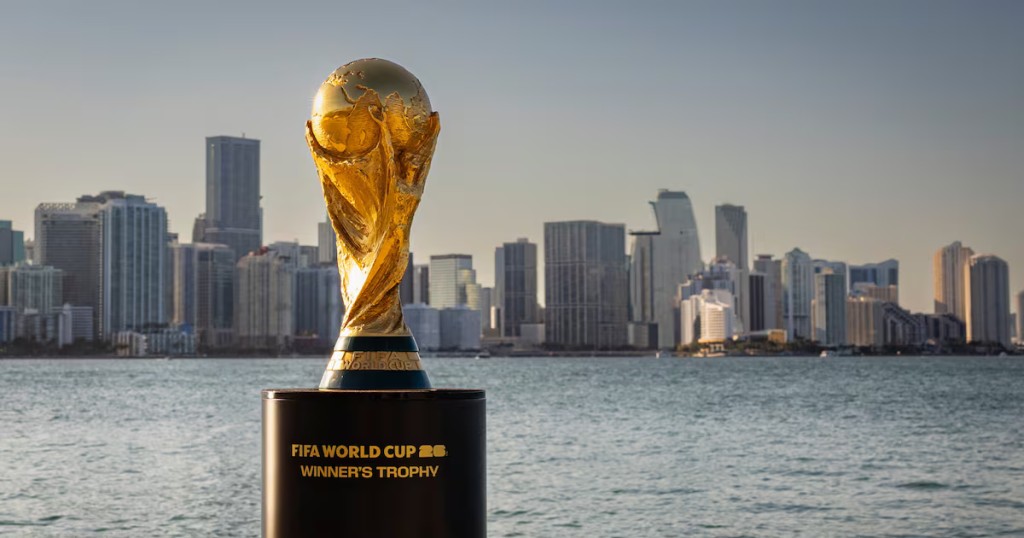
World football is entering a double-tempo phase. European club seasons are tightening as spring approaches, while, in the background, a World Cup of unprecedented scale is already reshaping calculations for coaches, players and supporters. At the centre of the weekly global mood remain the three leagues that still set the benchmark for intensity, style and commercial gravity: the Premier League, LaLiga and Serie A. Running in parallel, the 2026 World Cup draw has sketched an early map for a long summer across the United States, Canada and Mexico, under a 48-team format with a new knockout pathway.
These are not separate stories. What happens in Europe now will largely determine who arrives in June with momentum, who arrives with fatigue, and who carries an injury list that quietly undermines a national campaign before it begins.
1) The Premier League
A season that refuses mercy: pressure at the top, panic at the bottom
The Premier League remains the most unforgiving competition in terms of rhythm and physical stress. Fixtures arrive in waves, pressure is constant, and mood swings can be weekly. The title race matters, of course, but in England the real competition is often over margins: a single point that saves a coach, a last-minute equaliser that keeps a European dream alive, or a defeat that pushes an historic club into a relegation spiral.
This stage of the season is not decided by names alone. It is decided by depth. Who genuinely has a bench? Who can rotate without losing identity? Who has the psychological stamina to handle a run-in that turns every weekend into a referendum?
Another factor raises the temperature: multi-front football. Clubs juggling domestic cups and European commitments must manage minutes like currency. The best squads are not simply the most talented; they are the best managed.
What to watch in the coming weeks
- The title race becomes a contest of error-reduction. The side that makes fewer mistakes usually wins.
- The battle for European places creates a particular kind of pressure: teams chasing the Champions League often drop points against opponents fighting for survival.
- At the bottom, every match becomes a small final. The value of a draw rises sharply in relegation economics.
2) LaLiga
A clearer summit battle, a different football language
LaLiga speaks in a different dialect. The tempo is less chaotic than England’s, the tactical fingerprints are often more visible, and technical control tends to shape narratives. But the psychological pressure at the top is no lighter. In Spain, title races can hinge on one lapse of concentration, one set-piece, one positional mistake, or one striker reading a split second better than the defenders.
Crucially, LaLiga often rewards discipline as much as spectacle when the calendar tightens. Big games matter, but so do uncomfortable away trips where points are lost quietly and the table is rewritten without drama.
The angle that matters for Middle Eastern audiences
For our region, Spain is not simply a viewing habit; it is part of the national-team pipeline. The performance curve of key players in high-level European football often echoes months later on the international stage. In that sense, LaLiga is not entertainment alone; it is context.
What to watch in the coming weeks
- Away wins at this stage carry extra weight; they tend to separate champions from challengers.
- The effect of European weeks on domestic consistency: the league often punishes teams that cannot manage both.
- Defensive evolution among top-four contenders: the run-in tends to reward structure and organisation.
3) Serie A
A title race that may tilt one way, and a chase that never settles
Serie A this season offers a sharper storyline: a front-runner attempting to pull away, a pack behind chasing, and a dense battle for Champions League positions. Italy remains a league of tactical detail and match management. The ability to win difficult matches late is not only about quality; it is often about mentality, preparation, and in-game problem solving.
But Italy is never only about first place. Beneath the summit, the fight for Europe is frequently the more dramatic competition: heavy shirts, ambitious coaches, contrasting philosophies, and direct head-to-head fixtures that operate as six-point swings.
What to watch in the coming weeks
- Whether the leader’s advantage becomes a near-decision, or whether one stumble reopens the chase.
- The head-to-head clashes among European contenders: in Italy, these matches often decide the table more than the so-called “easy” games do.
- Injury management: as the schedule compresses, minute-allocation becomes competitive strategy.