Iraq is facing one of its most complex financial tests in 2026, as the fragility of its rentier budget structure coincides with growing instability in the oil export environment. With operating expenditure dominating the largest share of the budget, the state’s ability to pay salaries and meet essential obligations has become more dependent than ever on uninterrupted oil revenue flows.
The situation is becoming more sensitive because the Iraqi budget no longer has much room for maneuver. Salaries, pensions, and social welfare absorb the largest share of spending, while the deficit remains a structural one that cannot easily be contained if oil exports face a prolonged disruption or if prices fall below the levels assumed in the fiscal calculations.
Detail
• Circulating estimates indicate that the total annual budget, under the one-twelfth rule, stands at about 211 trillion Iraqi dinars.
• Operating expenditure accounts for around 156 trillion dinars, or nearly three-quarters of total public spending, including salaries, pensions, and social welfare.
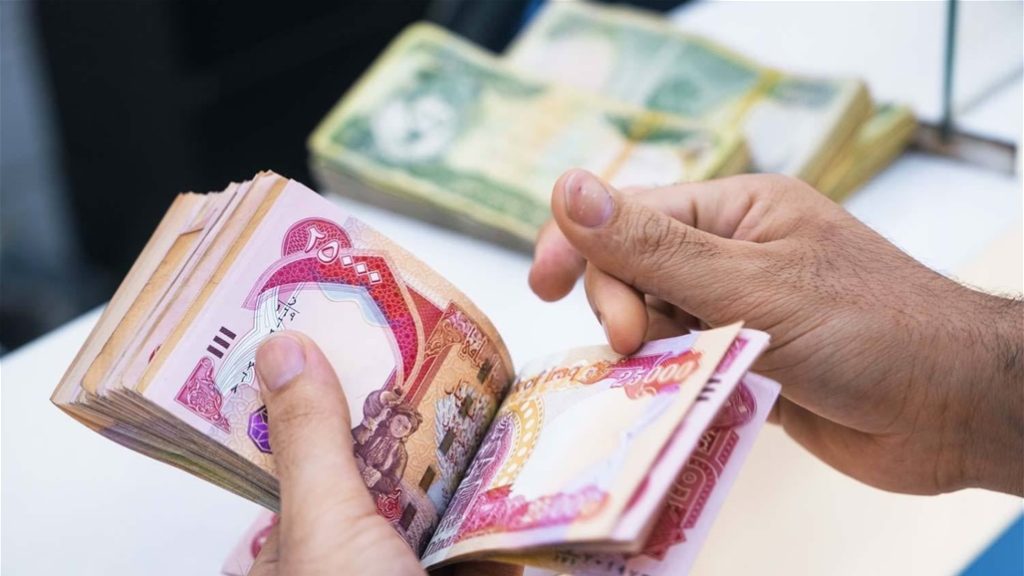
• Salaries alone amount to around 90 trillion dinars annually, or roughly 7.5 trillion dinars per month.
• The fiscal deficit is estimated at around 64 trillion dinars, a deficit that is effectively tied to Iraq’s ability to maintain high and steady oil revenues.
The deeper problem is that Iraq still depends on oil for between 88 and 90 percent of its public revenues. That means any disruption in exports or sharp fall in prices affects not only the budget figures, but the state’s ability itself to fund its core monthly obligations.
In this context, two pressures are converging at the same time:
• The southern route through the Gulf: Any disruption to navigation or shipping directly affects Iraqi exports, because most of the country’s oil leaves from the south.
• The northern route through Ceyhan: Restarting this line has shifted from being a political oil file to an urgent financial necessity, because its continued shutdown deprives the budget of an important relief valve at a highly sensitive moment.
The continued disruption of the Ceyhan line is also placing Baghdad under double pressure to reach a quick understanding with the Kurdistan Region and international oil companies, not only to resolve a technical or legal dispute, but to secure a vital source of revenue that could ease pressure on the treasury.
What Next?
If southern exports do not stabilize quickly, or if the northern route is not reactivated soon, the coming weeks could force the government into more difficult choices, including:
• Delaying or rescheduling salary payments.
• Freezing or slowing investment projects to secure operating expenditure.
• Increasing reliance on local liquidity and state-owned banks as a temporary solution.
• Greater pressure on monetary policy if the gap between revenues and obligations widens.
(Analysis)
What Iraq is facing is not a temporary cash squeeze, but a chronic exposure in the structure of the state’s finances. Once salaries become tied on a daily basis to the safety of oil exports, any regional crisis or internal political disruption turns into a direct threat to social stability. That is why the Ceyhan file, and the security of southern exports, are no longer merely oil issues. They have become part of the state’s own financial survival equation.
The other problem is that any temporary fix, whether through drawing on state-owned banks or postponing obligations, will not remove the root of the imbalance. It will only delay the moment of rupture. The real danger therefore does not lie in one troubled month, but in the entrenchment of a budget model that cannot withstand the first major shock in the market or the geopolitical environment.