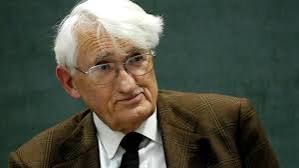
Jürgen Habermas, one of postwar Germany’s most prominent thinkers, has died after a career that stretched across nearly seven decades of philosophy, sociology, and public intervention. His name was closely tied to the Frankfurt School, but he moved well beyond a narrow academic frame to become a key reference point in understanding modern democracy, public opinion, institutional legitimacy, and the relationship between reason and the public sphere.
Detail
Habermas was born in 1929 in Düsseldorf and spent his childhood under Nazi Germany. He was born with a cleft palate and underwent early surgeries, an experience often linked to his later sensitivity to language, communication, and mutual recognition between human beings. He studied in Bonn, Göttingen, and Zurich, earned his doctorate from the University of Bonn in 1954, and later worked as an assistant to Theodor Adorno before establishing his own independent intellectual standing.
His name rose sharply with The Structural Transformation of the Public Sphere in 1962, where he explained how a space emerges between the state, the market, and the family, in which individuals meet to discuss public affairs and shape public opinion. The idea later became one of the most influential concepts in media studies, communication, democracy, and political culture.
He then deepened his project in The Theory of Communicative Action in 1981. There he defended a central idea: human beings are not driven only by interest and conflict, but also possess a capacity for rational understanding, and a healthy society requires communication oriented toward mutual understanding rather than domination or utility alone. The significance of this work also extends into the Arab intellectual sphere, because it was translated into Arabic and published years ago by the Arab Center for Research and Policy Studies in a translation by Fathi Meskini, giving Habermas’s ideas a wider presence in Arab debates on democracy, the public sphere, and communicative rationality. That is why Habermas remained important in political philosophy, sociology, legal theory, and the ethics of public debate.
His importance does not stop at books. In postwar Germany, he played a central role in debates over historical responsibility for the Nazi era, and rejected any attempt to soften the singularity of Nazi crimes or dissolve them into a broader historical narrative. He later defended European integration as a barrier against the return of hardline German nationalism.
What next?
After his death, debate over his legacy is likely to return strongly in three arenas: the future of the public sphere in the age of digital platforms, the fate of representative democracy under populist pressure, and the question that followed him throughout his life: can public reason still produce agreement in a world that is more polarised and less confident in truth? That is precisely what keeps Habermas present after death, not only as a classic name, but as a tool for understanding the crises of the present.
(Analysis)
Habermas’s value today lies in the fact that he stood against two paths at once: against authoritarianism that despises debate, and against a postmodern mood when it turns into total scepticism toward truth, normativity, and reason. He did not see democracy as merely a ballot box, but as a communicative structure that needs journalism, public debate, institutions, and a shared language that allows disagreement without the collapse of meaning. That is why his ideas remain deeply relevant in an age of rapid news cycles, sharp polarisation, and the erosion of trust in the public sphere. This is one of the main reasons he remains among the most influential thinkers of the second half of the twentieth century.