

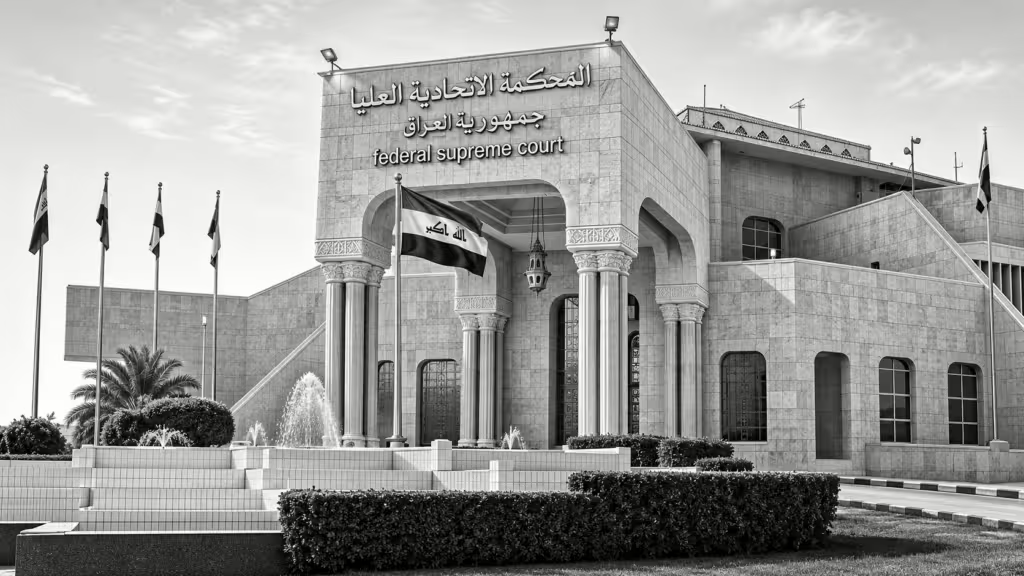
Key Points
- Iraq's Federal Supreme Court ruled the prime minister's measures in Kurdistan Region constitutional, by majority with two dissents.
- Ruling places border protection, crossings supervision, customs policy and oil oversight under federal authority, including inside the region.
- Decision is final and binding on all authorities, and fixes Kurdistan's territorial scope at 19 March 2003 boundaries.
The latest:
Border protection, customs crossings, unified automation systems and oversight of oil and gas operations inside the Kurdistan Region fall under federal authority, Iraq’s Federal Supreme Court ruled, upholding the constitutionality of measures taken by the prime minister. The court issued the decision by majority, with two members dissenting, and described it as final and binding on all authorities.
Details:
- The borders: Protecting, securing and defending Iraq’s international borders is an exclusive federal competence under Articles 109 and 110/Second, the court said. It said the federal government may deploy and manage the armed forces to secure all frontiers with neighbouring states, including borders inside territory administered by the Kurdistan Region.
- The crossings: Federal authorities may exercise supervision, monitoring and control over departments at all border crossings in Iraq, including those inside the Kurdistan Region, the court said, citing Border Crossings Authority Law No. 30 of 2016, while observing Article 114/First on administering customs in coordination with regional and provincial governments.
- The automation system: Establishing a unified national system to automate border crossings and customs, and linking it electronically to federal ministries across Iraq including crossings in the Kurdistan Region, falls to federal authorities under Article 110/Third, the court ruled, alongside setting the technical, financial and customs standards needed to operate it.
- Oil and gas: Management of extracted oil and gas is handled by the federal government together with producing regions and provinces under Article 112/First, the court said, while Article 111 vests ownership in all Iraqis. The oil ministry and federal oversight bodies may supervise, monitor and audit fields, operations and contracts.
- The precedents: On energy the court cited its decision No. 59/Federal/2012, consolidated with 110/Federal/2019, issued on 15 February 2022. On customs and revenue it cited decision No. 224/Federal/2023, consolidated with 269/Federal/2023, issued on 21 February 2024. Contracting, it said, is done by competent authorities under the law.
- Revenues and tariffs: Under Article 110/Third, federal authorities set fiscal and customs policy and a unified customs tariff, and supervise public revenues from fees, taxes and non-oil income across all of Iraq including the Kurdistan Region, the court said, with those revenues audited, settled and transferred to the public treasury.
- The territorial scope: Kurdistan’s authorities exercise power only over territory administered by the regional government on 19 March 2003 in Dohuk, Erbil, Sulaymaniyah, Kirkuk, Diyala and Nineveh, the court said, under Article 53/A of the Transitional Administrative Law kept in force by Article 143 of the 2005 constitution.
- Outside that scope: Administration of land outside that defined scope, and the exercise of constitutional, administrative and executive powers over it, belongs to federal authorities each within its remit, the court ruled. Actual administrative practice by regional authorities beyond that scope does not create constitutional competence for them.
- Disputed territories: The ruling observes the constitutional provisions on disputed areas in Article 58 of the Transitional Administrative Law and Article 140 of the constitution, the court said, without specifying how those provisions interact with the territorial limits it drew.
- Legal standing: The decision was issued by majority with two dissents, final and binding on all authorities, under Articles 93/Second and 94 of the 2005 constitution and Articles 4/Second and 5 of Federal Supreme Court Law No. 30 of 2005, amended by Law No. 25 of 2021. It was read publicly on 25 November 2026.
Between the lines:
The ruling settles several contested files at once: borders, crossings, customs automation, revenues, oil oversight and the region’s territorial limits. By stating that administrative practice outside the 2003 scope creates no constitutional competence, the court addressed the de facto situation directly, while its references to Article 114/First leave customs administration tied to coordination with regional authorities.
What’s next
Watch how federal ministries move to implement supervision at Kurdistan crossings and the unified automation system, the Kurdistan Regional Government’s response to the territorial scope finding, and any steps on oil contracts and revenue transfers.