The latest:
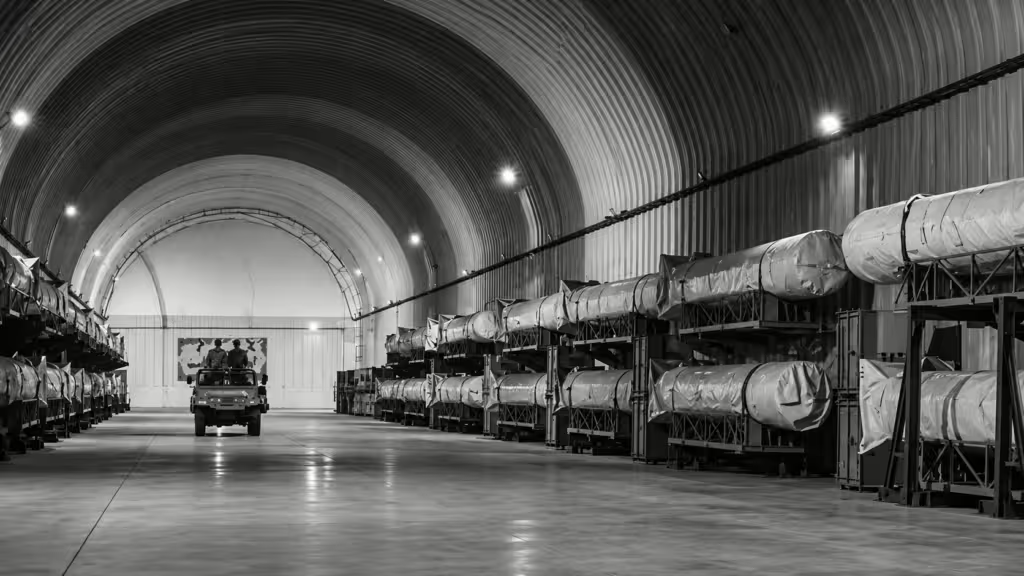
Iran put on display Saturday what it described as an underground missile city, pairing the footage with a warning that it has surprises in store and will not hesitate to use force. The reveal came a day after President Donald Trump said Tehran wants an agreement but not one he would accept, and as attacks on shipping continue in the Strait of Hormuz.
Details:
- The facility: Majid Mousavi, commander of the Revolutionary Guard’s Aerospace Force, visited the site and said his force stands ready to execute the supreme leader’s orders across all operational theaters. He said aerospace capabilities expanded significantly between rounds of conflict, with highly effective systems developed to strengthen deterrence.
- A familiar reveal: Officials present the site as new, but a comparable facility was announced earlier this month, leaving open whether the footage documents restored capability or serves as messaging aimed at Washington and Israel. No independent location or timeline for the site was provided.
- The rhetoric: Iranian media quoted Revolutionary Guard commander Ahmad Vahidi as saying what is happening to the enemy now is only the beginning, promising humiliation and complete defeat. Iran said the remarks were delivered from the facility that was shown.
- Araghchi’s terms: The foreign minister said any timetable is acceptable to Tehran provided its demands are met. He said the two-day plan Iran floated in late October remains on the table, and that compressing it to one day or two hours poses no problem if Washington is serious.
- The Hormuz condition: Araghchi said the United States must first fulfill specific commitments, after which Iran would reopen the Strait of Hormuz, describing those steps as paving the way for a final agreement without naming them. On nuclear material he set two red lines: it must not leave the country, and must be used according to Iran’s needs.
- Islamabad’s text: Araghchi said the memorandum of understanding presented by Islamabad is no longer on the table and carries no enforcement power.
- The tanker incidents: The Revolutionary Guard navy said a tanker sailing in violation of regulations and backed by the US military tried to cross an unauthorized corridor and struck naval mines, causing an explosion and fire. The Guard released audio of the blast and warned it is monitoring every vessel movement.
- Tasnim’s account: The Iranian agency reported two incidents overnight, the first near Khasab port and the second at dawn off Ghanam Island, attributing the explosions to ships striking naval mines. Iranian sources also claimed air defenses downed an American MQ-9 drone west of the strait.
- Trump’s position: Trump said falling fuel prices now hinge on how matters are settled with Iran, dismissing what he called 51 years of fake deals. Asked about a report that Iran plans to detonate a dirty bomb in the United States, he said Washington would act against Tehran if it did.
- Reconstruction signals: Iran opened an alternate route for the B1 bridge linking Tehran and Karaj, struck twice during the fighting. British swimmer Lewis Pugh, a UN ocean patron, was reported to have swum parts of the Strait of Hormuz to highlight the environmental consequences of a possible war.
Background:
About a week ago Trump said no deal was needed and instructed Vice President JD Vance to halt talks, saying Washington holds Iranian money and the strait, and that the time for an agreement had passed.
Between the lines:
Two tracks are running at once. Tehran is broadcasting force — the missile site, Vahidi’s defeat-the-enemy language, the mined tanker audio — while Araghchi keeps a compressed negotiating timetable alive and prices Hormuz as a tradable asset. The leverage being displayed is the same leverage being offered.
What’s next
Watch whether Washington responds to Araghchi’s demand for specific commitments, whether the two-day negotiating plan is taken up, and whether further explosions are reported along the southern sector of the Strait of Hormuz.