The latest:
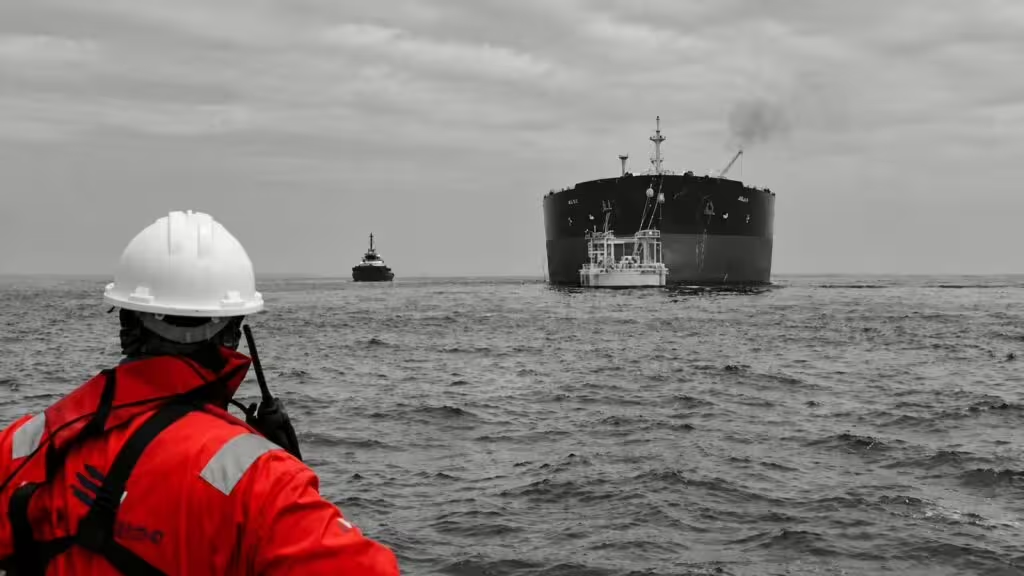
A coordinated Iranian campaign has built over days toward sending oil tankers through the US naval blockade, with warnings that any attack would trigger strikes on energy infrastructure across the Arab Gulf. Foreign Minister Abbas Araghchi told ILNA on Friday the blockade must be broken, adding Iran would do its utmost to export oil while continuing negotiations. No Iranian official has confirmed a convoy exists.
Details:
- The escalation path: The idea moved within days from Revolutionary Guard-linked outlets to parliament and then to Friday sermons in several cities, a sequence Tehran’s top-level decisions often follow before formal announcement. A council answering to the Supreme Leader coordinates Friday sermons nationwide.
- The opening salvo: Fars news agency on Wednesday urged Tehran to announce a tanker convoy officially and warn that any attack on it would bring strikes on regional energy infrastructure, singling out Emirati oil and Dubai’s telecom networks. A later Fars report named the UAE, Saudi Arabia, Qatar, Kuwait, Oman and Bahrain.
- Tanker tracking: TankerTrackers said Thursday Iran appears to be preparing to export again. Co-founder Samir Madani told Reuters a tanker was taking Iranian crude from another vessel in the Gulf, which if it clears the blockade would be the first seaborne crude export since mid-July. Al-Monitor counted more than 14 tankers near Kharg Island, most with trackers disabled.
- The sermons: In Ardabil, prayer leader Hassan Ameli, a member of the Assembly of Experts, said officials had decided to break the blockade and that tankers would soon sail from Kharg to China. He said: “Our armed forces have warned the Americans that if a single bullet is fired at them, all oil centers in the Arab Gulf states will be a legitimate target for Iran.”
- More threats: Tehran preacher Mohammad Javad Haj Ali Akbari said forces were on alert at sea, on land and in the air with orders to act without limits at a time of their choosing. In Khorramabad, Ahmad Reza Shahrokhi urged targeting Gulf rulers’ palaces if an attack came from their territory. In Tabriz, Ahmad Motahari Asl warned Iran had not yet closed Bab al-Mandab.
- The command link: Mostafa Najafi, described by Iranian media as an adviser to Supreme National Security Council secretary Mohsen Rezaei, wrote that the Supreme Leader had ordered an end to the no-war, no-peace condition, that the military option was on the table, and that Tehran would no longer tolerate the blockade.
- The numbers: Reuters, citing Kpler and Vortexa, reported Iran was loading about 2 million barrels per day of crude and condensate in March. By September Kpler logged no loadings at all, the first full month without any since the 1979 revolution. Output fell to roughly 1.8 million bpd, near half its pre-war level.
- The money clock: Chinese refiners typically pay one to two months after delivery, so payments for Iran’s last cargoes are expected by mid-December, Kpler crude analysis head Homayoun Falakshahi told Iran International. After that, Tehran is projected to lose 3 to 6 billion dollars a month.
- The US posture: CENTCOM widened the blockade Wednesday to cover ship-to-ship transfers, saying vessels may be stopped, inspected, diverted, seized or sent back to their Iranian port of origin, and warning non-compliant ships could face force. It reports diverting 150 merchant vessels and disabling five since June.
- Washington waits: President Donald Trump told Axios he is in no rush on Iran and will wait until after the new year, saying Saudi Arabia asked him to leave things as they are because Iran is coming apart. Treasury Secretary Scott Bessent told CNBC the pressure is working. Mossad chief Roman Gofman pressed in Washington last week for renewed joint strikes, per Axios and the Wall Street Journal.
Background:
US forces struck several Iranian tankers near Kharg and Jask in September after the Revolutionary Guard fired missiles at an American warship. The blockade has since cut Iran off from its main source of foreign currency.
Between the lines:
Iran International analyst Ali Hossein Ghazizadeh assessed that Tehran has concluded time is against it: Washington wants the blockade to hold until the state weakens enough to collapse, surrender or face mass protests. He judged Iran can provoke a clash but that a full war would be Washington’s and Israel’s decision. The sermon-to-parliament sequence and the mid-December payment cliff both point the same way.
What’s next
Watch whether tankers actually leave Kharg and whether CENTCOM stops them, the mid-December arrival of Chinese payments, Trump’s post-New Year decision point, and any Iranian confirmation that a convoy exists.