The latest:
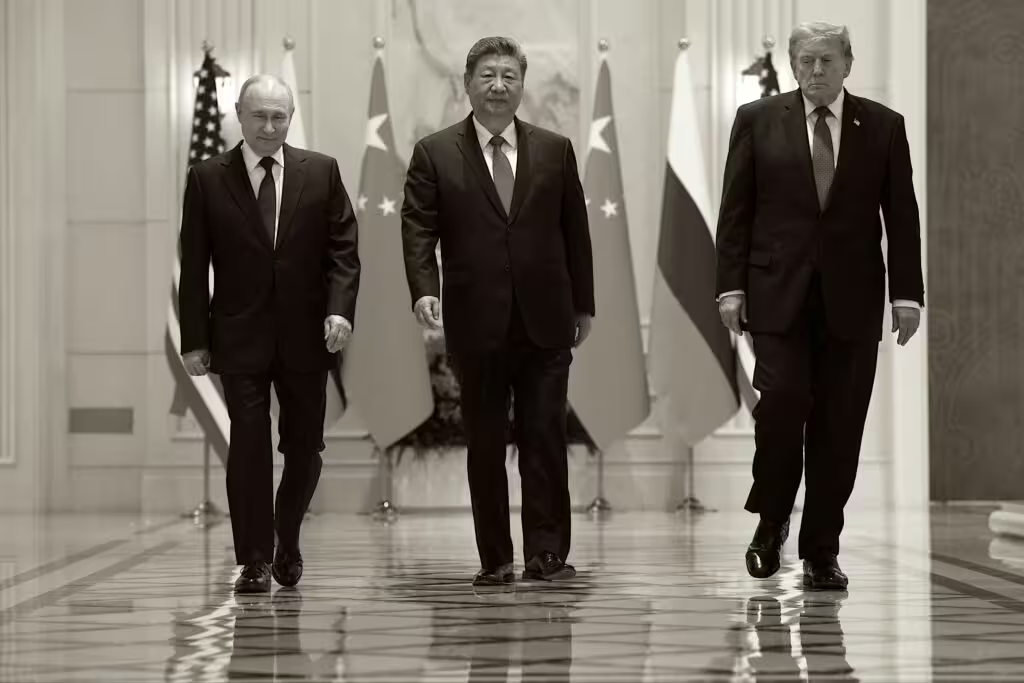
Three leaders who command the world’s largest nuclear arsenals sat around one table for the first time Thursday at a villa in Shenzhen, southern China, closing with agreement on UN reform, a pledge to increase fuel supply to the market, and talk of reducing nuclear risk. The Associated Press reported that no major breakthroughs were reached.
Details:
- The agreements: The Associated Press reported the three agreed on points including United Nations reform and a commitment to increase fuel supplies to the market. The leaders delivered brief opening remarks, took no questions, and issued a short statement that did not mention the wars in Ukraine or Iran.
- Trump’s framing: Trump said the United States, Russia and China are uniquely positioned to discuss reducing the number of nuclear weapons on earth and the risk of their use. According to Reuters, he told the opening session that peace has never been achieved by refusing opportunities to talk.
- Xi and Putin: Xi said the meeting would focus on strengthening global peace, later calling it positive and productive. Putin said the three states share responsibility for preserving international peace and described the talks as open and frank, citing shared interests in settling regional conflicts, including Ukraine.
- The arms-control gap: New START, the last nuclear arms limitation treaty between Russia and the United States, expired in February. Trump has said he wants a new, modern agreement including China. Beijing has less incentive to accept limits: its arsenal exceeds 600 warheads against American and Russian stockpiles above 5,000.
- Analysts’ reading: Daryl Kimball of the Arms Control Association said the meeting could at best begin a process leading to sustained talks on cutting arsenals, and that one meeting is unlikely to produce radical breakthroughs. Craig Singleton of the Foundation for Defense of Democracies said incentives to agree on substance are far weaker than incentives to appear together.
- Hormuz and trade: Trump said both leaders feel strongly that oil must keep flowing through the Strait of Hormuz, disrupted repeatedly by attacks during the Iran war. He signaled he would press Xi to buy more American agricultural products. Xi did not refer directly to Iran in his remarks.
- Taiwan: Xinhua reported that Xi raised Taiwan with Trump and stressed the need to improve communication on economic and trade issues. Reuters reported Xi told Trump the United States must “do the right thing” to avoid major setbacks in bilateral relations.
- The ICC clause: In a joint statement, the three criticized the International Criminal Court, saying state officials should enjoy immunity from its prosecutions and warning against abuse of its jurisdiction. Putin is wanted by the court, and the Trump administration has sanctioned ICC officials and the institution itself.
- Signs of friction: Chinese officials barred Bloomberg correspondent Annmarie Hordern from the trilateral meeting after she asked a question during the earlier Trump-Xi session. Chinese television aired footage of Trump appearing drowsy, while the White House posted a clip of him helping Xi onto an escalator.
- Putin’s position: Putin arrived after a setback in his war on Ukraine following the disabling of a key bridge linking Crimea to Russia. Japan and Taiwan reported Russian military aircraft incursions this week. Trump has declined to impose new sanctions on Moscow.
Background:
Xi hosted Putin at the APEC summit a day earlier, calling him an old friend; Putin called Xi a dear friend. China has provided economic support to Russia since the 2022 invasion of Ukraine, offering a financial lifeline after Western sanctions.
Between the lines:
The gap between rhetoric and output is the story: historic framing, but a joint statement silent on Ukraine and Iran, and no arms-control mechanism named. The ICC language is the one place where all three found concrete common interest, and it aligns with Putin’s outstanding warrant and Washington’s sanctions campaign. Negotiating without Ukraine or European and Asian allies at the table is what worries smaller states.
What’s next
Watch whether the fuel-supply pledge produces measurable volumes, whether any successor framework to New START is proposed, and the Trump-Xi meeting scheduled at the G20 summit in Florida in December.