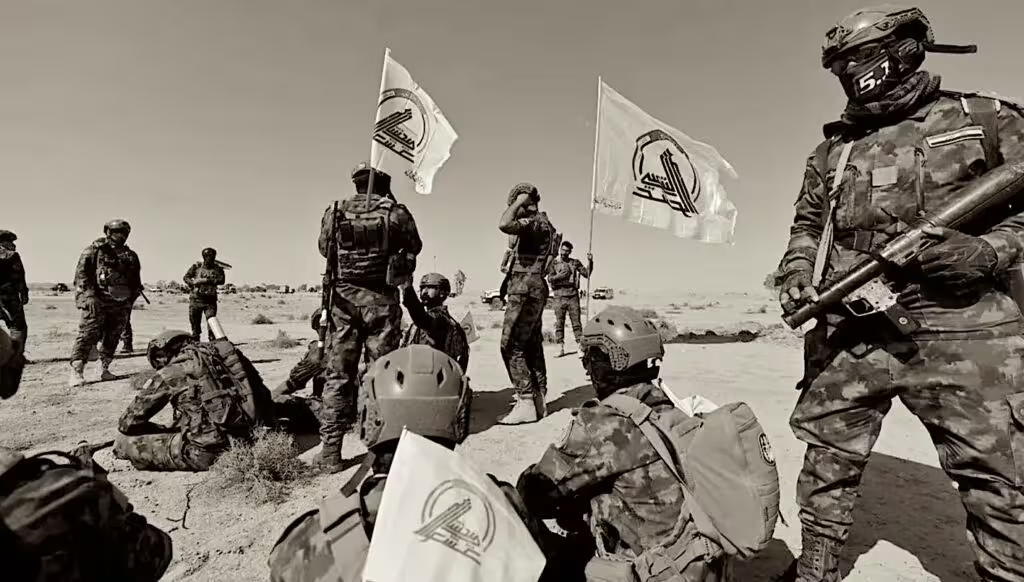
Roughly 42 non-Iraqi commanders, among them about 19 Houthis, were moved out of Jurf al-Sakhar south of Baghdad as the government’s withdrawal deadline for Kataib Hezbollah neared, sources told ontime+. The movement was coordinated with Iran’s Quds Force. Publicly, Baghdad has opened an investigation into suspected oil smuggling and announced its forces will enter the area.
Details:
- The numbers: Sources told ontime+ that about 42 non-Iraqi commanders were moved out, and put the number who left at roughly 32 — among them about 19 Houthis, four Lebanese, two volunteers from a Gulf state, and Iranians linked to the Revolutionary Guard and the Quds Force.
- The reasoning: An Iraqi security source concluded that the factions began extracting non-Iraqi commanders after judging that their threats and their influence inside the government might not be enough to stop Iraqi forces from entering the area.
- The route: The security source said an intelligence cell reporting directly to the prime minister’s office cross-checked information that Iranian commanders slipped from Jurf al-Sakhar to the residence of an influential Coordination Framework member, who secured their passage toward the Iranian border via Diyala, with trucks carrying heavy equipment seen heading the same way.
- The standoff: Kataib Hezbollah has threatened to confront government forces if they enter Jurf al-Sakhar and denied any involvement in oil smuggling. Quds Force commander Esmail Qaani arrived in Baghdad to take part in mediation, according to Kataib Hezbollah officials who spoke to The Associated Press.
- The oil file: During a press tour this week, a Kataib Hezbollah official acknowledged two oil refining facilities in the area and said the fuel runs the group’s vehicles and generators. A member of the parliamentary investigation committee said thermal imaging showed 25 tanks, each with a capacity of 36,000 liters.
- The displaced: Iraqi forces and armed factions retook Jurf al-Sakhar from ISIS in October 2014, and residents were displaced afterward. Amnesty International documented testimony in a 2016 report from residents who said gunmen forced them out, and said the controlling factions, led by Kataib Hezbollah, barred the mostly Sunni population from returning.
- No returns: In January 2019, a Human Rights Watch researcher reported that no returns to Jurf al-Sakhar had been recorded up to that point. More than a decade after the battle, Kataib Hezbollah still maintains an armed presence there.
- The deadline: An Iraqi source said Coordination Framework lawmakers intend to request a visit under the banner of a final mediation and may ask for an extension. A source in the prime minister’s office told ontime+ on the evening of November 18 that talks had stalled and that Prime Minister Ali al-Zaidi refused to extend the deadline, which expires Friday night.
- The dissent: US analyst Michael P. Pregent argued the operation is a handover between Iran-aligned forces presented as Iraqi sovereignty, pointing to the negotiators: Badr Organization leader Hadi al-Amiri, Kataib Hezbollah commander Abu Fadak, and the Quds Force chief. He said what matters is who commands the troops entering and who controls the ground afterward.
Between the lines:
The extraction of foreign commanders cuts against Kataib Hezbollah’s public threat to fight. Removing Houthi, Lebanese and Iranian personnel ahead of the deadline reduces what Iraqi investigators could find on the ground, and narrows the dispute to the two refining facilities and the 25 tanks cited by the parliamentary committee rather than to who was based there.
What’s next
The withdrawal deadline expires Friday night. Watch whether Coordination Framework lawmakers secure an extension, whether Iraqi forces enter, and whether investigators are allowed to inspect the two refining facilities.