Key Points
- Ankara asked lawmakers to ratify the Mecca Joint Defense Agreement signed with Saudi Arabia and Pakistan.
- The 16-article text mirrors NATO's Article 5 and blocks withdrawal for a decade.
- Ratification moves Turkey closer to backing Saudi defenses against Houthi attacks, short of troop deployment.
The latest:
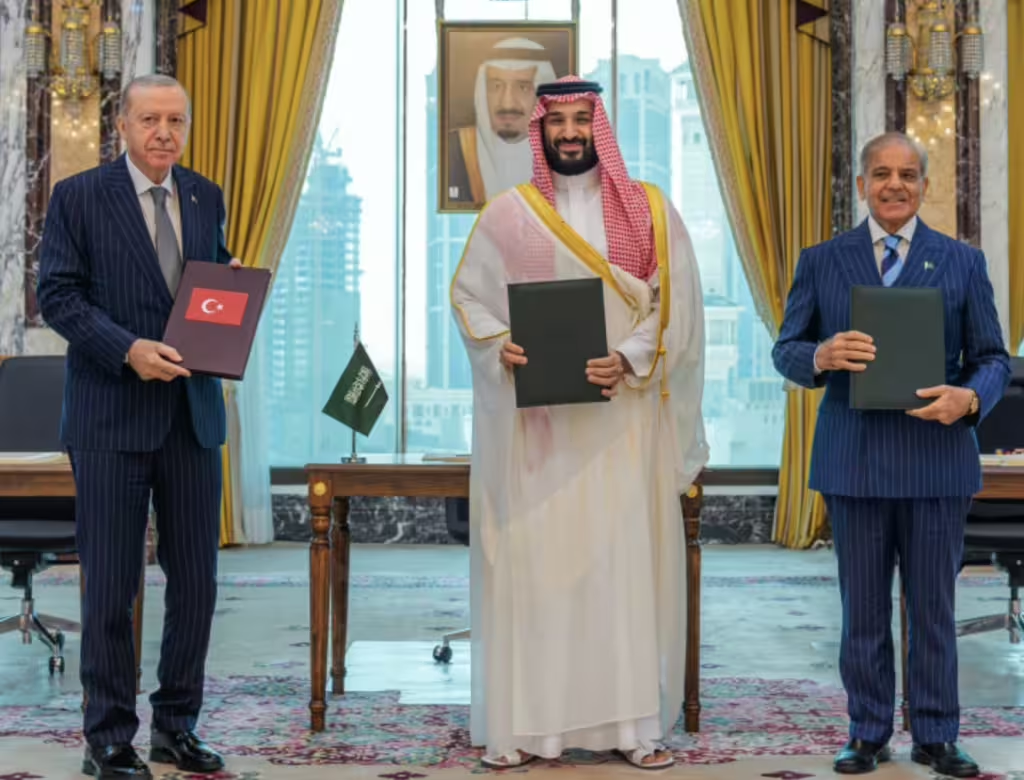
The text of a mutual defense pact binding Turkey, Saudi Arabia and Pakistan became public on Tuesday when Ankara submitted it to parliament for ratification, according to The Associated Press. Signed in Mecca in August, the agreement treats an armed attack on one signatory as an attack on all three. Turkish officials say it is defensive and will not send troops to fight in Yemen.
Details:
- The signatories: Saudi Crown Prince Mohammed bin Salman, Turkish President Recep Tayyip Erdogan and Pakistani Prime Minister Shehbaz Sharif signed the accord in the Saudi holy city in August, AP reported. It binds oil-rich Saudi Arabia, nuclear-armed Pakistan and Turkey, which fields NATO’s second-largest army.
- The 10-year clause: The 16-article text, published by Turkish state broadcaster TRT, bars any party from withdrawing for 10 years, after which a three-month notice is required. AP described the lock-in as a surprise in a pact whose contents were largely unknown before Tuesday.
- What it covers: Beyond mutual defense in line with the UN Charter’s right of self-defense, the accord opens the way to joint training, exercises and personnel exchanges. It also allows defense-industry cooperation, including joint weapons production, technology transfers and intelligence sharing.
- The Turkish position: Foreign Minister Hakan Fidan said Turkey and Pakistan are assessing air defense, electronic warfare and technical assistance for Riyadh. Answering opposition warnings that Turkey could be pulled into Yemen, he said: “Turkey will not be sending troops into another country’s territory to carry out an attack.”
- The Iran question: Turkish and Pakistani officials have insisted the pact is not directed at Iran or any other state, AP reported. Neither side has said how the three countries would respond if one of them came under Iranian attack.
- The Pakistani role: Islamabad has not sought parliamentary endorsement, but officials say the government backs the pact and that Pakistan would supply whatever military help the kingdom needs. Authorities declined to disclose deployment details, citing operational confidentiality, while stressing the role would be strictly defensive.
- The denial: Pakistan’s Information Ministry dismissed as speculative reports claiming 30,000 to 40,000 Pakistani troops had already been sent to Saudi Arabia. Pakistani soldiers have been stationed in the kingdom since the early 1980s to train and advise Saudi forces, in numbers never specified.
- The Saudi comment: Riyadh has said little publicly since the Houthi attacks. After a visit by Pakistan’s army chief, Defense Minister Khalid bin Salman wrote on X that the kingdom affirmed its commitment to continuing joint efforts to confront the attacks under the Mecca agreement.
- The machinery: The three states have created a Strategic Political and Defense Committee of foreign ministers, defense ministers and chiefs of staff, expected to meet twice a year. The secretariat will sit in Saudi Arabia, led by retired Pakistani Gen. Nauman Mahmood for a three-year term.
- The escalation: At an emergency meeting in Riyadh earlier this month, the three agreed to immediately implement their collective defense commitments, including arrangements for rapid deployment of agreed military forces and capabilities to Saudi Arabia. They gave no further detail.
Background:
Pakistan and Saudi Arabia signed a separate bilateral mutual defense agreement in September 2025. Pakistani Foreign Minister Ishaq Dar has said the Mecca accord does not replace existing arrangements and remains open to other countries willing to uphold its principles and settle disputes peacefully.
Between the lines:
The pact’s architecture points to durability rather than crisis response: a decade-long exit ban, a permanent secretariat in Saudi Arabia and a ministerial committee meeting twice yearly. AP frames it as three regional heavyweights assuming greater charge of their own security as US involvement narrows. The unanswered Iran question, and the refusal to specify assistance, keeps deterrence deliberately ambiguous.
What’s next
A Turkish parliamentary committee is expected to review the agreement in the coming days before the general assembly votes. Any deployment of Turkish personnel would require a separate parliamentary authorization.