Key Points
- Researcher Louis Shadwick says every oil Edward Hopper painted before art school copies another artist's published work.
- Most sources were colour plates in Art Interchange, a periodical that printed step-by-step copying instructions for amateurs.
- The finding removes Hopper's supposed boyhood Nyack landscapes and dates his first original oil to art school.
The latest:
Every oil painting Edward Hopper made before enrolling in art school was copied from another artist’s work, according to art historian Louis Shadwick, whose new biography traces each one to a published source. Shadwick writes that the canvases long celebrated as Hopper’s first original compositions reproduce plates from illustrated periodicals, and that Hopper may not have painted an original oil until the autumn of 1900.
Details:
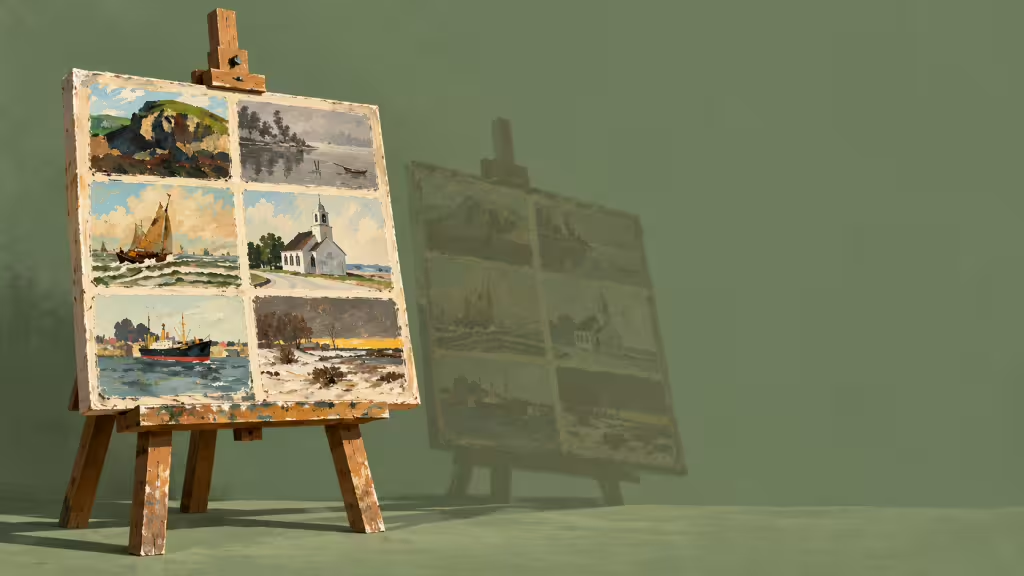
- The works: Shadwick identifies six early oils, all left in the attic of the family home in Nyack and unseen for decades. They were discovered in the late 1960s alongside unseen drawings and watercolours, and exhibited after Hopper’s death as his first original compositions in oil.
- The ice pond: Old Ice Pond at Nyack, dated around 1898-1900, has been cited as evidence of Hopper’s early attachment to the American scene and his interest in sunlight as mood. Shadwick says it copies A Winter Sunset by tonalist painter Bruce Crane.
- The first oil: Rowboat in Rocky Cove, signed and dated 1895 and long treated as Hopper’s first oil, copies a watercolour titled Lake View by an unidentified painter, Shadwick says. It is inscribed Athelstane, which he says may point to a Wisconsin lake or the unknown artist’s signature.
- The source: Both plates ran in the Art Interchange, a widely read magazine for amateur artists: Crane’s in December 1890, Lake View in February 1891. Each came with full copying instructions. The guidance for Lake View called it “a very simple subject and well adapted to beginners”.
- More matches: Country Road, around 1896, copies A Landscape Study in Color by American tonalist John Francis Murphy, reproduced in the Art Interchange on 27 March 1886. Ships, around 1898, copies Edward Moran’s Marine View from the magazine’s mid-August 1886 issue.
- The unsourced one: Church and Landscape, first titled Winter Scene and once described as a snowy Nyack Baptist church, is also a copy, Shadwick says. Its original remains unidentified, but two 1893 paintings of the same scene by Edgar Barnes Gilson and a Victorian porcelain plaque confirm the status.
- New attribution: A previously uncatalogued painting titled Clipper Ship Being Towed by Tug, dated around 1900, copies Fred Pansing’s Stormy Voyage, published as a lithograph in the New York Recorder art supplement on 7 May 1893. Shadwick says it may predate the 1895 rowboat, though its exact date cannot be established.
- The titles: Neither Nyack title came from Hopper. Both were assigned by Reverend Arthayer R. Sanborn, the paintings’ first owner, shortly after the artist’s death. Sanborn also named the rowboat picture Rowboat on Hudson. The Nyack associations outlived the later retitling and shaped decades of writing.
- The signatures: Hopper signed the works E.H. or E. Hopper with no indication they were copies; only Church and Landscape is unsigned. Shadwick reads this as youthful pride in work never meant for public view rather than any attempt to mislead.
Background:
Hopper converted the attic of the Nyack family home into a studio at about 13, moving from watercolours to oils. He entered the New York School of Art in autumn 1900, where students were encouraged to copy other artists.
Between the lines:
Shadwick argues the copies dismantle two durable claims: that Hopper’s talent emerged in adolescence with virtually no instruction, and that he met American art movements only at art school. The repeated use of Art Interchange plates from 1886 onward suggests the household subscribed for years. The pattern also ties Hopper early to American tonalism, the Crane and Murphy style dominant around 1900.
What’s next
Edward Hopper: A Life by Louis Shadwick was published in the US by Yale University Press on 13 October, with UK publication set for 24 November. Responses from Hopper collections holding the reattributed early oils are the next signal.