Key Points
- Hundreds queued in Hong Kong Tuesday to see a Van Gogh unexhibited publicly for over 60 years.
- Chestnut Trees in Blossom was painted in May 1890, weeks before the artist's death at 37.
- Sotheby's expects about $180 million on November 18, a potential auction record for Van Gogh.
The latest:
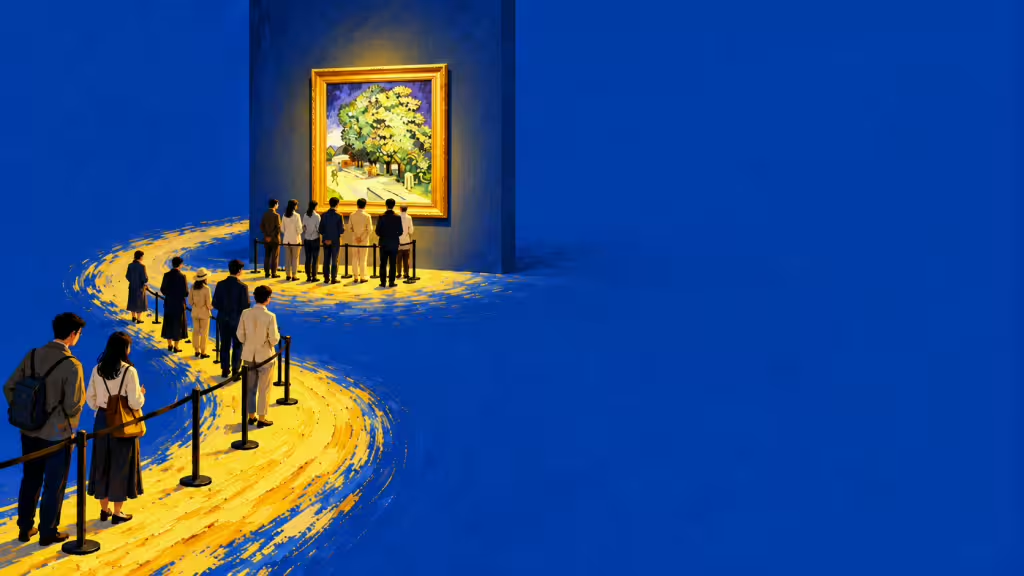
Hundreds of people lined up in Hong Kong on Tuesday for a first look at Vincent van Gogh’s Chestnut Trees in Blossom, a canvas that has not been publicly exhibited in more than six decades, Reuters reported. Sotheby’s expects the work to fetch roughly $180 million when it goes under the hammer in New York on November 18, and says it is positioned to break the auction record for the artist.
Details:
- The painting: Chataigniers en fleurs, or Chestnut Trees in Blossom, was painted in May 1890 in the French village of Auvers-sur-Oise, where Van Gogh died about two months later at 37. It depicts a massive blossoming chestnut tree whose flowering canopy dominates the composition.
- The estimate: Sotheby’s values the work at about $180 million for the November 18 sale in New York. Scott Niichel, of the house’s modern and contemporary art department in New York, said the painting is poised to set a new auction record for a Van Gogh.
- The pitch: Niichel described the period the canvas belongs to as “a moment of extraordinary optimism, frenetic energy, enthusiasm, passion, and colour in the artist’s body of work.” The Auvers-sur-Oise works followed his release from a psychiatric asylum in Saint-Remy-de-Provence.
- Why it is rare: Paintings from the final Auvers period seldom reach the market, and Reuters reported the sale will draw collectors, museums and investors alike. The canvas has stayed out of public view for more than 60 years, making Tuesday’s Hong Kong preview the first chance for most visitors to see it.
- The crowd: Li Shanshan, a 50-year-old art lover, travelled about two and a half hours from the southern city of Shenzhen to attend. She said she had never heard of the painting before and wanted to see it with her own eyes.
- The wider sale: The Van Gogh is part of a group of 12 long-unseen works going to auction, including pieces by Paul Cezanne and Claude Monet. Five were unveiled at Sotheby’s in London in late September, among them Cezanne’s Arlequin and Monet’s Le Jardin des Tuileries.
- Early ownership: After Van Gogh’s death in July 1890 the painting passed to his brother Theo, then to Theo’s widow Johanna van Gogh-Bonger and their son Vincent Willem. It later belonged to German publisher Samuel Fischer, founder of S. Fischer Verlag.
- Later hands: It then entered the collection of George Buddy DeSylva, the American songwriter, film producer and Capitol Records co-founder. In 1953 collector Harriet Harris-Jonas acquired it; her holdings prompted New York’s Metropolitan Museum of Art to organise patron visits to her Fifth Avenue apartment.
- Current owners: The Blaquier family acquired the painting from art dealer Wildenstein in 1975. Sotheby’s did not disclose a reserve price or the terms under which the family is selling.
Background:
Van Gogh spent his final months in Auvers-sur-Oise after leaving a psychiatric asylum in Saint-Remy-de-Provence, producing a burst of work in the weeks before his death in July 1890. Canvases from that period are among the scarcest in his output.
Between the lines:
The $180 million estimate makes the November sale a read on the top of the art market. Sotheby’s is leaning on scarcity: a final-period Auvers canvas, unseen publicly for 60 years, with an ownership chain running through a German publisher, a Capitol Records co-founder and a Fifth Avenue collection. Reuters noted collectors have kept competing for trophy works despite broader economic uncertainty.
What’s next
The November 18 New York sale is the test. Watch whether the hammer price clears the $180 million estimate and beats the existing Van Gogh auction record, and how the remaining works in the 12-piece group perform.