Key Points
- Security firm XBOW says AI agents helped build a working three-bug Chrome exploit chain in six days.
- Google paid 250,000 dollars, described as its first award under 2026 bounty rules; all three bugs are patched.
- Compute cost 40,000 dollars on a publicly available model, putting browser exploitation within reach of a budget.
The latest:
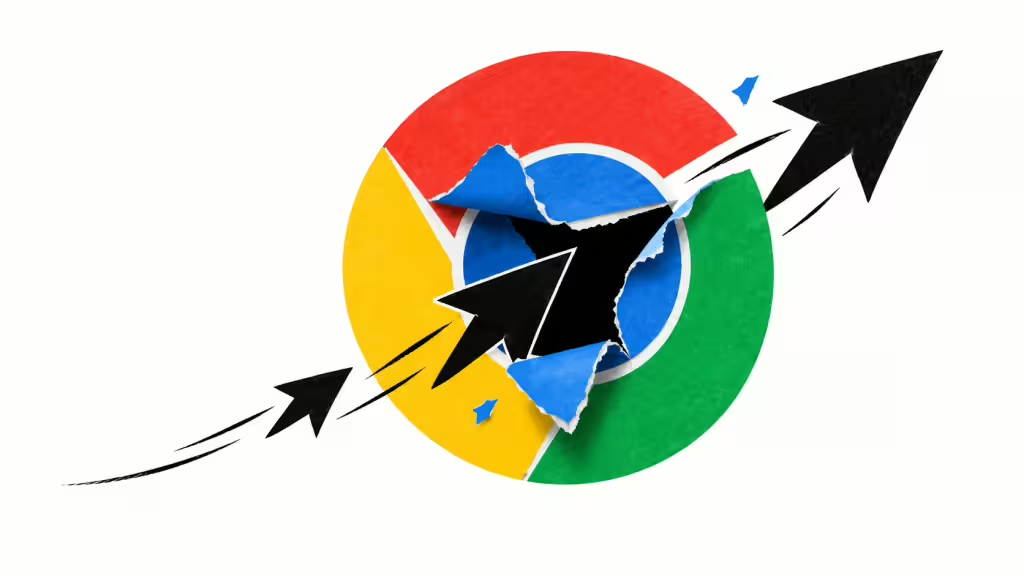
A three-bug exploit chain against Chrome, a browser XBOW estimates is used by about a billion people worldwide, was assembled in six days with AI agents doing the code search and the first drafts, the security company said in an October 13, 2026 post. Google paid 250,000 dollars for the work, which XBOW described as the first award under the company’s new 2026 bounty rules.
Details:
- The timeline: XBOW said the project started at a company-wide meeting in Malta in early 2026, with Black Hat in August as the target. After Google said it already knew about one of the bugs in the original chain, researcher Brendan Dolan-Gavitt built the replacement exploit in Las Vegas between Sunday, August 2 and Friday, August 7, 2026.
- The model: The company said it used GPT-5.6 Sol from OpenAI and earlier versions, and deliberately chose a publicly available model rather than a specialized or restricted one. That choice is the core of XBOW’s claim: the capability is not gated behind privileged access to frontier tooling.
- The cost: Compute for the winning six-day chain came to 40,000 dollars, by XBOW’s accounting. Set against a 250,000 dollar payout, the economics of browser exploitation shift from a scarce specialist skill measured in months to a budgeted expense measured in days.
- The division of labor: Humans set strategy, chose where to search, reviewed the agents’ output and redirected them based on early results, XBOW said, naming Dolan-Gavitt, Andres Luxenberg, Paul Lee and Willem Pinckaers. The AI searched Chrome source code, tested ideas, built proof-of-concept demos and wrote first drafts of the exploit.
- The architecture: The chain was built as three independent parts, each with a backup alternative. XBOW said that design is what allowed the team to swap in a spare vulnerability once Google indicated one of the originals had already been reported, rather than restarting the whole effort.
- What is withheld: XBOW did not publish CVE identifiers, bug classes or affected Chrome version numbers, pointing readers to a companion post for technical detail. The company said all three vulnerabilities have been fixed, and did not date either the patches or the bounty, placing it only earlier this year.
- The claim: XBOW framed the result as a turning point for defense, saying that “for the first time ever, defenders have access to the skills of attackers at the click of a button.” Google issued no direct comment in the post.
- The user advice: The company urged users to update Chrome and relaunch it when an update is available, noting that a fix takes effect only once the browser is restarted. Its advice to software makers was blunter: test your own code for vulnerabilities before attackers do.
Background:
Google runs one of the industry’s largest bug bounty programs, with browser exploit chains among the highest-paid categories. XBOW said its 250,000 dollar award was the first granted under rules Google introduced for 2026.
Between the lines:
The six days and 40,000 dollars matter more than the three bugs. XBOW’s own account has humans picking targets and reviewing output, so this is not autonomous hacking — but the expensive, scarce part, reading a vast codebase and drafting working exploits, was handled by a model anyone can buy. The same arithmetic that favors defenders testing their software favors whoever reaches it first.
What’s next
Watch whether Google or other browser makers disclose the CVEs and affected Chrome versions, whether XBOW’s companion technical post names them, and whether further 2026 bounty awards at this tier follow.