The latest:
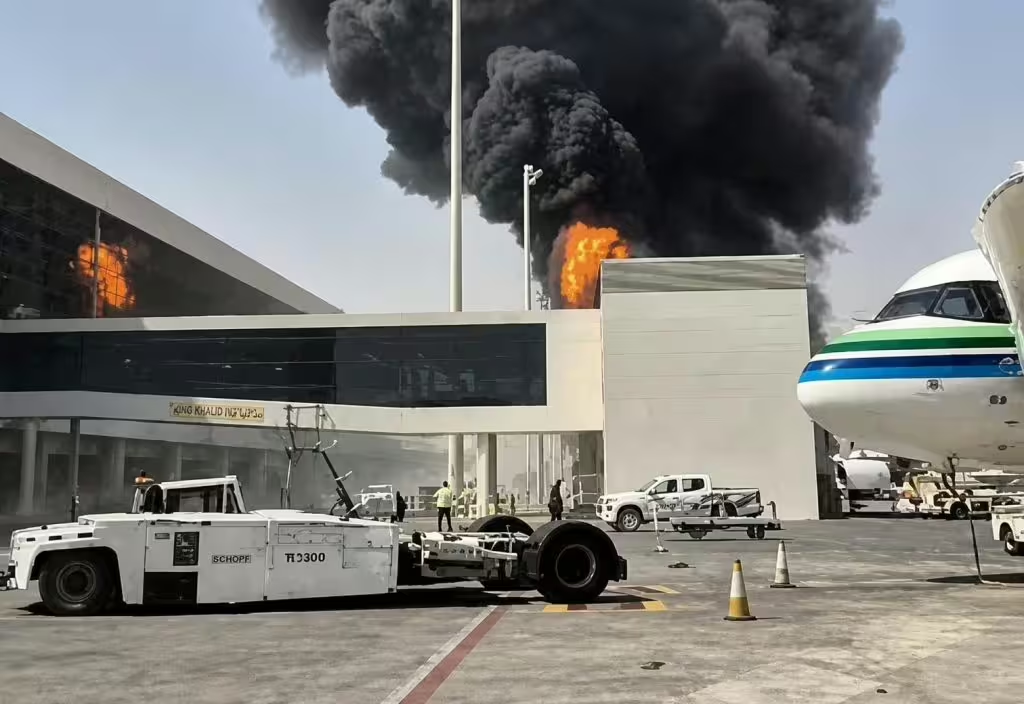
Three missile and drone attacks on Riyadh’s King Khalid International Airport in a single week have killed at least 14 people and wounded at least 320, Reuters reported, with the deadliest strike landing Saturday as pilgrims in white ihram robes queued to board. Saudi authorities have opened an investigation into the failure of air defenses over one of the kingdom’s most protected zones, the Associated Press reported.
Details:
- The deadliest strike: The Times reported that Saturday’s missile hit as Muslim pilgrims lined up at the airport, killing 13 including a prominent Bangladeshi cleric. No missile alert sounded beforehand. The footage spread across the Islamic world and sharpened scrutiny of the kingdom’s ability to protect a facility central to its image.
- The sequence: According to The Times, Thursday’s strike destroyed a passenger aircraft on the tarmac and killed a pilot and two others. Days earlier, another attack killed one person at the same airport.
- The defense failure: Two regional officials told the Associated Press that a preliminary investigation found the Houthis launched several drones first, clearing the way for cruise and ballistic missiles, some able to maneuver and evade Patriot interceptors. One said the inquiry is also examining why there was no early warning, given the projectiles covered more than 1,000 kilometers. Both spoke anonymously.
- The escalation trigger: The Times reported that the current round began with a Saudi airstrike in June on a Houthi-controlled airport to block an Iran-backed aircraft from landing, intended as a display of dominance over Yemen. The two sides had signed a 2022 ceasefire ending seven years of war.
- The Houthi counter: After the June strike the Houthis began targeting Saudi oil tankers and, with Iraqi allies, a pipeline carrying millions of barrels from the Gulf to the Red Sea, The Times reported. Iran had been pressing them to close Bab al-Mandab as its leverage over Hormuz weakened.
- Ground losses: With Emirati forces gone, including Apache helicopters and the Mokha command center, the Houthis seized Mokha and the adjacent Bab al-Mandab strait last month, according to The Times. Saudi-backed government forces launched a counter-offensive last week to retake the lost territory.
- Riyadh disrupted: Companies at the King Abdullah Financial District told staff to work remotely, employees said on condition of anonymity. Riyadh authorities moved schools to remote learning this week. International carriers canceled flights and Britain warned citizens against flying to the capital.
- The airport status: Saudi Arabia’s General Authority of Civil Aviation gave no date Monday for resuming operations at King Khalid airport, Reuters reported. After earlier attacks, the authority had moved quickly to reopen the facility each time.
- Tehran’s offer: Iranian foreign ministry spokesman Esmail Baqaei said Iran is deeply concerned about the Arabian Peninsula and has declared its readiness to mediate between the two sides “many times,” according to the Associated Press.
Background:
The Houthis, who call themselves Ansar Allah, control large parts of Yemen including Sanaa. The Times reported the group has built commercial ties with al-Qaeda in Somalia and operates as an Iranian foothold overlooking the Red Sea.
Between the lines:
The Times argues the kingdom is caught between two bitter options. Seeking peace with rebels emboldened by the capture of Mokha, alongside a wider deal with Iran, would cost Riyadh its deterrent credibility and, it believes, only postpone the next round. Pressing the offensive, perhaps with Washington, risks the foreign investment the kingdom has courted while building Riyadh airport into a regional hub.
What’s next
Watch for the civil aviation authority to set a reopening date for King Khalid airport, the findings of the air defense investigation, and whether Saudi-backed forces advance toward Mokha or Riyadh engages Iran’s mediation offer.