Key Points
- A tanker near Qatar was hit Wednesday night and Houthi missiles struck Riyadh's airport Thursday.
- Brent settled at $104.27 a barrel, up 4.1%, with WTI also up 4.1% to $91.87.
- Analysts say Tehran is escalating selectively to force a diplomatic settlement without a full war.
The latest:
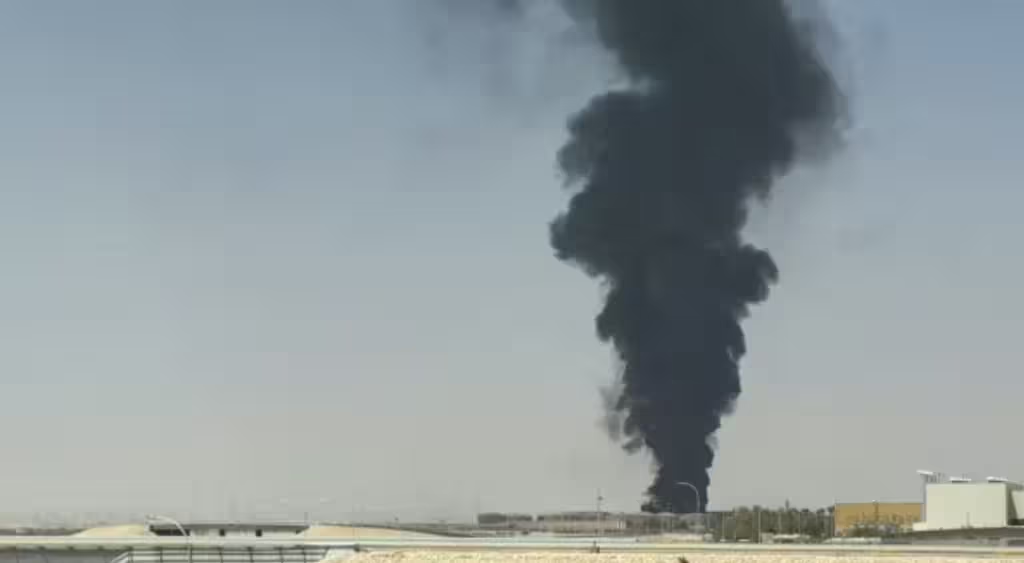
An oil and chemical tanker was struck by several projectiles near Qatar late Wednesday, causing casualties, according to maritime intelligence firm Vanguard and the U.K. Maritime Trade Operations agency. No one claimed responsibility, but regional officials said Iran was likely behind it. Hours later, Houthi missiles damaged aircraft at Riyadh’s King Khalid International Airport, the third straight day of strikes on the Saudi capital.
Details:
- The market reaction: Brent crude, the international benchmark, settled at $104.27 a barrel, up 4.1%, while WTI rose 4.1% to $91.87, The Wall Street Journal reported. Surging energy prices weighed on equities and Treasury yields, extending the impact well beyond the shipping lanes themselves.
- The airport damage: At least two aircraft were struck at King Khalid International Airport on Thursday. An empty commercial plane at Terminal 4, which handles domestic flights, was hit in the afternoon, and dozens of incoming flights were canceled or diverted. Falling debris from an intercepted ballistic missile hit a kindergarten and a medical-clinic complex.
- The Houthi claim: Military spokesman Yahya Sare’e said the airport had been hit by one ballistic missile and two cruise missiles. The Saudi-led coalition said it shot down two ballistic missiles Thursday. It was at least the third time the airport had been targeted since Tuesday.
- Inside the city: Residents across Riyadh said they heard at least five large explosions Thursday morning but received no phone alerts from authorities. Workers in the financial district, students at some international schools and diplomats were ordered to evacuate or shelter in place, several in windowless rooms, according to a mother who spoke to parents at several schools.
- Trump’s position: Trump said Thursday the United States will not attack Iran before next month’s midterm elections, citing productive talks with Tehran, in a Truth Social post. He has declined Saudi requests for direct U.S. military help against the Houthis, though the Pentagon is providing intelligence and other support.
- The Saudi response: The Houthis said Saudi aircraft carried out several airstrikes across areas they control, including telecommunications networks in San’a, Hodeidah airport and Ibb, causing several casualties. Houthi leader Abdul Malik al-Houthi said in a televised speech that Saudi Arabia’s government cannot achieve its objectives of controlling Yemen.
- Aviation warnings: The Houthis have repeatedly warned all international airlines using Saudi airspace to halt flights, excluding those over Mecca and Medina. The European Union Aviation Safety Agency told carriers that recurrent missile and drone attacks, combined with air-defense activation, raise the risk of civil aircraft being misidentified.
- Export workarounds: Gulf producers have leaned on U.S.-protected tanker movements, ship-to-ship transfers outside Hormuz and pipelines bypassing the strait. Saudi Arabia resumed exports from both its Gulf and Red Sea coasts after repairing part of the damage to its East-West pipeline from an attack last month.
- Information controls: Saudi authorities have warned the public since Tuesday that filming and sharing images of drone and missile attacks, or of interceptions, could bring legal charges. No casualty figure from Thursday’s strikes on the capital was announced.
Background:
Houthi strikes inside the kingdom intensified after Riyadh launched a campaign to retake Houthi-held territory in Yemen that threatened Saudi shipping through Bab al-Mandeb. Attacks on Riyadh, more than 500 miles north of the fighting, have become a daily occurrence.
Between the lines:
Analysts cited by the Journal assess that Tehran is calibrating: enough pressure on Hormuz shipping to lift oil prices and squeeze Washington before the midterms, but short of the full confrontation Iran doubts it can win. Andreas Krieg of King’s College London said neither side has abandoned diplomacy, which is what makes the moment dangerous. The Houthis, armed and trained by Tehran, appear markedly less cautious than their backers.
What’s next
Watch whether U.S. officials move off their deferral on operations against Iran, whether airlines suspend Saudi routes after the EU aviation warning, and whether Brent holds above $100 as attacks on Riyadh enter a fourth day.