The latest:
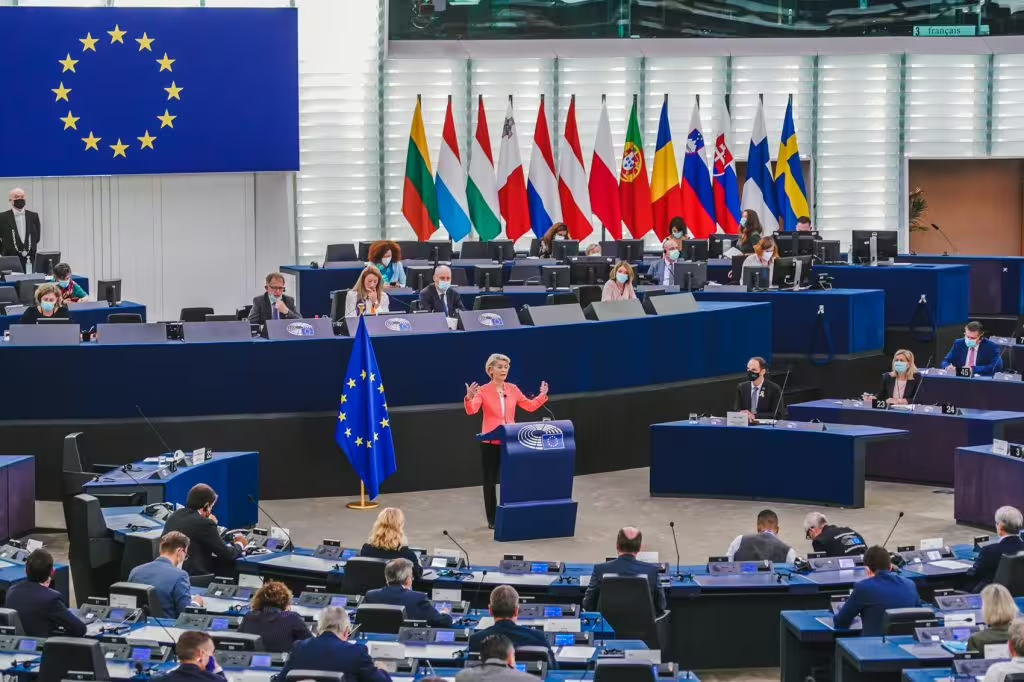
A European Parliament resolution calling for a unified EU strategy against Muslim Brotherhood networks passed in Strasbourg on Thursday by 381 votes to 167, with 15 abstentions. Tabled by the centre-right European People’s Party, the non-binding text asks EU institutions to trace European money paid to Islamist entities, map cross-border structures and assess whether linked individuals and groups should be placed on the bloc’s terrorism list.
Details:
- What it demands: The resolution, titled the need for a European strategy to counter the infiltration of extremist groups and the influence of the Brotherhood network, calls for common EU monitoring tools rather than leaving assessments to each member state, and seeks tighter scrutiny of entities suspected of links to the group.
- The funding track: The EPP said a main aim is tracing the path of European funds paid to Islamist entities and halting any financing for them. The text also calls for FEMYSO, the Forum of European Muslim Youth and Student Organisations, described as close to the Brotherhood, to be permanently excluded from EU institutions.
- The objection: The radical left, Greens and Socialists and Democrats said in advance they would not support the text, arguing part of it carries Islamophobic overtones. French Green MEP Melissa Camara attacked its placement on the agenda at the initiative of the right and far right, saying it only let those currents air hostility toward Islam and foreigners.
- The rapporteur: Celine Imart, who drafted the resolution, told Wednesday’s debate that Islamist infiltration does not always begin with the noise of weapons but with “a smile, a carefully coordinated tie, and the language of human rights twisted out of context.”
- The Commission line: EU Home Affairs and Migration Commissioner Magnus Brunner told the same debate that the terrorist threat tied to Islamist extremism in Europe has in recent years been linked to jihadist actors and ideas, including movements such as the Brotherhood. The Austrian official added that member states’ views diverge, even as the Commission takes the concerns seriously.
- Legal limits: The vote does not itself place the Brotherhood or affiliated bodies on the European terrorism list, and carries no binding force. It functions as political pressure on EU institutions and member states to act within a more unified framework, leaving any listing to later files meeting legal criteria.
- The French push: France drove the file toward Brussels. Its National Assembly adopted a non-binding resolution in January 2026 urging that the Brotherhood and its leaders be added to the EU terrorism list, after the assembly’s European affairs committee cited the networks’ cross-border character. The French interior ministry published a report on political Islam in May 2025 warning of infiltration attempts from the ground up.
- The American track: Washington designated the Brotherhood in Egypt a Specially Designated Global Terrorist in January 2026, a step Cairo welcomed. Egypt’s foreign ministry said the designation matches a position held since after 30 June 2013, when it classified the group as a terrorist organisation.
- State-level move: The European Observatory for Combating Extremism said on Wednesday that Florida designated the Brotherhood and the Council on American-Islamic Relations, alongside another body, as domestic terrorist organisations on 29 September, barring them from state and local funding and cancelling scholarships benefiting affiliated schools.
- The EU list: In February 2026 the Council of the European Union broadened the criteria for its terrorism list to cover leaders of listed groups and people and entities tied to terrorist acts through financing, training or recruitment, but left the list itself unchanged in that review.
Background:
Egypt began legal action against the Brotherhood in 2013, banning its activity and closing its premises, then listing the group and affiliated entities as terrorist entities through subsequent judicial rulings, with official Egyptian records showing those listings continued in later years.
Between the lines:
Analysts told Sky News Arabia the resolution’s near-term effect lies less in any listing than in scrutiny: funding sources, associations’ ties to European institutions, and links between entities. French academic Franck Fernelle said the group operates through a decentralised structure of mosques, schools and community organisations, and that member states diverge sharply, with Austria and France tougher and Britain and Belgium more permissive, precisely the gap the text targets.
What’s next
Watch whether the Commission and member states convert the non-binding text into proposals, and whether national intelligence and financial files from France, Germany and Austria are assembled into a listing request meeting EU legal criteria.