
Key Points
- The Army trialed its Next Generation Command and Control gear during a live-fire exercise in Sumatra.
- More than 80 companies supply NGC2 technology, with Army-wide rollout not expected until 2032.
- The system aims to cut targeting time from hours to minutes against drone-era threats.
The latest:
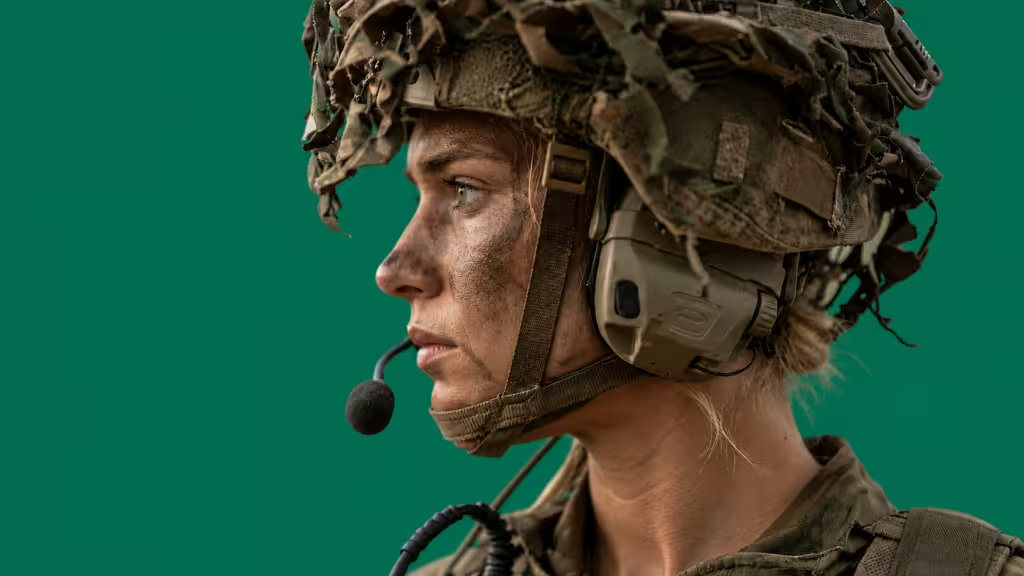
Chest-strapped smartphones, Wi-Fi-capable radios and satellite terminals replaced paper maps and tent-sized command posts as US soldiers assaulted a trench in Baturaja, Indonesia, in the first full field test of the Army’s Next Generation Command and Control package in jungle conditions. Army officials said the terrain resembles what troops could face in a Pacific conflict. One lieutenant’s radio dropped out mid-breach.
Details:
- The gear: The Wall Street Journal reported that troops wore smartphones displaying real-time unit locations and carried radios linked into a mobile network, converting voices into digital signals routed through headsets. A drone surveyed the terrain beforehand.
- The failure: First Lt. Diego Gonzalez lost contact with his commander as his unit breached the trench, relying on nearby troops to relay messages until his device rebooted. Capt. Johnathon Muraski said the outage hit at a crucial moment. The troops did not identify whether hardware or software caused it.
- The scale: More than 80 companies contribute technology to NGC2, from satellite internet terminals on armored vehicles to the data layer letting previously separate weapons systems and sensors share information. Army officials and contractors say it can compress targeting from hours to minutes.
- The money: The Army is requesting roughly $3.8 billion for NGC2 in its fiscal 2027 budget, according to Army officials. Fielding across about 450,000 active-duty troops is expected to run until 2032. The Army has not published a dollar figure for the full program.
- The watchdog: The Government Accountability Office said in August that the Army lacked a detailed schedule identifying which units receive the new capabilities and when, and had limited visibility into long-term costs. The Army responded that it has since produced rollout plans and projected costs.
- The criticism: Retired Maj. Gen. John Ferrari of the American Enterprise Institute argued the Army should move faster and spend more, warning that six years is an eternity in technology and that AI’s pace could leave anything fielded today obsolete within a few years.
- The command shift: Brig. Gen. Ed Matthaidess, the exercise’s Army forces commander, said main command posts once required 250-to-300-person tent structures and trailer-sized satellite dishes. Functions can now be distributed across smaller mobile nodes anchored by a Stryker connected to the cloud, with surviving nodes absorbing the load.
- The connectivity: Soldiers said their Stryker was fitted with a Starshield terminal, SpaceX’s military version of Starlink, only days before deploying. The link keeps units tied to rear command posts via the cloud, letting distant commanders view the same live battlefield map as troops in the field.
- More faults: A Journal reporter’s issued NGC2 smartphone overheated in roughly 90-degree Fahrenheit heat and stopped working until it cooled. Some real-time location data was slightly off, at times placing one soldier ahead of another who was actually behind.
- The upside: Sgt. First Class James Luce, unable to see through tall grass after two simulated casualties, used the digital map to pick a medevac landing zone in about 30 seconds, against a couple of minutes with a humidity-prone paper map. He said: “But a couple minutes, that could be life or death.”
Background:
Initial testing of the NGC2 concept began in 2024. Former Army Secretary Dan Driscoll told a congressional committee that Ukraine’s system fully integrates every drone, sensor and shooting platform into one network, and said the Army’s pre-NGC2 systems do not.
Between the lines:
The Indonesia drill surfaced the program’s central tension. The same package that cut a medevac decision from minutes to seconds also dropped a platoon leader’s voice at the breach and overheated in jungle temperatures. Matthaidess framed the bet plainly: unable to match China in missiles or manpower, the Army is wagering that finding targets faster makes each shot count more. Troops themselves were split, some doubting the practicality of screens in a firefight.
What’s next
Watch the fiscal 2027 appropriations outcome for the $3.8 billion request, further GAO follow-up on the Army’s revised fielding schedule and cost projections, and whether the service names specific units and dates ahead of 2032.