Key Points
- SpaceX launched a prototype satellite carrying four Google AI chips on Thursday for a year-long orbital test.
- The Suncatcher project aims at solar-powered data centers built from thousands of interconnected satellites.
- Outcome shapes whether compute moves off Earth, where power and cooling constraints are tightening.
The latest:
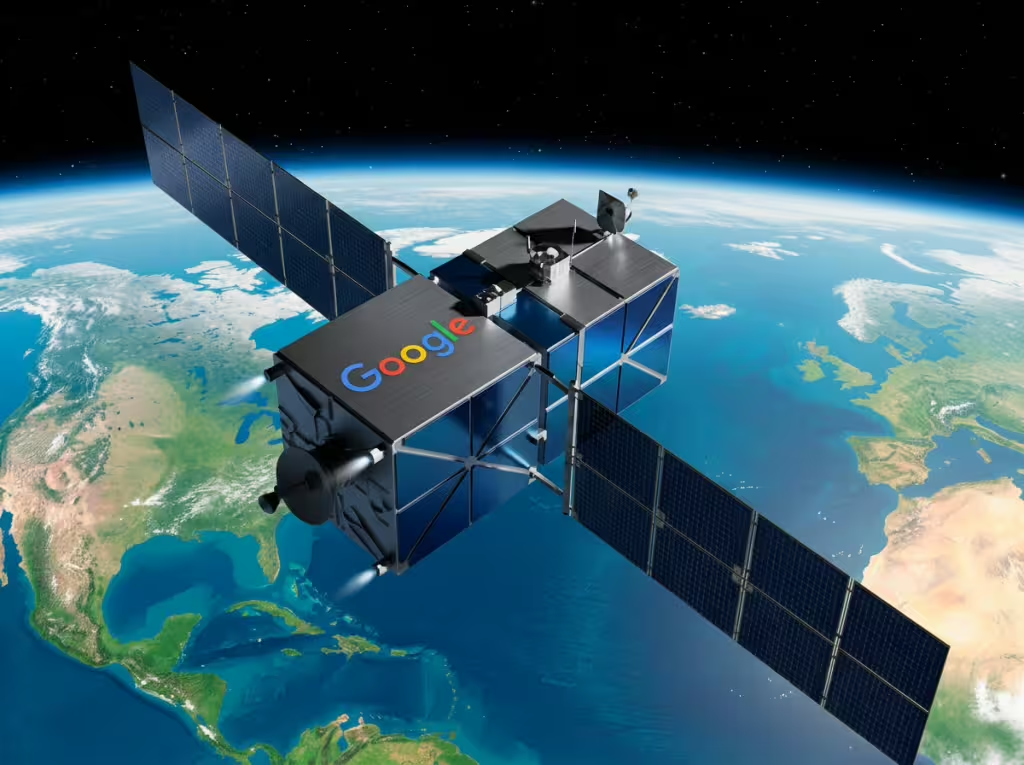
Four of Google’s Tensor Processing Units are now in orbit aboard a refrigerator-sized prototype satellite, launched by SpaceX from California just after 11:30 a.m. local time Thursday. The year-long experiment tests whether AI chips can survive space. It is the opening step of Suncatcher, Google’s plan for a solar-powered orbital data center.
Details:
- The payload: The prototype carries four TPUs, Google’s in-house AI accelerators, and was one of several payloads on the rocket. The chips will run large language models and answer simple queries in orbit, according to The Wall Street Journal, making this a live workload test rather than a hardware survival check alone.
- The partner: Google designed the satellite with Planet Labs. Solar panels are expected to harvest up to eight times the energy of an equivalent panel on Earth, where atmosphere, weather and nighttime cut output. Future satellites would fly in sun-synchronous orbit, keeping them in sunlight around the clock.
- Google’s framing: Travis Beals, senior director of Paradigms of Intelligence, an AI research team inside Alphabet-owned Google, described the sun as by far the largest power source in the solar system. He said the TPUs had already been tested under simulated space conditions, but that “no amount of testing is as good as the real thing.”
- The physical risks: A chip endures up to 100 times the force of gravity during launch, then must withstand cosmic rays and solar events in orbit. Overheating is a third hazard: terrestrial cooling methods do not work in space, leaving radiators that convert heat into infrared light as the alternative.
- The scale problem: Val Elbert, global leader of Boston Consulting Group’s technology, media and telecommunications practice, said future satellites would need solar panels and radiators the size of a Boeing 747. The current prototype is roughly the size of a refrigerator.
- The numbers: Beals estimated it could take about 10,000 such satellites to assemble a single 1-gigawatt data center in space. Elbert put the cost of building and launching an equivalent 1-gigawatt facility in orbit at around $30 billion today, and assessed that the cost equation will keep favoring Earth-based data centers for now.
- The field: Google is among the first companies to put AI chips into space. SpaceX and Blue Origin are reported to be planning similar projects, according to The Wall Street Journal, placing the orbital compute race alongside the terrestrial buildout of AI infrastructure.
- The next launch: Google plans to send more TPUs into space in 2027, this time on two interconnected satellites. That step moves the experiment from single-unit survival toward the satellite-to-satellite links any orbital data center would require. No specific launch date has been announced.
Background:
Tensor Processing Units are Google’s custom chips for training and running AI models, deployed across its terrestrial data centers. Ground-based AI facilities face mounting constraints on electricity supply and cooling capacity, the pressures Suncatcher is designed to test an escape from.
Between the lines:
The economics, not the physics, define this experiment. Elbert’s $30 billion estimate and the 10,000-satellite figure put a commercial orbital data center well beyond current reach, which makes the year-long test a long-horizon option rather than a near-term build. The eightfold solar advantage and round-the-clock sun-synchronous exposure are the variables Google is betting can eventually close that gap.
What’s next
The orbital experiment runs for a year, with chip survival through cosmic rays, solar events and thermal load as the measurable outcomes. The 2027 launch of two interconnected satellites is the next milestone, testing satellite-to-satellite links.