
Key Points
- Pentagon is deploying a third carrier strike group and Marine unit, adding up to 10,000 troops.
- Trump rejected Iran's seven-day ceasefire offer and said he may resume bombing after the midterms.
- Diplomacy is stalled over mistrust and clashing timelines, raising the odds of renewed fighting.
The latest:
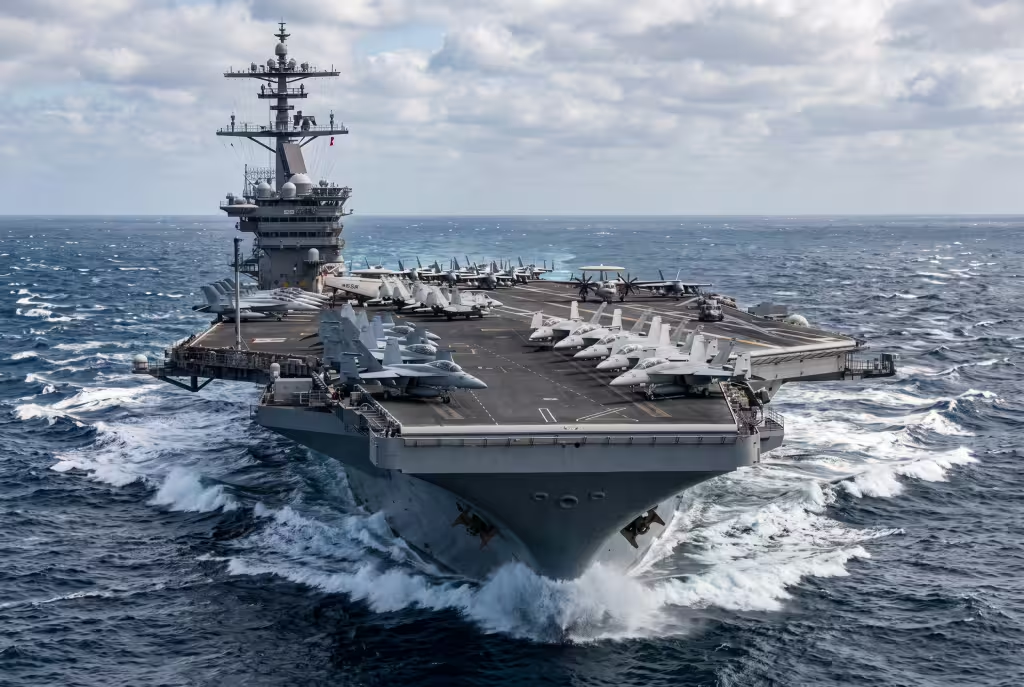
A third U.S. aircraft-carrier strike group and an additional Marine expeditionary unit are heading to the Middle East, adding 9,000 to 10,000 troops to a region that already hosts more than 50,000, U.S. officials told The Wall Street Journal. The ships, jets, Marines and sailors are due to arrive by the end of November, the month Trump recently told aides he expects to resume bombing Iran.
Details:
- The ships: The carrier USS Theodore Roosevelt left San Diego on Sunday on a scheduled deployment, and the USS Makin Island Amphibious Ready Group — three amphibious ships carrying Marines from the 13th Marine Expeditionary Unit — left on Monday, U.S. officials told The Wall Street Journal.
- The force math: The carriers USS George H.W. Bush and USS George Washington are already in the region, alongside ships from the USS Boxer Amphibious Ready Group. If the Washington stays once the Roosevelt arrives, it would be the first three-carrier presence since April; officials said it could instead return to its home port in Japan.
- Rejected offer: Trump turned down Iran’s latest proposal for a seven-day ceasefire days before the deployments. Under it, the Strait of Hormuz — normally carrying about a fifth of the world’s oil — would have reopened and nuclear talks resumed, in exchange for Washington lifting its blockade of Iranian ports.
- Trump’s position: In a Time interview published Thursday, Trump said what Iran is ready to do is not good enough for him, repeated that he is weighing a resumption of major combat operations after the midterms, and said he does not believe peace with Iran is ever achievable.
- Other U.S. moves: Defense Secretary Pete Hegseth has extended deployments of units central to major combat operations, including air-defense batteries countering Iranian missiles and drones and the Army’s 82nd Airborne Division. Navy officials said about 20 ships have been kept in the region to enforce the blockade and escort commercial shipping.
- The strain: Navy officials said the added deployments compound supply shortages and near-record operational tempo, and that the Roosevelt’s crew is prepared for a longer-than-normal deployment. Iran has fired ballistic missiles at American warships in recent weeks.
- The diplomatic gap: Axios reported that both governments say they prefer a negotiated end to the war, but their frameworks diverge: Trump seeks a sweeping accord redefining the relationship, while Iranian officials want a narrow, indirect, low-profile arrangement they treat as a truce rather than a peace deal.
- The mistrust: Iran claims Trump cheated it twice by striking during negotiations. U.S. officials counter that Iran violated the June 2026 memorandum of understanding by attacking ships in the Strait of Hormuz days after signing, and say they cannot rely on the Revolutionary Guard to honor any agreement.
- Domestic pressure: Axios reported that Iranian negotiators backing a deal face constant attacks at home, pushing them toward harder positions, while Trump is pressed by the right to avoid a deal and mocked by the left over terms resembling the 2015 nuclear accord, repeatedly pulling him back from moderate positions.
- Iran’s framing: President Masoud Pezeshkian defended the talks on Thursday, saying Tehran has never fled dialogue despite being targeted three times after the agreement was signed, and that Washington should abandon the idea of forcing Iran to its knees. Revolutionary Guard figures argue only battlefield costs can end the war.
Background:
Two rounds of failed talks over 18 months preceded two wars, according to Axios. A ceasefire reached after fighting that began on Feb. 28 collapsed, and the June memorandum of understanding unraveled within days, triggering renewed escalation and sporadic combat since.
Between the lines:
The build-up and the diplomacy run on the same clock: the reinforcements are due by end-November, the month Trump has signaled for renewed bombing, and a third carrier would widen his strike options rather than narrow them. Carnegie analyst Karim Sadjadpour assessed that Trump’s demand for speed collides with an Iranian style built on playing for time.
What’s next
Watch whether the USS George Washington stays or sails for Japan, the arrival of the Roosevelt and Makin Island groups by late November, the U.S. midterms, and any revised Iranian ceasefire offer on Hormuz.